

We need to collect ethnicity data during COVID testing if we're to get on top of Sydney's outbreak
- Written by: Andrew Jakubowicz, Emeritus Professor of Sociology, University of Technology Sydney
There are certain facts about COVID governments in other countries quickly realised. In the US, UK, New Zealand and Canada, they have known for a long time COVID disproportionately affects people of colour from cultural minorities.
In Australia, we know more about how COVID is affecting Indigenous people — though still not enough — because we are watching this data very closely. But we have no clear idea about other ethnic groups in wider Australian society — this data remains unavailable to the public, a sure sign politics has trumped science.
In Sydney, we are now seeing how the intersection between ethnicity, class politics and public health interventions has produced serious consequences.
An outbreak that started in the east, under lax surveillance and permissive admonitions, has spread to the west where it has led to increasingly draconian policing, a virus that has yet to be contained, and feelings among some residents they are being scapegoated.
On the one hand, they feel they are framed as the cause of the pandemic spread, while on the other they find it hard to get access to vaccines.
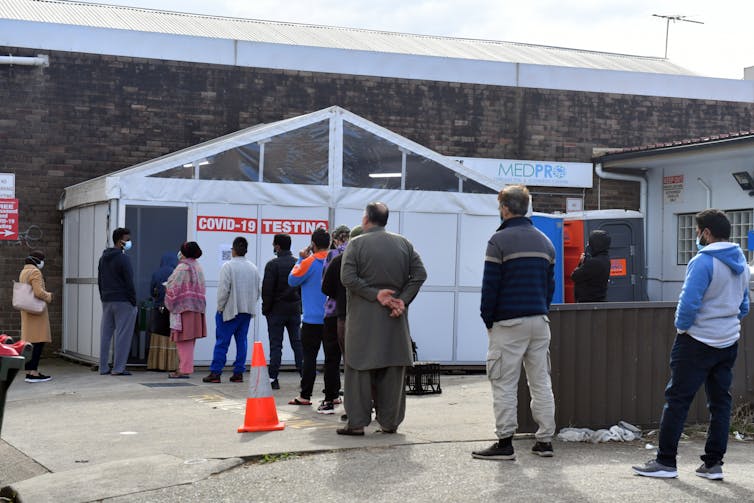 A pop-up COVID testing clinic in the southwestern Sydney suburb of Lakemba.
Mick Tsikas/AAP
A pop-up COVID testing clinic in the southwestern Sydney suburb of Lakemba.
Mick Tsikas/AAP
Why the cultural geography of Sydney matters
If we had known the ethnicity and language of the first COVID carrier in the current outbreak — an unvaccinated driver who had been contracted to ferry infected flight crew to quarantine — it would have allowed health officials to focus on his ethnic networks and ensure appropriate languages and messaging were used.
However, his testing did not apparently collect ethnicity, country of birth, or language spoken at home other than English. And by the time his positive test came back, the virus was off and running.
The jump from Bondi Junction to Hoxton Park then allowed the virus to enter a rich milieu of cultural diversity comprising many languages, dialects, cultures, and health literacy levels. The density of living arrangements, interactions among extended families, and poor quality of COVID messages in community languages contributed to the spread.
Early in the outbreak, Mariam Joseph, a doctor who works in Fairfield and Liverpool, appeared on ABC to broadcast a message in Syriac Aramaic to Assyrian Christians, the first group in the west to be badly affected. At least one Assyrian Christian has died.
While one viewer criticised the message on Facebook, saying “Assyrians are highly educated and understand the COVID rules […] we don’t need a ‘representative’ to explain it”, most comments from the community were positive and pleaded for much wider use of community languages in public messaging. One person wrote in Aramaic,
Thank you for your valuable guidance to avoid the crisis.
The cultural geography of Sydney makes clear why different strategies are important. Rates of vaccination, especially among the elderly, are much higher in the east and much lower in the west, reflecting health literacy, economic resources, education and power.
The west houses a much more extensive population of vulnerable people, many of whom are health care, aged care and disability workers. Extended families living in overcrowded housing are also at a higher risk of infection.
Moreover, there is a growing sense of inequity, with many in the west believing they have been selected for undeserved “punishment”, while the east still wanders around enjoying the winter sunshine.
Attempts to take a more proactive approach
Over a year ago, I wrote two articles that forecast the likelihood of a major outbreak in multicultural communities if steps to collect information about the ethnic makeup of tested populations were not put in place.
I then tried to get some sort of action from either the federal or NSW governments, but ran into political roadblocks.
Victoria began to amend data-collecting strategies around November, allowing health officials to see which communities weren’t receiving adequate messaging and therefore missing out on testing.
By December, the federal Health Department had set up an advisory group on cultural and linguistic diversity, many months after similar groups were established for Indigenous Australians, the arts sector, aged care, disability, and sports. Unexpectedly, I was invited to donate my services to this group.
It was not until February that Commonwealth-funded GP testing clinics began to collect data on country of birth and language spoken at home. This data, however, still is not reported publicly and makes up only a small minority of tests carried out in the states.
The private clinics that are carrying out much of the testing have yet to collect any ethnic data, though the state does in Victoria.
Concerns around collecting this data
From the outset, I was focused on the role this specific data could play in supporting local public health workers in “getting ahead” of the curve.
However, NSW seemed particularly reluctant, driven apparently by the political concerns of the state government to keep the optics right, especially as Premier Gladys Berejiklian’s contact-tracing approach was now considered the “gold standard” by the prime minister.
I have every respect for the frontline workers, multicultural health communications workers, contact tracers, and community engagement staff in state agencies, but they may be working with more than one hand tied behind their backs.
Read more: We asked multicultural communities how best to communicate COVID-19 advice. Here's what they told us
This is due to the fear of generating public backlash against any ethnic communities that might appear to be more vulnerable, portrayed to be more guilty of bad behaviour, or more likely to cause problems to their neighbours.
This is not an unrealistic fear, as the shock jocks have had a field day targeting African communities in Victoria’s public housing, while other ethnic communities, especially Chinese-Australians, have been the targets of vicious racist harassment.
Another concern sometimes expressed about this data is whether asking people to identify their country of birth and language spoken at home would reduce their willingness to be tested.
But people do have to provide this information when being vaccinated and it’s collected from every infected patient. Multicultural leaders support also support the collection of this data, provided there are assurances it is used sensitively.
It’s clear this lack of data has hampered NSW’s ability to reach vulnerable communities and tailor messages that may be more effective in three ways - staying COVID safe, getting COVID tested, and getting vaccinated where this is possible.
From my community networks, I have a fair sense of where the current outbreak was concentrated in western Sydney and where the next threads were likely to lead. It would be much better, though, if there were real data and real pathways to make it usable to the people who need it now.
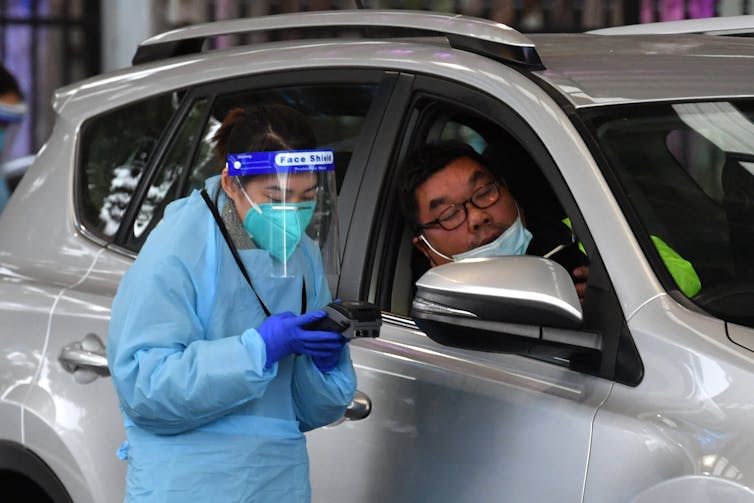 A pop-up COVID testing clinic at the Fairfield Showgrounds in Sydney.
Mick Tsikas/AAP
A pop-up COVID testing clinic at the Fairfield Showgrounds in Sydney.
Mick Tsikas/AAP
We need a more targeted approach
Over the past year, there have been regular commentaries decrying the lack of clear strategies to ensure the safety and engagement of “multicultural communities”, yet most of these pieces end in a sense of an ongoing yet unresolved impasse.
The situation remains complex, as the federal government’s CALD COVID advisory committee has discovered in its endeavours to work through the complications generated by multiple levels of responsibility, data collection, and ethical constraints.
Read more: Understanding how African-Australians think about COVID can help tailor public health messaging
But as the virus spreads, there are clear social measures we have chosen not to use. In order to support people effectively, craft appropriate messaging and predict transmission pathways, it is crucial to use the languages, cultures and local networks that bind these communities together.
Unfortunately, however, the public may have lost its trust in the political system to recognise these realities and protect diverse communities without regard to race, ethnicity, class or religion. That is a trust that must be won back.
Authors: Andrew Jakubowicz, Emeritus Professor of Sociology, University of Technology Sydney


















