

Australia must get serious about airborne infection transmission. Here's what we need to do
- Written by: Lidia Morawska, Professor, Science and Engineering Faculty; Director, International Laboratory for Air Quality and Health (WHO CC for Air Quality and Health); Director - Australia, Australia – China Centre for Air Quality Science and Management (ACC-AQSM)
Australia is now in the grip of its second winter marred by the pandemic, with crippling lockdowns in multiple cities.
Earlier this month, the federal government announced a four-stage plan to bring the country back to something resembling normality. Acknowledging it will be impossible to eradicate COVID-19 completely, the plan focuses on a variety of steps — most notably vaccination — to enable the country to live with the virus.
However, if we want this plan to work, there’s one crucial control measure yet to be considered: protection against airborne transmission of the infection in public indoor spaces.
We need to modernise our indoor environments to protect Australians from respiratory infections, and more broadly, from all indoor air hazards. This includes indoor exposure to pollution originating from outdoors, such as bushfire smoke.
The evidence is in
The body of scientific evidence pointing to airborne transmission as the key route by which SARS-CoV-2 spreads is now overwhelming.
Put simply, over the past 18 months, we have come to understand most people become infected with the virus that causes COVID-19 by inhaling it from shared air. The risk is predominantly indoors.
Consequently, every public building should have control measures in place to provide adequate ventilation.
But this information hasn’t been communicated to Australians — many of whom remain focused on hand washing and cleaning surfaces. These are good practices, but because SARS-CoV-2 spreads predominantly through the air, they likely provide only a marginal contribution to infection control.
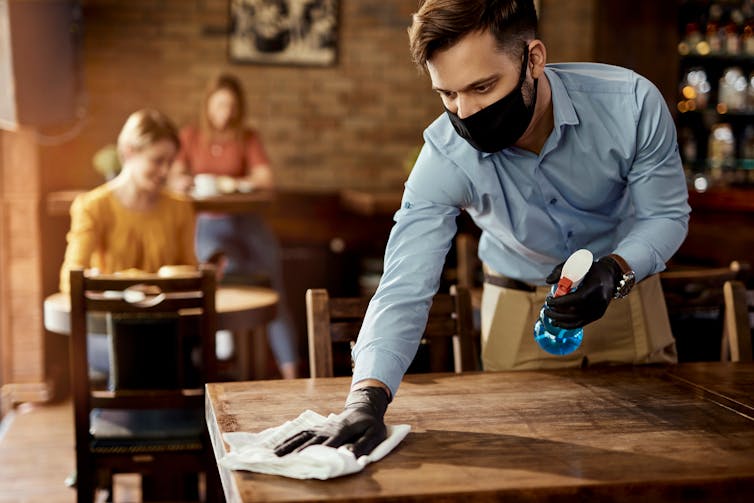 Surfaces don’t appear to be a major source of SARS-CoV-2 transmission.
Shutterstock
Surfaces don’t appear to be a major source of SARS-CoV-2 transmission.
Shutterstock
While the World Health Organization has recently released a roadmap to improve indoor ventilation in the context of COVID-19, many Australian public spaces are significantly under-ventilated.
We don’t know exactly what proportion of infections would be prevented by improving ventilation in public places, but the evidence indicates this could drastically reduce the risk.
Read more: Australia has a new four-phase plan for a return to normality. Here's what we know so far
So how do we do it?
Appropriate building engineering controls include sufficient and effective ventilation, possibly enhanced by particle filtration and air disinfection systems. It’s also important to avoid recirculating air, as well as overcrowding.
We have the technology to make these changes, and these are things that can often be implemented at low cost. But for this to happen, Australia must first recognise the significant contribution these measures make to infection control. I propose the following solutions.
1. Establish a national regulatory group for clean indoor air
This is an issue that will require co-operation across various areas of government. The establishment of a national regulatory group — led by the federal government working with the states and territories through the national cabinet — would provide a platform for the relevant ministries to cooperate on this matter.
The key goal should be the explicit inclusion of protection against indoor air hazards (including airborne infection control) in the statements of purpose and definitions of all relevant Australian building design and engineering standards, regulations, and codes.
Read more: The pressure is on for Australia to accept the coronavirus really can spread in the air we breathe
2. Provide financial support
It will be important to establish a national fund enabling the rollout of indoor environment modernisation measures addressing both immediate emergencies, such as COVID-19, as well as a long-term transition process.
Over a period of years, all new buildings would ideally be designed to ensure good indoor air quality, while existing buildings would be retrofitted with the same objective.
3. Create a communication campaign
The Australian government should set up a communication campaign to educate people on the risks of shared air, and on how to improve ventilation.
Steps people can take themselves to improve ventilation include opening windows, and raising the issue with those responsible for the space if they feel ventilation is inadequate.
 Opening windows is one way to improve ventilation.
Shutterstock
Opening windows is one way to improve ventilation.
Shutterstock
Yes, it might sound daunting. But it’s possible
At first, it may appear to be a huge task to ensure clean indoor air to the entire country. Is it possible?
Perhaps the same questions were asked by Britons when in the 19th Century, Sir Edwin Chadwick was tasked by the British government with investigating clean water supply and centralised sewage systems.
His recommendations in 1842 changed the approach to sanitation in Britain, and ultimately the world, creating enormous public health benefits and corresponding economic dividends through health-care savings.
We cannot imagine now what it would be like to live without clean water flowing from our taps.
What we need is a similar “revolution” in Australia regarding clean indoor air — one that future generations will rightly regard as a baseline standard for the built environment.
Australia already has sophisticated building infrastructure and public health regulatory frameworks to support the required advances. These will require modernisation, but it’s far from a case of building from nothing.
Read more: How does bushfire smoke affect our health? 6 things you need to know
Numerous expert Australian colleagues and myself would be pleased to offer our assistance to make this dream an Australian reality.
Importantly, in this crucial period while we wait for high levels of vaccination, addressing ventilation could be the difference between recurring lockdowns or enjoying a COVID-free life.
Authors: Lidia Morawska, Professor, Science and Engineering Faculty; Director, International Laboratory for Air Quality and Health (WHO CC for Air Quality and Health); Director - Australia, Australia – China Centre for Air Quality Science and Management (ACC-AQSM), Queensland University of Technology


















