

For too long, research was done 'on_ First Nations peoples, not _with' them. Universities can change this
- Written by: Victoria Rawlings, Lecturer, University of Sydney School of Education and Social Work, University of Sydney
For too long, “research” was an activity done to or on Indigenous people; it was something imposed from the outside. This was especially the case for people who came from communities that were oppressed or marginalised in the colonialism of the 19th and 20th centuries.
Indigenous people throughout the world feel they have been the subjects of endless measurement, recording, and invasion of privacy with little or no apparent benefit except for the scholars who make careers out of it. Māori scholar Linda Tuhiwai Smith calls this approach “research adventures in Indigenous lands” in her book Decolonising Methodologies.
Our collaboratively edited volume, Community-Led Research: Walking New Pathways Together, represents a substantial step towards redressing power imbalances that continue to characterise much academic research.
The book asks how to move research done to and on people towards for and with people. It features both community and academic voices and reflects on research that foregrounds non-academic priorities.
Since the global Civil Rights movement of the 1960s and beyond, academic researchers have recognised the political and moral responsibilities we have to those impacted by our studies.
To meet their responsibilities to different communities, researchers have incorporated methodologies such as:
participatory action research, in which members of the community affected by the research actively participate in different parts of the project
public patient involvement, in which non-academic people work as employees or volunteers in organisations’ high-level work
community-based participatory research, which aims to equitably involve community members and others in research projects.
Each of these are slightly different, and are used variously in different disciplines, but their increasing presence affirms that involving communities in research is crucial for good research outcomes.
However, we have found approaches putting community at the centre of research beyond disciplinary siloes have not yet been documented in a comprehensive way. Our book builds on previous research by bringing together various community-led approaches, including from education and social work, health and medicine, and archaeology.
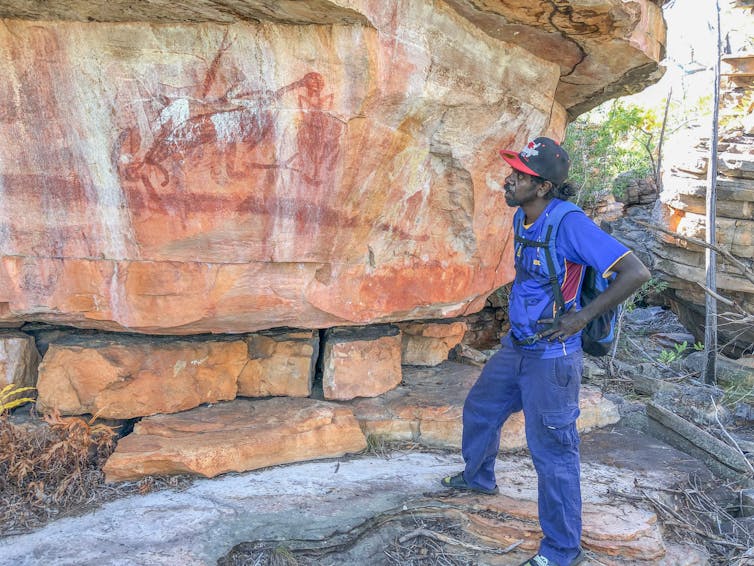 In a non-related study, Flinders University archaeologists and scientists are using artificial intelligence to study how Aboriginal rock painters’ styles developed over thousands of years.
Flinders University/AAP
In a non-related study, Flinders University archaeologists and scientists are using artificial intelligence to study how Aboriginal rock painters’ styles developed over thousands of years.
Flinders University/AAP
Stories, not blueprints
The chapters in our book reflect on community-led approaches to research in different spaces. They consider questions of identification of a community, appropriate protocols, and how to build positive collaborations.
The authors do not attempt to provide a template that can be applied in all research situations. Nor should they. As several chapters point out, there is a risk to “community-led” becoming another buzzword that ends up being appropriated for marketing or institutional propaganda.
We found community-led research must be built on a foundation of real relationships, mutual respect, and true reciprocity. We have all come into community-led research from different disciplinary perspectives and research experiences, as well as personal experiences.
As the editors of the volume, we were inspired by working with young people, Pacific Islanders and Aboriginal and Torres Strait Islander communities. Each of us has our own ideas about community-led research because of who we work with and where our interests lie. We reflect on our own work individually below to give a sense of different experiences in the field.
Rawlings: While young people clearly make up a large and important part of our community, they often don’t get a seat at the table, even when research is “about” them. They can be seen as not critical or sophisticated enough to partner in research, or as needing “protection”, where they are seen as too innocent to take part in research about sensitive issues.
Imagine, then, co-designing research with LGBTIQA+ young people about their experiences of self-harm and suicide. While some young people may baulk at participating in this kind of discussion, research shows they benefit from conversations about their distress and trauma, particularly when they feel it might benefit others.
We found this to be the case as we co-designed our research in partnership with a youth advisory group. Not only did the young people benefit, but our research was higher quality, too.
Flexner: My first trip to Vanuatu, in 2011, was almost a parody of cultural and linguistic misunderstanding, and geographical disorientation in the remote southern islands of Erromango and Tanna.
However, that initial fieldwork experience proved formative. It taught me how to work with community through the chiefs, elders, and knowledge holders facilitated by the Vanuatu Cultural Centre filwokas (fieldworkers). It set up intellectual engagement with cultural traditions encapsulated by the Melanesian term kastom (which translates as customs or traditions).
After a decade of research in Vanuatu, I still find myself learning new things, and finding new ways to work with the people who call these islands home.
Riley: A huge concern in First Nations communities is in having no control over what research is undertaken or the right to veto the interpretation of data and findings. This is due to the fact much past research has helped to form government policies and practices concerning First Nations lives with little life improvement. This is clearly evidenced in current Closing the Gap statistics.
Often, First Nations peoples find they are called upon when the government and researchers arrive at an impasse and they do not know what else to do. Let us change this approach and ensure First Nations peoples are asked what research they want undertaken first and what benefits they want from the research.
That is, how can research improve First Nations people’s lives and enhance community development?
Read more: Nigerian academics weigh in on the faults and frustrations of managing COVID-19
New pathways and old limitations
Although we are inspired by the contributions in Community-Led Research: Walking New Pathways Together, we also need to recognise and acknowledge the limits of what we do. Universities remain institutions that many people, especially Indigenous people, associate with colonialism.
Besides our work in the communities, one of our great challenges is how to make the places where we work as academics more welcoming, inclusive, and egalitarian. Further, there are very real differences that regularly map onto differences in class, nation, geographical region, and identities.
It is impossible to dismantle 500 years of history in a single project, no matter how much goodwill the researchers and community establish together. Community-led research is in part about changing academic research, but it is also about changing other kinds of relationships in the world we all live in.
There is great promise in so many new approaches people are taking in their research, and their understandings of the groups of people they work with both inside and outside of academia. Community-led research is, however, a type of research that is still developing and we do not believe our work is finished. Rather, our pathway is just beginning.
Authors: Victoria Rawlings, Lecturer, University of Sydney School of Education and Social Work, University of Sydney

















