

Aboriginal art on a car? How an Indigenous artist and an adventurer met in the 1930 wet season in Kakadu
- Written by Joakim Goldhahn, Rock Art Australia Ian Potter Kimberley Chair, The University of Western Australia
Aboriginal and Torres Strait Islander readers are advised this article contains images and names of deceased people.
Histories of Indigenous Australia are filled with stories of cross-cultural encounters. Many of these were harsh and brutal, leaving inter-generational wounds that are still healing. Other encounters can be framed around mutual curiosity.
Our recent research just published in History Australia has illuminated one such story, a fascinating encounter between two Australian icons: adventurer Francis Birtles and prolific Aboriginal artist Nayombolmi.
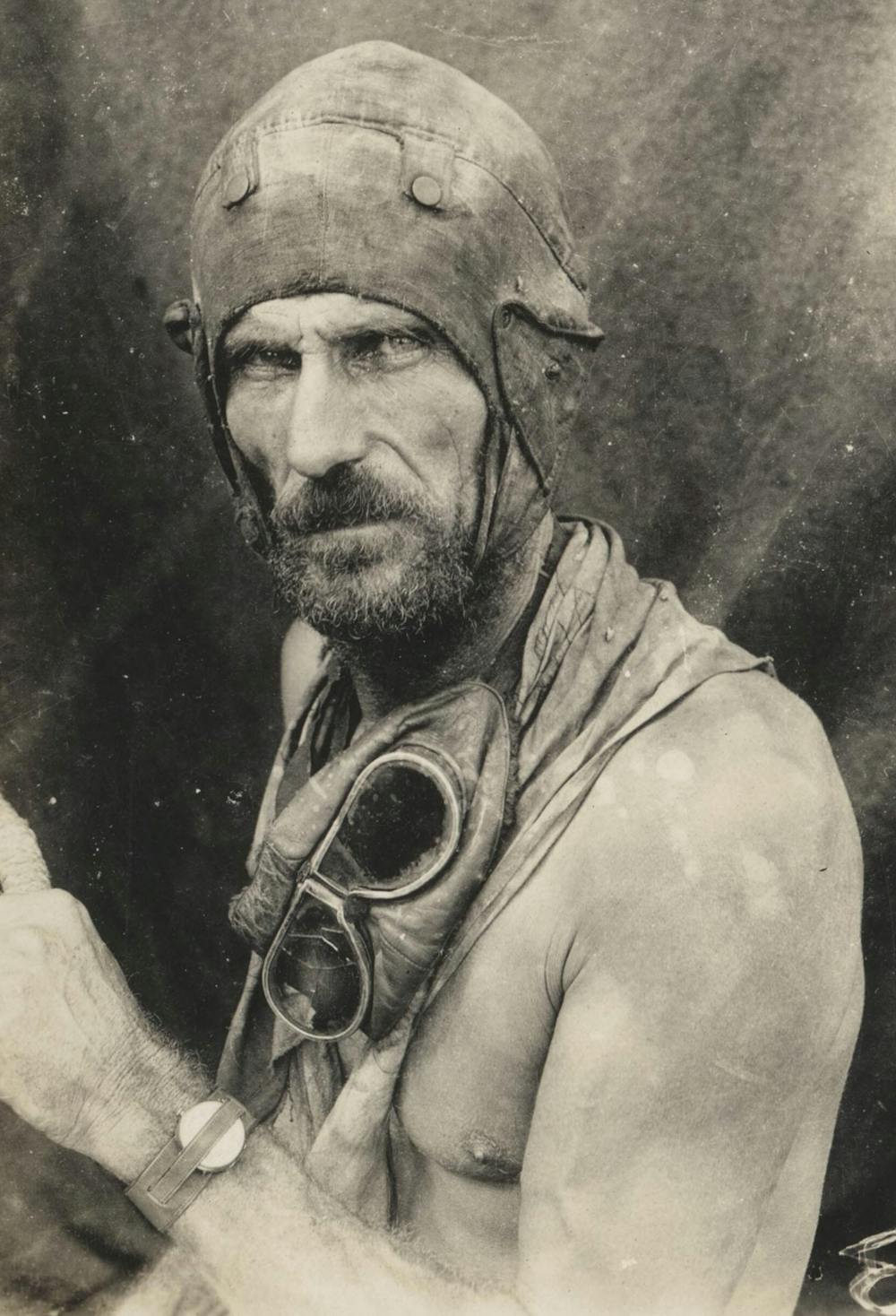 Francis Birtles in Arnhem Land, late 1920s.
Photographer unknown. Courtesy of the National Library of Australia
Francis Birtles in Arnhem Land, late 1920s.
Photographer unknown. Courtesy of the National Library of Australia
An early celebrity
Born in 1881, Birtles has been described as one of Australia’s first homegrown superstars.
In the early 1900s, he crossed the continent, first on bicycle and later by car. He presented his adventures in books featuring his own photographs and made movies, which were screened in major Australian towns.
A rugged explorer, he presented white Australians with a new understanding of the outback. Biographer Warren Brown writes: “This young, fit, bronzed adventurer seemed to embody the excitement and optimism of a new country flourishing in a new century.”
Birtles’ books and movies include many stories about encounters with Indigenous Australians. In the beginning he made use of a colonial trope that pictured them as “primitive savages”. Some of his works gave audiences the impression Birtles was escaping danger. Our new research presents another picture.
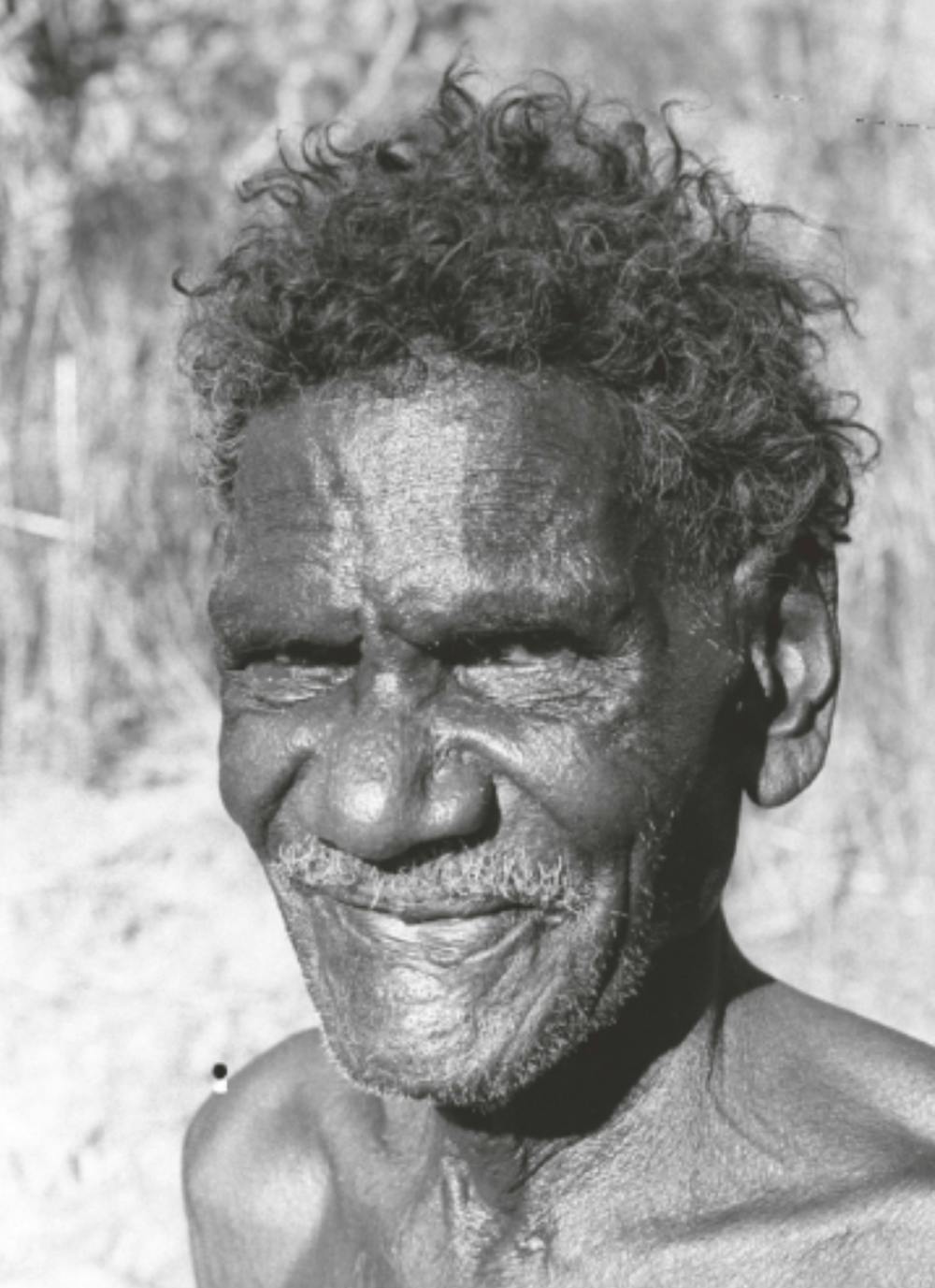 Nayombolmi in 1966.
Photograph by Lance Bennett. Copyright: Estate of Lance Bennett, courtesy of Barbara Spencer., Author provided
Nayombolmi in 1966.
Photograph by Lance Bennett. Copyright: Estate of Lance Bennett, courtesy of Barbara Spencer., Author provided
A skilled artist
While Birtles is well known, few people know about Nayombolmi. In fact, the identification of him as the Aboriginal person posing on Birtles’ car in the discussed photography, has never been formally acknowledged until now.
Nayombolmi was born in today’s Kakadu National Park. He had a traditional upbringing and is remembered as a fully initiated man of “High Degree”. First and foremost though, Nayombolmi is known as a skilled artist.
One of his bark paintings was included in the National Museum of Australia’s Old Masters exhibition in 2013.
He also created some of Australia’s most famous rock art, such as the Anbangbang shelter in the Burrungkuy (Nourlangie) area in Kakadu.
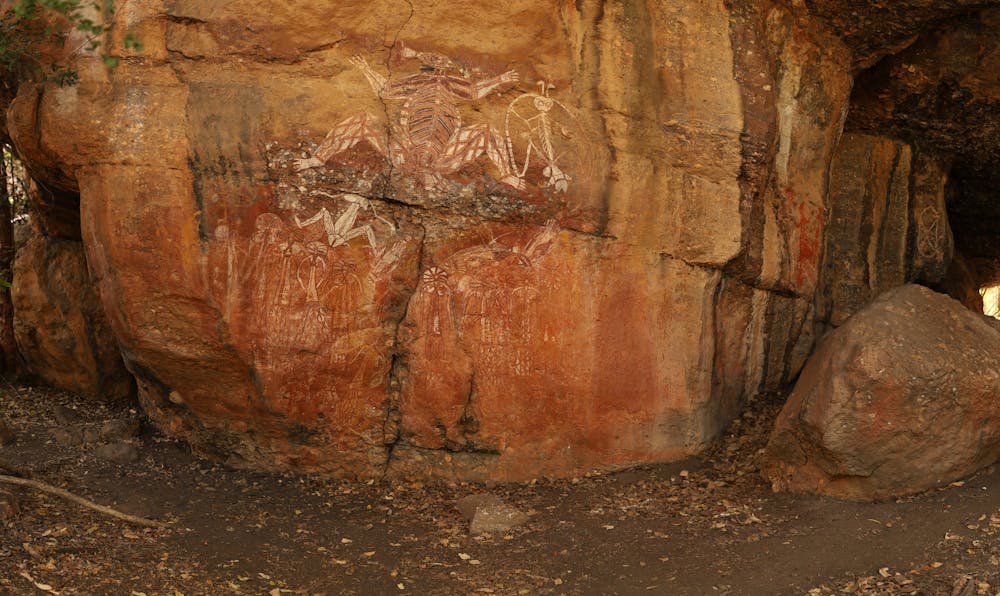 The Angbangbang shelter with some of Nayombolmi’s many artworks.
Andrea Jalandoni, Author provided
The Angbangbang shelter with some of Nayombolmi’s many artworks.
Andrea Jalandoni, Author provided
Read more: 'Our dad's painting is hiding, in secret place': how Aboriginal rock art can live on even when gone
A very long drive
The two men met during the wet season of 1929–1930 in today’s Kakadu.
Birtles had just returned from an adventure that made him the first person to drive a car from London to Melbourne — his famous “Sundowner” Bean Car, now on display at the National Museum of Australia in Canberra.
After a well-earned rest, he took off for Arnhem Land together with his dog Yowie in a brand new Bean car. Having lost his savings in the 1929 Wall Street stock market crash, he went bush to try to find gold. As explained in his 1935 memoirs:
One day in an undulating ridge I found that which I had spent months seeking — gold. […] I worked there during the whole of the wet season, from October to April. From a party of blacks, travelling through that part of the country, I obtained some tea, [giving] them some tobacco in exchange. It was a lonely camp. […] The little tribe, passing through on a pilgrimage from one hunting-ground to another, were the only human beings I saw during the months I was there.
Our new research about known rock art artists in Kakadu has shown that the “pilgrims” included Nayombolmi and his closest kin. From Birtles’ photographs the encounter appears to have been a relaxed one.
One photograph shows Birtles having tea with Yowie. Aboriginal spears are placed on the side of Birtles’ car and a dead wallaby on its bonnet. On the rear of the car are unmistakable Aboriginal paintings that seem to have been there for some time.
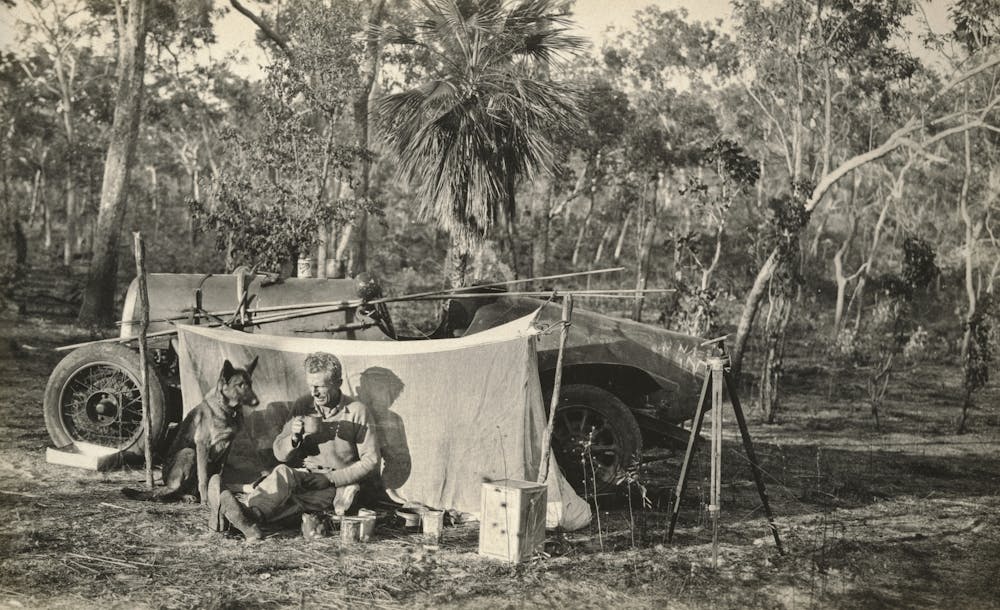 Birtles has tea with his dog Yowie. Traditional Aboriginal spears hang on his car and a dead wallaby is draped over the bonnet.
National Library Australia
Birtles has tea with his dog Yowie. Traditional Aboriginal spears hang on his car and a dead wallaby is draped over the bonnet.
National Library Australia
Another photograph shows the owner of the spears. An Aboriginal man with scarification across his chest holding a recent kill — a bush turkey. He has a pipe in his mouth.
In the background, another Aboriginal man we believe to be Nayombolmi sits on the rear of the car. The photographs seem to confirm Birtles’ account of the exchange of tea and tobacco.
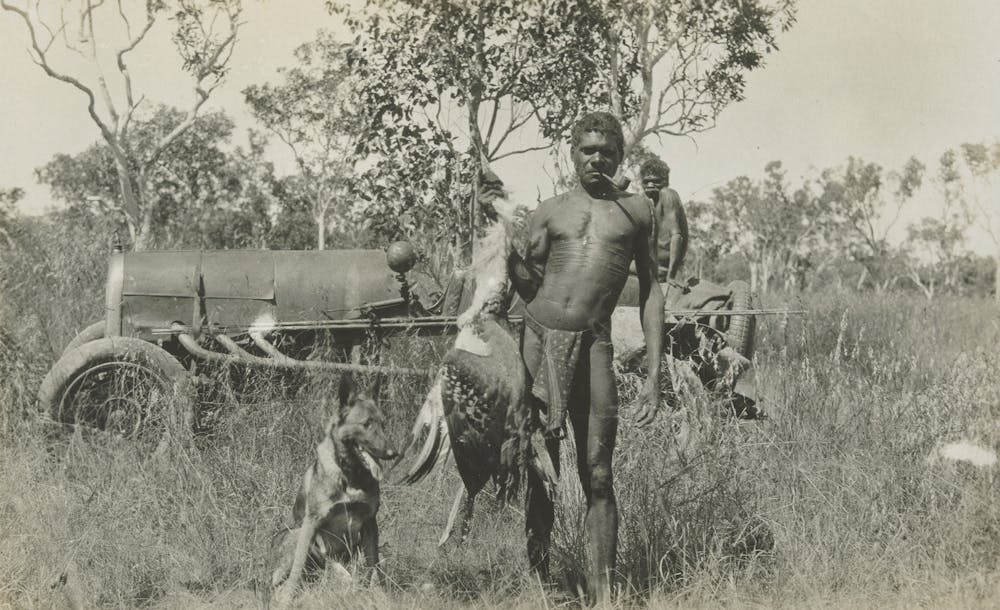 Birtles’ car with the spears, Yowie and two of the ‘pilgrims;’ the one to the right we believe is Nayombolmi.
Francis Birtles/National Library Australia, Author provided
Birtles’ car with the spears, Yowie and two of the ‘pilgrims;’ the one to the right we believe is Nayombolmi.
Francis Birtles/National Library Australia, Author provided
Car as canvas
The most fascinating photograph (the lead image above) shows Birtles’ car decorated with 19 traditional Aboriginal rock art images depicting an emu, a fresh water crocodile, two long-necked turtles, a saratoga (fish), a hand-and-arm stencil and 14 dancing and crawling human-like figures.
On the rear end of the car, Nayombolmi sits on a dead kangaroo holding a dog in his lap. Birtles sits in the driver’s seat holding a live magpie goose.
The identification of Nayombolmi — sometimes described as the most prolific known rock art artist in the world — was recorded by Dan Gillespie in the early 1980s during oral history with Nayombolmi’s kin brother, George Namingum.
Shown the photograph of the painted car, Namingum identified Nayombolmi as the artist. He declared: “Oh yeah. That’s my brother” and added that Nayombolmi “used to painting everything”.
The identification has since been confirmed by Nayombolmi’s closest kin, who knew him when they were young.
After the unexpected encounters between Nayombolmi and Birtles, a gold mine known as Arnhem Land Gold Development Company – No Liability was established through Birtles’ agency. Nayombolmi, his family and other local Aboriginal people worked at the mine — though were paid with food, tobacco and alcohol rather than cash.
Birtles quickly sold his mine shares and became rich, allowing him to possess things he “always wanted”; as he wrote later: “The sort of things a man of my tastes dreams of owning when he hasn’t a cracker”.
Nayombolmi and his kin — despite the friendly encounter captured on film, decorating Birtle’s car, and the fact they were instrumental to the mining operations — were left with nothing.
We do not know what happened to the car that Nayombolmi painted. The photographs are all that remain.
Our research has been undertaken in close collaboration with Djok Senior Traditional Owner Jeffrey Lee and Parks Australia (Kakadu).
Authors: Joakim Goldhahn, Rock Art Australia Ian Potter Kimberley Chair, The University of Western Australia

















