

Why sweet-toothed possums graze on stressed, sickly-looking trees
- Written by Gregory Moore, Doctor of Botany, The University of Melbourne
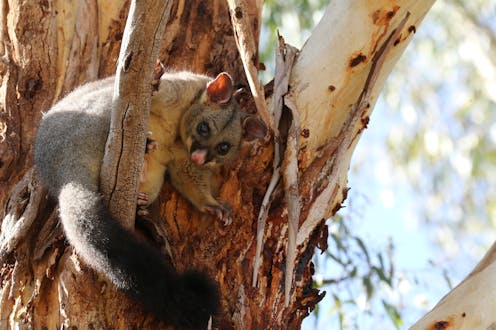
From time to time, I’m contacted by people who have a favourite garden tree that seems suddenly to be in serious decline and lacking healthy foliage. Often the decline has been occurring over many months, but when first noticed, the change seems to have been dramatic.
The symptoms described accord with grazing — where animals nibble at foliage until it’s quite degraded — so I ask if they have seen brushtail possums in the tree.
More often than not the answer is a firm, “No!”
However, just because you haven’t seen them, it doesn’t mean the possums aren’t there. One owner, who said they weren’t aware of any possums, checked at night with a torch; they counted 56 possums in a single, sick-looking river red gum.
It’s not uncommon for one tree within a group of the same species to be grazed while other trees are left alone.
In the early evening, a steady stream of possums can be seen coming from all directions and from nesting sites in other trees hundreds of metres away, all homing in on the one sickly specimen.
To the human eye, this seems very strange behaviour. Wouldn’t the possums be better off grazing on a healthy tree?
But possums are real tree experts and know exactly what they are doing.
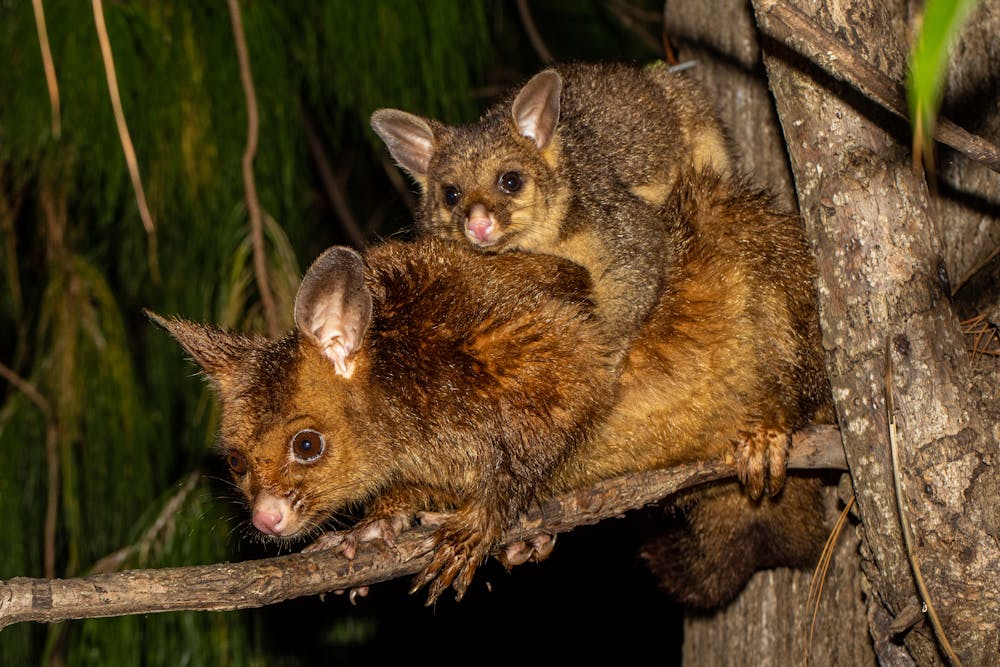
Read more: Curious Kids: if trees are cut down in the city, where will possums live?
It’s all about the sugar content
The common brushtail possum, Trichosurus vulpecula, will eat both plants and small animals if given the chance, but plants form the bulk of their diet. Eucalypt leaves are a favourite, but they’ll nibble the leaves of other plants in our gardens.
So what is going on when one tree is grazed in preference to others? One of the main drivers revolves around sugar.
 Eucalypt leaves are a favourite for possums.
Shutterstock
Eucalypt leaves are a favourite for possums.
Shutterstock
When plants photosynthesise, one of the first products of the process is sugar. Sugars are carbohydrates made up of carbon, hydrogen and oxygen atoms and one of the most common is glucose (C₆H₁₂O₆), which is the common sugar used in coffee, tea and cooking.
Sugar may be copping a bit of stick at present for its role in human diets, but in terms of plant metabolism, glucose is a marvellous molecule.
It is made from simple and ready available ingredients. It is soluble in water and can be easily transported around inside the plant. And it stores significant energy.
This makes it a very accessible and desirable molecule within the plant, but too much glucose in solution can cause problems for the plant and attract grazers keen on an easy sugar hit.
The plant has evolved an elegant solution to these problems. It simply takes two or more glucose molecules and bonds them together to make starch‚ which is not very soluble in water, contains lots of energy and so is an ideal storage form of carbohydrate.
The plant converts any excess glucose that it has into starch for later use when things might be tougher.
What’s this got to do with possums, again?
When a plant is stressed, one of its first responses is to mobilise its resources. Among other things, it often converts its starch reserves back to sugar. As soon as this happens, the stressed plant becomes sweeter than its healthier neighbours — and brushtail possums know it.
Some stressed trees emit chemicals that can be picked up by grazers. In other cases, the grazers may come upon a stressed tree by chance.
In either case, the grazer gets an increased sugar hit and so will return to the tree when the opportunity presents; other grazers may follow.
In the case of brushtail possums, a possum may return to the same tree night after night and, despite territorial disputes, may be joined by other possums in a feeding feast.
 Plants form the bulk of the possum diet.
Shutterstock
Plants form the bulk of the possum diet.
Shutterstock
A stressed tree is a grazer’s delight
Initially, the tree may have been stressed by drought, poor nutrition or waterlogged soils. The increased grazing then adds to the level of stress.
And when lots of leaves are removed, many trees such as eucalypts, elms, oaks and even deciduous conifers will respond by producing new leaves and shoots. These lovely new leaves and shoots are soft and loaded with sugars — a grazer’s delight.
With more stress, the tree converts more and more starch into sugar and produces yet more new leaves and shoots — so the grazers get a sweet and nutritious reward for their efforts. They will keep returning to the same tree.
All of this extra grazing comes at a price to the tree, which is exhausting its starch reserves, but getting little or no reward from the sugar produced.
Eventually, the tree will succumb. It may die from starvation due to the loss of its reserves and the failure of new foliage to survive long enough to photosynthesise. Or it may die from another environmental stress or a pest or disease attack.
Grazing can be lethal to a tree, but you can see why the grazers keep coming back.
Stressed trees are an easy and rewarding energy source. Perhaps, like us, the possums become addicted to a high sugar diet and simply can’t resist returning to the tree — even if, in the end, the tree is grazed to death.
Read more: Hidden housemates: when possums go bump in the night
Authors: Gregory Moore, Doctor of Botany, The University of Melbourne
Read more https://theconversation.com/why-sweet-toothed-possums-graze-on-stressed-sickly-looking-trees-169241

















