

the deep mountains and mysterious valleys of Tokyo's Nezu Museum
- Written by Olivia Meehan, Object-based Learning Co-ordinator, The University of Melbourne
In this series we pay tribute to the art we wish could visit — and hope to see once travel restrictions are lifted.
A nimble row of bamboo grows between the street and the grounds of the Nezu Museum 根津美術館 in Minami-Aoyama, Tokyo. The softly murmuring greenery gently ushers you along the side of the museum, beneath its overarching eaves, to the entrance.
In the winter months, when there is snowfall in the capital, masses of snow slide off the roof to line the ground at the bottom of this bamboo, creating the illusion of a white-peaked mountain range on the path.
There are many such transporting and transient scenes to be found at the Nezu Museum and Garden, located on the private estate of the Nezu family and housing the extraordinary collection of pre-modern East Asian treasures amassed by businessman and philanthropist Nezu Kaichirō (1860-1940).
The original house, built in 1906, was destroyed in an air raid in 1945. Following successive reconstructions over the decades, the decision was made to undertake a large scale renovation to restore Nezu’s vision.
The renowned Japanese architect Kuma Kengo redesigned the museum building with elements found in traditional Japanese residential architecture and a contemporary finish. It reopened in 2009.
Read more: If I could go anywhere: a world through the eyes of botanical artist Marianne North at Kew Gardens
The foyer opens to full length windows overlooking the garden, a modern take on the traditional Japanese idea of creating an invisible threshold from the inside to outside world. Buddhist sculptural pieces are displayed facing inwards: they cast a friendly eye on visitors whose gaze naturally drifts from the garden inside. Though not specifically a house museum, the atmosphere here has the intimate characteristics of a private home.
I have a deep interest in museums that were once someone’s home, especially those with gardens; however small. From Kettle’s Yard in Cambridge, England to the Alvar Aalto House/Studio in Helsinki, to the Musée Nissim de Camondo, Paris, I seek them out for the intimacy and personality sometimes missing from large, formal museum spaces.
Kengo Kuma talks about his design principles for Nezu Museum Tokyo.A gentle, calm atmosphere
There are over 7,400 objects in the Nezu collection, many of which are classifed as Important Cultural Property or national treasure. In some galleries, the LED light fittings are programmed and adjusted to resemble sunrise; in others, to imitate the diffused light from a paper lantern.
These carefully considered aspects of display serve to protect the objects from harsh, possibly damaging light, and generate a gentle, calm atmosphere. Each object is also afforded a luxurious amount of room, making it easier to become absorbed in the ritual of close observation.
Read more: If I could go anywhere: Japanese art island Chichu, a meditation and an education
We might be invited to contemplate a small but robust 16th century, jewel-shaped ceramic incense container. Or to behold the pair of 19th century, six-fold screens created by Suzuki Kiitsu: Mountain Streams in Summer and Autumn — so modern and bright the water appears to flow across and off the panels.
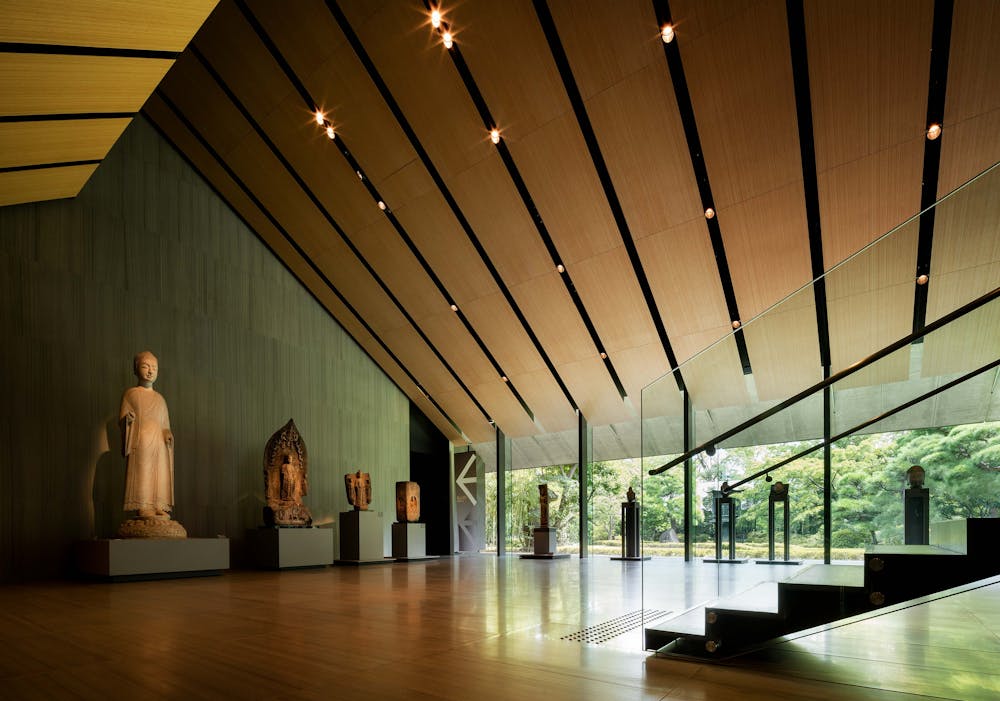
At each turn, I feel as if I am activating Kuma’s architectural vision of designing a space at one with the landscape, not imposed upon it. This is a building that works in harmony with its surroundings. Stepping into the garden offers a seamless continuum of this experience.
As I think about living with objects and nature, I recall the brilliant short film made by husband and wife design team Charles and Ray Eames in 1955: House: After Five Years of Living. Composed entirely of 35mm slides, the film details their modernist family home in the Californian neighbourhood of Pacific Palisades. Intersecting with the building itself are objects and artefacts; table settings and images of nature such as pine needles or the silhouette of a eucalyptus tree. Just like Kuma’s approach, emphasis is placed on texture and warmth coupled with steel, and cool stone.
House: After Five Years of Living.Four types of tea-houses
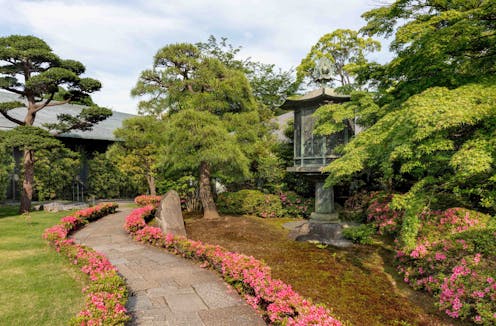
The garden of the Nezu Museum comprises a series of panoramic views and four types of tea-houses framed by the delicate architecture of maple trees and other foliage. The variant greens are pleasantly overwhelming, an irresistible and gentle embrace as you wander the winding pathways of this vast and multifaceted estate occupying 17,000 square metres of metropolitan Tokyo.
The initial layout reflected the shinzan-yūkoku garden style, translated as “deep mountains and mysterious valleys”, and over the years it has been carefully restored to reflect the tastes of Nezu.
The variation and life of a mountainside appears in small and delicate ways: pruned hedges, rocks covered in moss. Glimpses of the pond through a veil of evergreen trees might reveal a momentary sparkle of sun glitter or the reflection of clouds.
In the spirit of the ritual of tea drinking, the museum’s cafe, also designed by Kuma, sits at the end of a stone path lined with a low, snaking hedge of pink azalea. I have a long list of favourite museum cafés. This one is in the top tier. A glass tea-house nestled amongst the trees, it serves a deliciously refreshing matcha.
Nezu Museum Garden Tour.Drinking fragrantnew tea from UjiI can scoop up the essenceand understandhow the ancients came to adore it.
-Ōtagaki Rengetsu (1791-1875)
The Nezu Museum is a cultural retreat offering restorative experiences through art, objects and its captivating garden. I look forward to our reunion once the borders are open again.
Authors: Olivia Meehan, Object-based Learning Co-ordinator, The University of Melbourne

















