

Physical distancing at school is a challenge. Here are 5 ways to keep our children safer
- Written by Fatemeh Aminpour, Associate Lecturer, School of Built Environment, UNSW
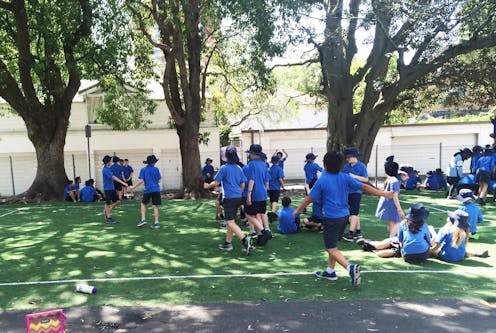
Children account for a large proportion of new infections in Australia’s current COVID-19 outbreaks. This has raised concerns about their safe return to school.
As schools in New South Wales and Victoria resume face-to-face learning, children under 12 will be more vulnerable to COVID-19 infection since vaccination of this age group hasn’t started in Australia (although they are less likely to get seriously ill). Face masks are not mandatory for these students either, but are mandatory for secondary school students in Victoria and in NSW.
Therefore, physical distancing and use of outdoor spaces for school activities top the list of recommendations to keep children safe from COVID-19.
Read more: From vaccination to ventilation: 5 ways to keep kids safe from COVID when schools reopen
However, physical distancing, even outdoors, can be hardly practised if the school is overcrowded. Overcrowding is common in Australian schools, which are increasingly accommodating more students. This issue has been recognised as a significant barrier to children’s free activities, especially during recess and when they are on the move.
In NSW, for example, the required open space per student is 10 square metres and nearly all schools meet this standard. While this seems to allow a fair amount of room for physical distancing, children may nevertheless believe their schools are overcrowded and don’t offer enough room for play.
Read more: Let them play! Kids need freedom from play restrictions to develop
Why does this happen? Do children use school grounds in ways that we don’t anticipate?
My PhD study conducted in three public primary schools in Sydney reveals children’s use and perception of school environments differ from what adult designers intended. Children dislike and avoid some of the school ground spaces designed by adults.
Large parts of school grounds, including covered outdoor learning areas, are covered with low-quality asphalt on which children are not allowed to run and cannot sit comfortably.
The “no running on concrete” rule restricts children’s intense physical activity to areas covered with grass or synthetic rubber. The problem is these areas are often not big enough for the numbers of children who want to use them, resulting in crowding.
Adding to the problem is the “out of bounds” rule, which bars children from using areas that are out of sight of staff. These areas are often around the edges of school grounds because staff tend to supervise children from the central parts of the school. Out-of-bounds areas are underused yet could provide extra space for children’s physical, social and dramatic play.
So, how can school design and planning help overcome the crowding that makes physical distancing difficult?
1. Provide quality material for ground surfaces
By replacing asphalt with better quality surface materials, children’s activities can be spread out across more of the school grounds, easing crowding. This will reduce the impact on children’s physical activity of the “no running on concrete” rule.
In a recent study, we found natural grass is children’s favourite surface for activities like running or performing gymnastics. It doesn’t become too hot in the sun, isn’t slippery and doesn’t hurt if they fall.
2. Increase opportunities for nature play
Besides the known benefits of nature play for children’s well-being, natural settings usually attract smaller groups that may result in less crowding. This contrasts with spaces such as sports fields where large numbers often play together.
My recent research shows children prefer trees with wide canopies, accessible branches, upraised roots and/or soft trunks because they offer sensory stimulation and opportunities for co-operative play.
Read more: Children learn science in nature play long before they get to school classrooms and labs
3. Recognise the value of neglected areas
Out-of-bounds areas at schools are often neglected based on the questionable assumption of their low value for children’s play. Making better use of these spaces can disperse children over the whole school area and enhance their opportunities for safe play.
Children may also find these spaces quiet and less busy since they are typically secluded and partially segregated from sanctioned areas. Less noisy spaces make it easier for children to talk with each other, which is a significant part of their socio-dramatic play.
4. Create separate zones
School layouts can be designed to establish separate zones that offer suitable secluded spaces for various groups, or cohorts, of students in order to avoid crowding. A cohort is a distinct group that stays together for the entire school day for in-person learning, with little or no contact between groups.
“Cohorting”, also known as “podding”, allows for more efficient contact tracing in the event of a positive COVID-19 test result. Targeted testing, quarantine and isolation can be applied to a single cohort/pod rather than schoolwide closures in the event of an individual or group testing positive.
5. Use nearby community/public spaces
Schools can locate the extra space they need on nearby community/public open spaces when the local council and the Department of Education reach a joint-use agreement. Children’s safe use of these sites depends on:
- the quality of these facilities
- their location in the neighbourhood
- ease of walking there to and from school
- access during school hours.
Sharing neighbourhood facilities can help meet children’s need for access to broader recreational resources. It also strengthens the social bond between schools and their communities.
Overcrowding in Australian schools is not a new issue yet could be an obstacle to safe face-to-face education at a time when it is desperately needed. Current concerns about COVID-19 outbreaks at schools can prompt policy and institutional redesign to tackle this longstanding problem of overcrowding. Children and school communities should be engaged in the earlier phases of school design and planning to tap into their unique insights into the effectiveness of educational environments.
Read more: In debates about opening schools, we're neglecting an important voice: our children's
Authors: Fatemeh Aminpour, Associate Lecturer, School of Built Environment, UNSW

















