

Modern Australian
Times Advertising

Hit hard by the pandemic, researchers expect its impacts to linger for years

  • Written by Sora Park, Associate Dean of Research, Faculty of Arts & Design, University of Canberra

Hit hard by the pandemic, researchers expect its impacts to linger for years

The impacts of COVID-19 on Australian university researchers are likely to have consequences for research productivity and quality for many years to come.

According to an online survey of academics at the University of Canberra between November 2020 and February 2021, they have deep concerns about their ability to undertake research during the pandemic and the flow-on effects of this. The findings are consistent with those of Research Australia from research in 2020 and 2021 and suggest Australia’s research sector will take a substantive hit from COVID-19.

The knowledge produced by university research generates an estimated 10% of Australia’s GDP. Without access to JobKeeper in 2020, universities across the sector cut back on casual staff and increased the teaching load of full-time academics. Combined with the challenges of working from home, this has had a real impact on research, not just immediately but in the longer term.

Read more: $7.6 billion and 11% of researchers: our estimate of how much Australian university research stands to lose by 2024

Almost three-quarters (73%) of respondents reported teaching commitments increased in the transition to online learning. Almost two-thirds reported delays in project milestones (63%) and publication (62%).

Bar chart showing percentages of researchers reporting negative impacts of pandemic on their activities
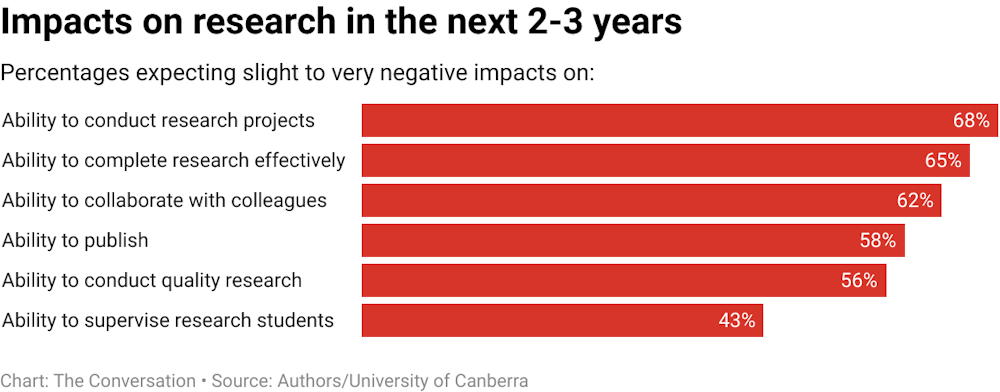
In addition to reduced research productivity, staff expressed concerns about the quality of outputs as they are aware their general mental well-being has been affected. As one academic said: “Although I have completed the usual number of papers, I am concerned about their quality due to the sense of being so overwhelmed by work and the COVID impacts that I couldn’t apply my usual critical judgements.” Impacts on researchers are highly uneven About half (52%) of respondents felt positive about the flexibility of working from home. In fact, we may see a shift in the work culture following the pandemic. An Australian Bureau of Statistics survey in June found one-third (33%) of Australians said working from home was the aspect of COVID life they would most like to continue. However, working from home did not translate into work-life balance and productivity for many academics. Domestic arrangements for a significant number have had an overall negative impact. These impacts particularly affected those with carers’ responsibilities. Of those with children up to year 12, 64% said working at home had a negative impact on the hours of work, compared with 50% of those with no children at home. Those with children at home were three times more likely to say their domestic responsibilities had a negative impact on their research. The impacts of COVID-19 on academic staff are not evenly distributed. There was a disproportionate gender impact, which is in line with previous reports across the sector. Impacts were greatest on academics in the early stages of their careers, often with young families. Bar chart showing percentage of academics saying pandemic had an impact on domestic arrangements This differential impact is reflected in other research into academic publishing, which shows the gender gap widening during the pandemic. Read more: How COVID is widening the academic gender divide What does the future hold? Research is a long-term endeavour. It takes years and even decades for research to come to fruition. We asked respondents how they saw the future of their research. The majority felt pessimistic about all aspects of research: funding, publication, collaborating and supervising PhD students. More than two-thirds of respondents had negative views about their ability to attract funding and pursue research projects in the near future. More importantly, those who have young families are feeling despondent about their research careers. A majority of them say their ability to publish will be hampered for the next two to three years. This group is the future of Australian academic research, so the negative impact of COVID-19 is of serious concern. This is bad for Australia in terms of lost or delayed advances in science and technology, stalled or postponed advances in health care and treatment, reduced capacity to inform public debate, and fewer opportunities to contribute to Australia’s lifestyle and culture. The impacts of the pandemic on the emerging generation of researchers will have long-term consequences. Read more: Early and mid-career scientists face a bleak future in the wake of the pandemic In June, the ABS survey of pandemic impacts found one in five (20%) Australians experienced high or very high levels of psychological distress due to COVID-19. This has not changed since last November. Like many Australians, academics are under enormous pressure trying to balance work and home life. As well as the concerns about the blurring of work and home life, we found evidence of low morale and exhaustion among staff. These findings match those of a report released today by Professional Scientists Australia. There is a need for both the government and universities to develop a long-term, tailored strategy to support the research community. This will help ensure Australia’s research effort continues at its above-world-class level, with the associated societal benefits it brings. The survey and the analysis of the data were carried out in collaboration with Janie Busby Grant, Elke Stracke, Simon Niemeyer, Roland Goecke, and Dianne Gleeson at the University of Canberra. Authors: Sora Park, Associate Dean of Research, Faculty of Arts & Design, University of Canberra

Read more https://theconversation.com/hit-hard-by-the-pandemic-researchers-expect-its-impacts-to-linger-for-years-169366

Interstate Car Transporter Urges Buyers to Book Early

As the conflict in the Middle East continues to put increasing pressure on local fuel supply, Australian transport companies are experiencing increasi...

Digital Minimalism for Business Owners: Fewer Tools, Better Systems

Be honest. How many apps are open right now? One for scheduling, another for invoices, a third for customer notes, plus a spreadsheet someone email...

The Importance Of Proactive NDIS Renewal Preparation For Sustaining Your Provider Business

Your NDIS renewal notice is not a signal to start preparing. By the time it arrives, preparation should already be well underway. For new providers, s...

Why Fire Extinguisher Testing in Sydney Is Becoming a Records Game, Not Only a Maintenance Job

A fire extinguisher used to feel like one of the simpler parts of building safety. It hung on the wall, wore a service tag, and sat there quietly unle...

The Switchboard Upgrade Question Every Melbourne Renovator Should Ask Before the Walls Close Up

Renovations have a funny way of making people think on surfaces first. Splashback, stone, joinery, tapware, paint. Fair enough too. That is the exciti...

Winter Sanitation Gaps in Parramatta Kitchens: A Hidden Pest Risk

Winter brings a host of changes to our homes, from the chill in the air to the cozy warmth indoors. However, this season also introduces sanitation ch...

When to Seek Advice from Employment Lawyers in Melbourne

Australian employment law is detailed and, at times, complex, with rights and obligations that aren't always obvious to employees or employers witho...

7 Benefits of Professional Gutter Cleaning for Australian Homeowners

Gutters aren't exactly glamorous. They sit up there on the edge of your roof, doing their job quietly - until they stop working. Clogged, overflowing ...

Pipe Floats Strengthening Pipeline Performance In Demanding Environments

Pipelines often travel through environments that are anything but predictable, water currents shift, terrain changes, and materials keep moving unde...

Why Ceiling Fans Are Essential For Comfort, Efficiency, And Modern Living

Creating a comfortable indoor environment is not just about temperature; it is about how air moves, how a room feels, and how efficiently energy is ...

Why Duct Cleaning In Melbourne Is A Smart Investment For Healthier Living Spaces

Behind your walls, ceilings, and vents lies a network quietly working every day to keep your home comfortable. Yet over time, this system can become...

Disability Service Providers Supporting Inclusive And Independent Living

Finding the right support system can feel like assembling a puzzle where every piece must fit just right. For individuals and families navigating di...

A Beginner's Guide to Owning a Caravan in Australia

Owning a caravan opens up a style of travel that's hard to match for freedom and flexibility. However, for those just starting out, the process of c...

Preparing Your Air Conditioner for Summer: What Most Homeowners Overlook

As temperatures rise, many homeowners switch on their air conditioning for the first time in months — only to find it’s not performing the way i...

What Actually Adds Value to Properties in Newcastle

Newcastle has seen steady growth over the past few years, with more buyers looking beyond Sydney for lifestyle, space, and long-term value. As dema...

What is Design and Build in Construction?

Imagine you’re about to start a new construction project, maybe it’s a custom home or a commercial building. You’ve got the idea, the land, an...

Commercial roof leak detection: why early action protects your building

Water ingress is one of the most disruptive and costly issues facing commercial properties. For property managers and facilities teams, even a minor...

Custom Photo Frames: Turning Everyday Moments into Lasting Displays

Photos capture moments, but how you display them determines how they’re experienced every day. A meaningful photograph deserves more than a generi...
















