

The world’s first professional acrobats were flipping through the Middle East 4,000 years ago
- Written by Javier Alvarez-Mon, Professor in Near Eastern Archaeology and Art, Macquarie University
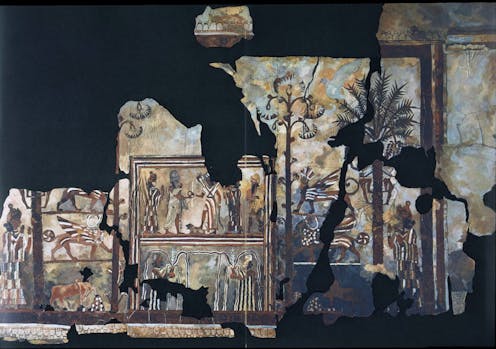
Inhabitants of the ancient city-states of the Middle East enjoyed a vibrant social and economic life centred on palace and temple institutions, supported by surrounding agricultural and pastoralist communities. People, goods and ideas flowed between these cities generating a cultural sphere within which strong local identities and customs were preserved.
One such custom that arose in the area of Syria was the professional acrobat, or huppû, attached to the royal court.
The first known mention of the huppû is in administrative documents from the ancient city of Ebla (Tell Mardikh) in Syria dated as early as 2320 BCE. Details of the profession can be further pieced together from snippets of information in a royal archive (1771-1764 BCE) of about 20,000 tablets preserved at the neighbouring city of Mari (Tell Hariri) on the Euphrates River.
Accounting records and personal letters unveil troupes of huppû who performed several times per month for special events to celebrate the king’s safe return to the city, the arrival of special visitors and religious festivals. The program for the festival of the goddess Ishtar included huppû, wrestlers, and lamentation priests who sung in the ancient Sumerian language accompanied by drums.
These productions were so admired, the cast and crew accompanied the king to entertain in foreign kingdoms.
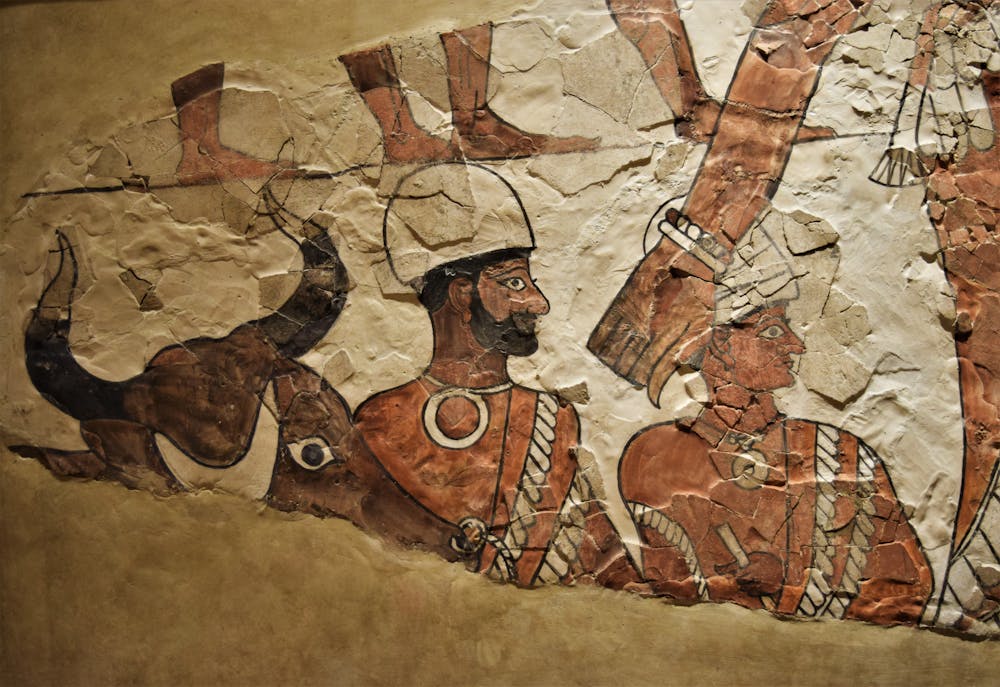
Craft of the huppû
There are just two surviving adjectives used to describe the performances of the huppû, but they evoke a visual feast of high-energy movement.
The first, mēlulu, variously meant “to play”, “to act” and “to fight”.
The second, nabalkutu, was applied to a range of bold and dynamic actions: “to clear an obstacle”, “to rebel against authority”, “to turn upside down”, “to change sides”, “to tumble” (said of a flying bird) and “to roll” (said of waves and earthquakes).
We can envisage groups of huppû showcasing a choreographed blend of acrobatic feats and dance, harmonising physical strength and control with bodily expression to win over an audience.
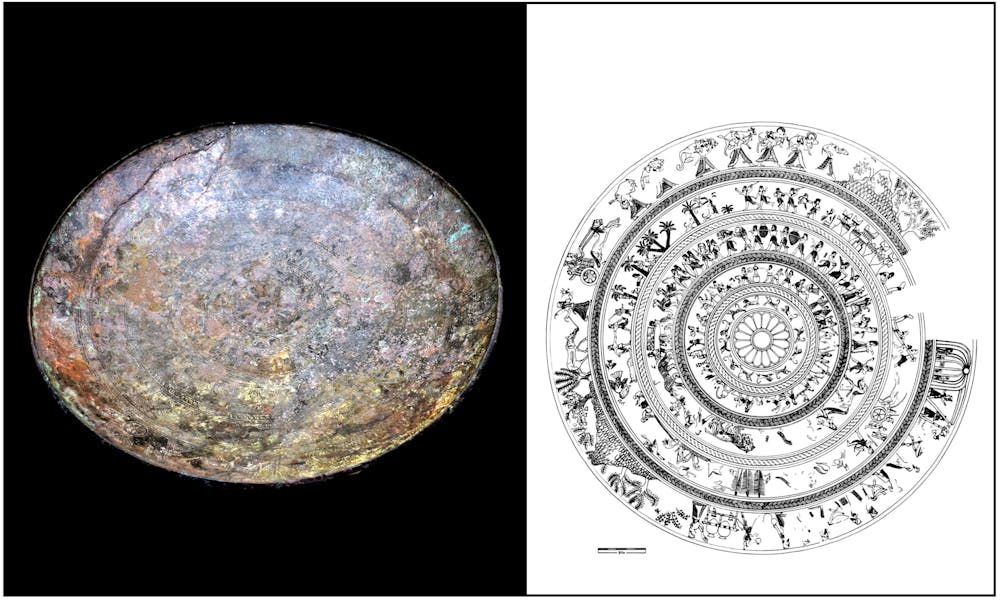 This bowl from Arjan, c.600 BCE, depicts some of the skills the early acrobats would have performed.
Photograph J. Álvarez-Mon; drawing courtesy of Y. Majidzadeh, Author provided
This bowl from Arjan, c.600 BCE, depicts some of the skills the early acrobats would have performed.
Photograph J. Álvarez-Mon; drawing courtesy of Y. Majidzadeh, Author provided
The craft appears to have been a male-only pursuit. There are no records of a female form of the noun huppû, nor any documented huppû with a female name.
Access to formal education in writing and the arts in ancient Syria, as elsewhere in the Near East, was determined primarily by one’s family status: most children followed in the footsteps of their parents.
Specialist conservatories existed for promising male and female musicians and singers while, much like modern athletes, young male huppû apprentices were sent to dedicated academies to learn mastery through years of repetitive and strenuous drills.
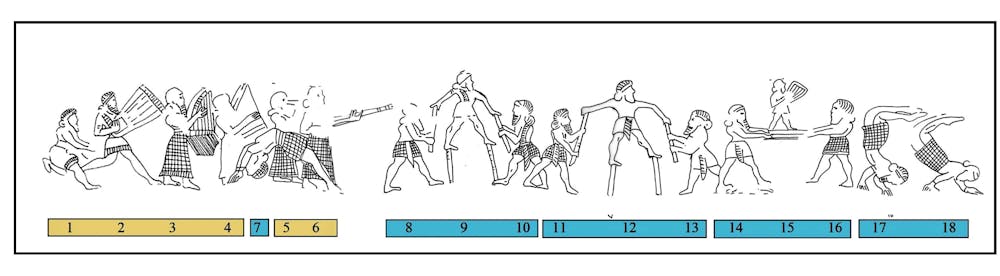 Acrobats from the Arjan Bowl, ca. 600 BCE.
Drawing by J. Álvarez-Mon, Author provided
Acrobats from the Arjan Bowl, ca. 600 BCE.
Drawing by J. Álvarez-Mon, Author provided
Through preserved correspondence between the literate elite, it seems the divide between artistic conservatories and athletic academies reflected a mind-body split in cultural values.
Tension between the schools surface in a letter composed by the beleaguered head of the royal huppû troupe, Piradi, to the king Zimri-Lim, dated around 1763 BCE.
First appealing to the king’s good judgement (“my lord knows when I am lying and when I am not”) Piradi goes on to lament the under-appreciated difficulty of his art (a grievance somewhat verified by a pay disparity between musicians and acrobats in the royal accounts) and the contempt he endures from the musicians.
Indeed, from one musician’s own pen: “if I break my oath, they can chase me down and make me a huppû!”
Read more: The perils of history and antiquity in Syria
Living as a huppû
Troupe members lived outside the palace and most probably had families – although not always happy ones, judging by Piradi’s declaration a woman had just left his house and robbed him of his possessions.
Employment was on a casual basis. Payments were collected after performances, probably several times per month, in the form of silver shekels.
A surviving list of palace disbursements for a tour to a neighbouring town points to a reasonable living: an ordinary huppû collected one shekel; the second-in-command two; and the head five.
(For perspective, a single silver shekel bought 300 kg of barley.)
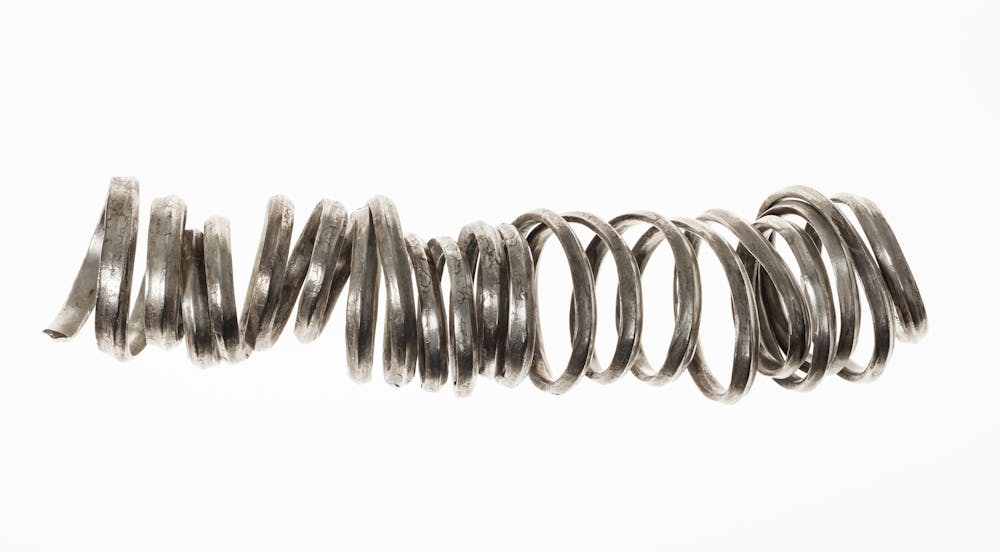 Silver coil from ancient Iraq. Silver was snipped off the coil, weighed in shekels, and used as a kind of money.
Oriental Institute, University of Chicago
Silver coil from ancient Iraq. Silver was snipped off the coil, weighed in shekels, and used as a kind of money.
Oriental Institute, University of Chicago
The head huppû was an especially privileged role. Piradi enjoyed direct access to the ear of the king, and he attracted extravagant gifts including “first quality” garments, silver weapons and wine.
But head of troupe was a high-stress position in a competitive line of work.
The huppû from the city of Mari faced an ever-present threat of outside competition, especially rivals from the famed huppû school of nearby Halep (modern Aleppo), and potential work shortages and lay-offs with the arrival of a new ruler targeting funding cuts in the arts.
A lasting legacy
The huppû profession sustained itself under the same name – and probably much the same form – for well over a thousand years.
This is attested by a legal contract signed by a private huppû coach named Nanā-uzelli in 628 BCE about 450 km from Mari at Borsippa, near Babylon in Iraq. For the price of two silver shekels, he would train a man’s son for a period of two years and five months.
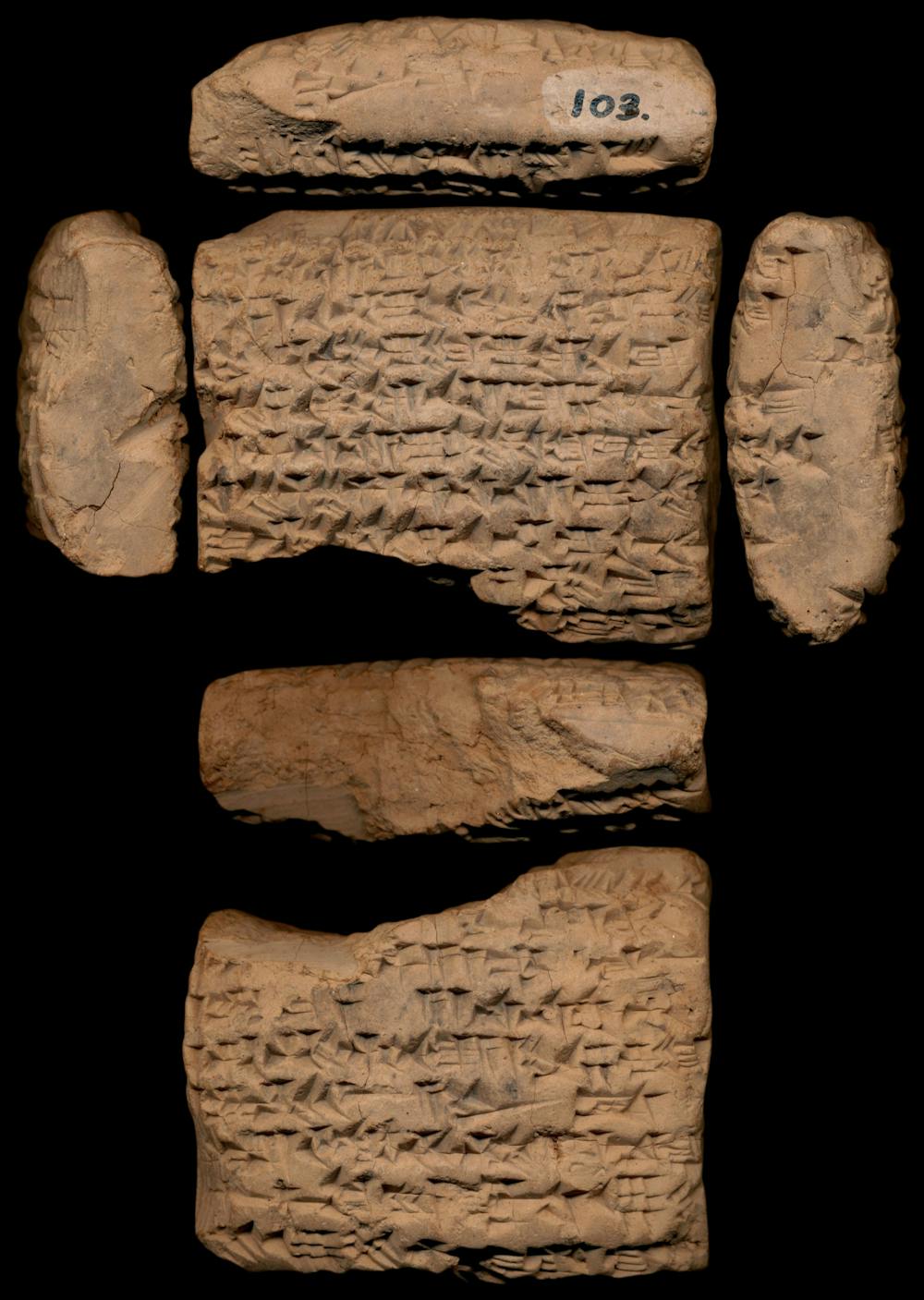 The huppû coach tablet from Borsippa, 628 BCE.
Chester Beatty Museum, Dublin, CT103, Author provided
The huppû coach tablet from Borsippa, 628 BCE.
Chester Beatty Museum, Dublin, CT103, Author provided
Further evidence for the vast spread of the huppû craft through the Middle East from its Syrian homeland is a royal banquet scene engraved inside an Elamite bronze bowl from southwest Iran around 600 BCE.
One of the oldest depictions of its kind, the bowl displays an ensemble of musicians performing in tandem with a troupe of back-bending, stilt-balancing, hand-walking acrobats.
Next time you are watching the gymnastics, or see some acrobats at the circus, have a think back on the ways humans have been pushing their bodies to the limits for thousands of years.
Authors: Javier Alvarez-Mon, Professor in Near Eastern Archaeology and Art, Macquarie University

















