

how we cracked a 400-year-old alchemical cipher
- Written by Richard Bean, Research Fellow, The University of Queensland
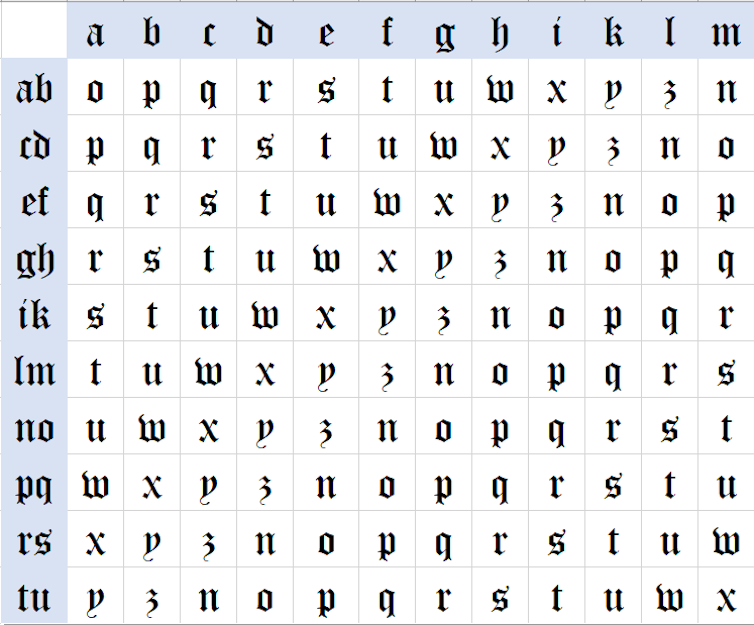
What secret alchemical knowledge could be so important it required sophisticated encryption?
The setting was Amsterdam, 2019. A conference organised by the Society for the History of Alchemy and Chemistry had just concluded at the Embassy of the Free Mind, in a lecture hall opened by historical-fiction author Dan Brown.
At the conference, Science History Institute Postdoctoral Researcher Megan Piorko presented a curious manuscript belonging to English alchemists John Dee (1527–1608) and his son Arthur Dee (1579–1651). In the pre-modern world, alchemy was a means to understand nature through ancient secret knowledge and chemical experiment.
Within Dee’s alchemical manuscript was a cipher table, followed by encrypted ciphertext under the heading “Hermeticae Philosophiae medulla” — or Marrow of the Hermetic Philosophy. The table would end up being a valuable tool in decrypting the cipher, but could only be interpreted correctly once the hidden “key” was found.
It was during post-conference drinks in a dimly lit bar that Megan decided to investigate the mysterious alchemical cipher — with the help of her colleague, University of Graz Postdoctoral Researcher Sarah Lang.
A recipe for the elixir of life
Megan and Sarah shared their initial analysis on a history of chemistry blog and presented the historical discovery to cryptology experts from around the world at the 2021 HistoCrypt conference.
Based on the rest of the notebook’s contents, they believed the ciphertext contained a recipe for the fabled Philosophers’ Stone — an elixir that supposedly prolongs the owner’s life and grants the ability to produce gold from base metals.
The mysterious cipher received much interest, and Sarah and Megan were soon inundated with emails from would-be code-breakers. That’s when Richard Bean entered the picture. Less than a week after the HistoCrypt proceedings went live, Richard contacted Lang and Piorko with exciting news: he’d cracked the code.
Megan and Sarah’s initial hypothesis was confirmed; the encrypted ciphertext was indeed an alchemical recipe for the Philosophers’ Stone. Together, the trio began to translate and analyse the 177-word passage.
Read more: Why the ancient promise of alchemy is fulfilled in reading
The alchemist behind the cipher
But who wrote this alchemical cipher in the first place, and why encrypt it?
Alchemical knowledge was shrouded in secrecy, as practitioners believed it could only be understood by true adepts.
Encrypting the most valuable trade secret, the Philosophers’ Stone, would have provided an added layer of protection against alchemical fraud and the unenlightened. Alchemists spent their lives searching for this vital substance, with many believing they had the key to successfully unlocking the secret recipe.
Arthur Dee was an English alchemist and spent most of his career as royal physician to Tsar Michael I of Russia. He continued to add to the alchemical manuscript after his father’s death — and the cipher appears to be in Arthur’s handwriting.
We don’t know the exact date John Dee, Arthur’s father, started writing in this manuscript, or when Arthur added the cipher table and encrypted text he titled “The Marrow of Hermetic Philosophy”.
However, we do know Arthur wrote another manuscript in 1634 titled Arca Arcanorum — or Secret of Secrets — where he celebrates his alchemical success with the Philosophers’ Stone, claiming he discovered the true recipe.
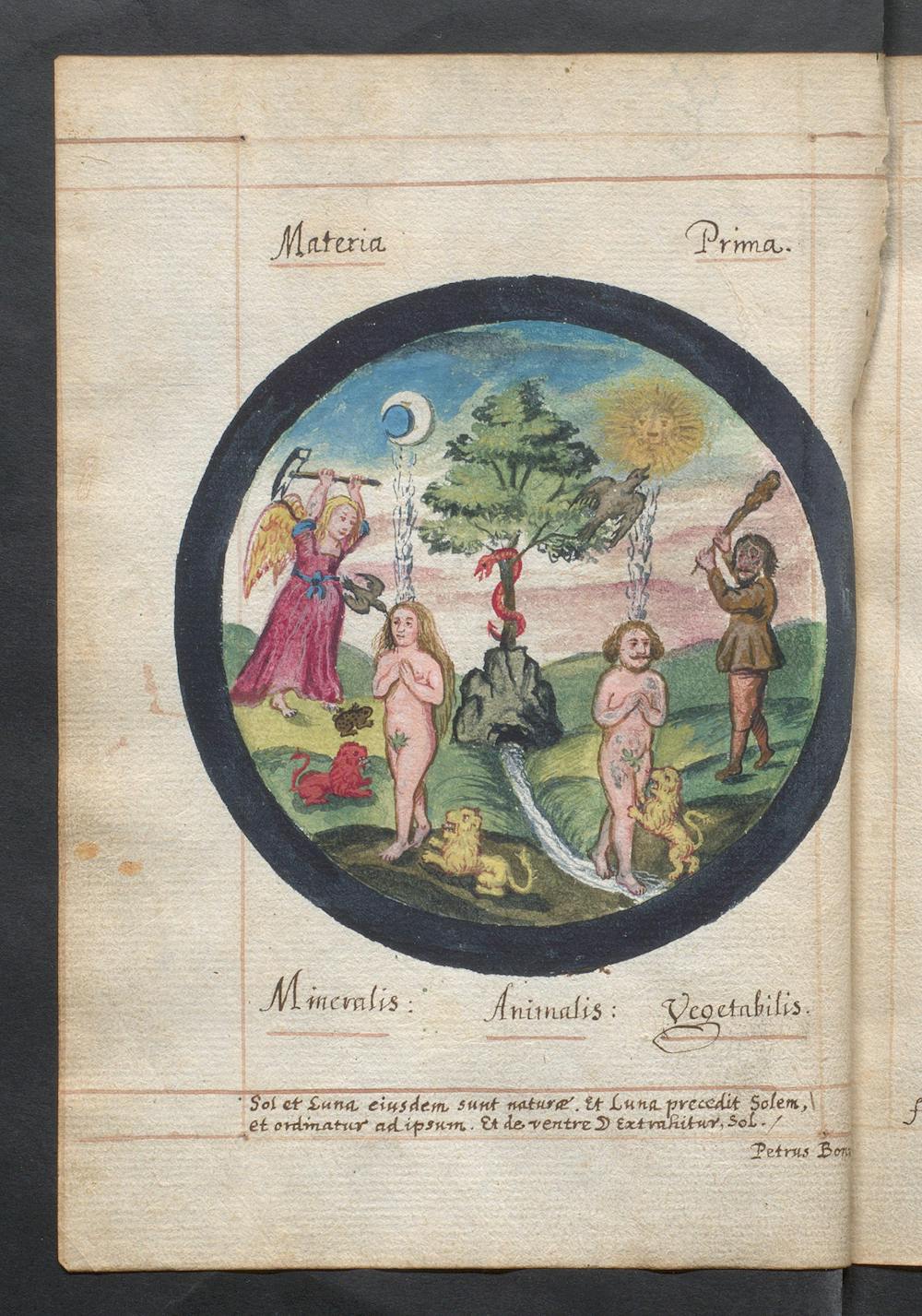
He decorated Arca Arcanorum with an emblem copied from a medieval alchemical scroll, illustrating the allegorical process of alchemical transmutation necessary for the Philosophers’ Stone.
Cracking the code
What clues led to decrypting the mysterious Marrow of the Hermetic Philosophy passage?
Adjacent to the encrypted text is a table resembling one used in a traditional style of cipher called a Bellaso/Della Porta cipher — invented in 1553 by Italian cryptologist Giovan Battista Bellaso, and written about in 1563 by Giambattista della Porta. This was the first clue.
The Latin title indicated the text itself was also in Latin. This was corroborated by the lack of letters V and J in the cipher table, as V and J are interchangeable with U and I, respectively, in printed Latin text.
This was good news, as Richard had access to Latin statistical models from previous decryption projects. Armed with this information, he set off in search of patterns that would lead him to the cipher “key” — a word or phrase that could be used in conjunction with the cipher table to decipher the text.
Richard soon realised the key was included at the end of the text, which is unusual. It was surprisingly long too, made up of 45 letters — arduous even for today’s computer-password standards. The trio would later realise the key was also written elsewhere in the manuscript, hidden in plain sight.
In keeping with the typical encryption practices of the period, Arthur Dee had written the key on the back of the cipher table. It read: sic alter iason aurea felici portabis uellera colcho, meaning “like a new Jason you will carry the Golden Fleece away from the lucky Colchian”.
An ancient myth
This key is adapted from the last verses of an alchemical poem by Giovanni Aurelio Augurello titled Chrysopoeia (circa 1505), with “chrysopoeia” also being the ancient Greek word for the art of gold-making.
The poem is about the ancient Greek myth of Jason and the Argonauts, which was reinterpreted during the early modern period as an allegory for alchemy. In the myth of Jason and the Argonauts, the Argonauts sail to the land of Colchis (in modern-day Georgia) to retrieve the “Golden Fleece”. In an alchemical context, the fleece is a symbol for the Philosophers’ Stone.
The actual text of the Marrow of the Hermetic Philosophy mentions taking an alchemical “egg” — not further described — from an athanor, which is a type of furnace used for gentle heating over a long period of time.
Afterwards, instructions are given for how long to wait until the different alchemical phases ensue (the blackening, whitening and the red phase). It says the end product — either a silver tincture or the gold-making elixir — will depend on when the process is stopped.
If the directions are followed correctly, the code-cracking reader is promised:
… then you will have a truly gold-making elixir by whose benevolence all the misery of poverty is put to flight and those who suffer from any illness will be restored to health.
Contrary to what was believed for a long time, alchemical recipes do contain chemical processes which can be reproduced in modern laboratories. It’s only towards the end (during the production of the Philosophers’ Stone) that the recipe becomes too vague to reproduce — at least not without further interpretation.
However, they do sometimes produce a blood-red glass (which is what the stone was said to look like).
Journey to the centre of the archive
What can we learn from historical ciphers? Cryptology experts have just scratched the surface of early-modern encryption practices. Much secret alchemical knowledge remains uncovered from a time when making gold and extending the natural limit of life was believed possible through alchemy.
The decryption of this 400-year-old cipher suggests we have much ground to dig through yet. Who knows what other alchemical ciphers are waiting to be discovered in the depths of the archive?
Read more: Declassified Cold War code-breaking manual has lessons for solving 'impossible' puzzles
Authors: Richard Bean, Research Fellow, The University of Queensland


















