

Why do we wake around 3am and dwell on our fears and shortcomings?
- Written by Greg Murray, Professor and Director, Centre for Mental Health, Swinburne University of Technology, Swinburne University of Technology

When I wake at 3am or so, I’m prone to picking on myself. And I know I’m not the only one who does this. A friend of mine calls 3am thoughts “barbed-wire thinking”, because you can get caught in it.
The thoughts are often distressing and punitive. Strikingly, these concerns vaporise in the daylight, proving that the 3am thinking was completely irrational and unproductive.
So, what’s going on?
I’m a psychology researcher with expertise in mood, sleep, and the circadian system (the internal clock regulating sleep). Here’s what the research says about what may be behind this common experience.
What’s happening in your body at 3am?
In a normal night’s sleep, our neurobiology reaches a turning point around 3 or 4am.
Core body temperature starts to rise, sleep drive is reducing (because we’ve had a chunk of sleep), secretion of melatonin (the sleep hormone) has peaked, and levels of cortisol (a stress hormone) are increasing as the body prepares to launch us into the day.
Remarkably, all this activity happens independent of cues from the environment such as dawn light – nature decided long ago that sunrise and sunset are so important that they must be predicted (hence the circadian system).
We actually wake up many times each night, and light sleep is more common in the second half of the night. When sleep is going well for us, we are simply unaware of these awakenings. But add a bit of stress and there is a good chance that waking will become a fully self-aware state.
Not surprisingly, there is evidence the pandemic is a sleep-disturbing stressor. So if you’re experiencing 3am wakings at the moment, you’re definitely not alone.
Read more: Did we used to have two sleeps rather than one? Should we again?
Stress also impacts sleep in insomnia, where people become hypervigilant about being awake.
Concerns about being awake when one “should” be asleep can cause the person to jolt themselves into anxious wakefulness whenever they go through a light sleep phase.
If that sounds like you, be aware that insomnia responds well to psychological treatment with cognitive behavioural therapy. There’s also a strong link between sleep and depression, so it’s important to speak to your doctor if you have any concerns about your sleep.
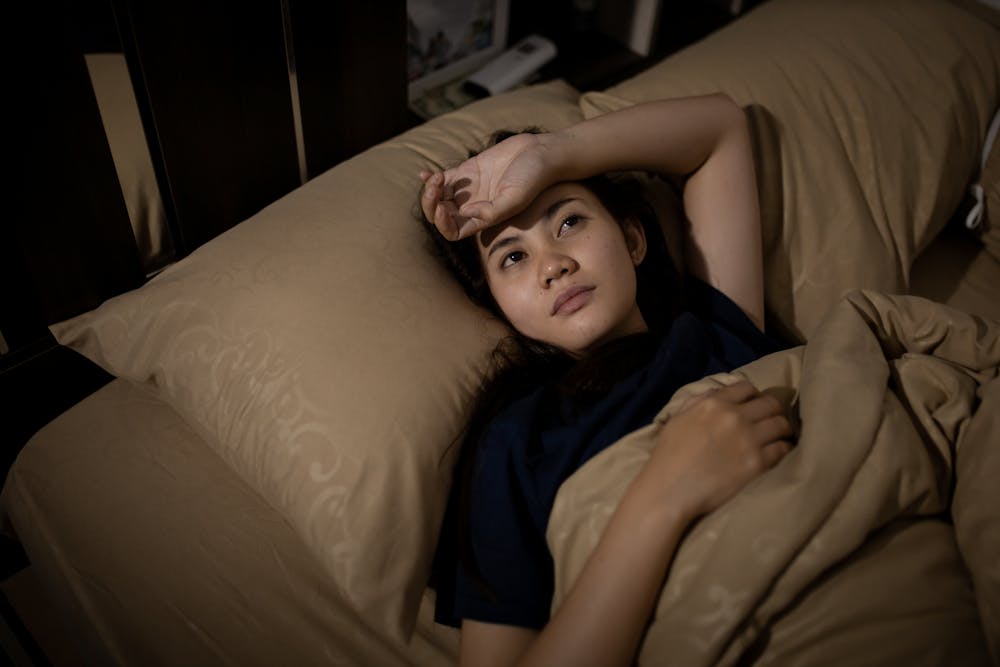
Catastrophising in the wee hours
As a cognitive therapist, I sometimes joke the only thing good about 3am waking is that it gives us all a vivid example of catastrophising.
Around this time in the sleep cycle, we’re at our lowest ebb physically and cognitively. From nature’s viewpoint, this is meant to be a time of physical and emotional recovery, so it’s understandable that our internal resources are low.
But we also lack other resources in the middle of the night – social connections, cultural assets, all the coping skills of an adult are unavailable at this time. With none of our human skills and capital, we are left alone in the dark with our thoughts. So the mind is partly right when it concludes the problems it’s generated are unsolvable – at 3am, most problems literally would be.
Once the sun’s up, we’re listening to the radio, chewing our Vegemite toast and pushing the cat off the bench, and our 3am problems are put in perspective. We can’t believe the solution of just ringing this person, postponing that thing, or checking such-and-such was overlooked in the wee hours.
The truth is, our mind isn’t really looking for a solution at 3am. We might think we are problem solving by mentally working over issues at this hour, but this isn’t really problem solving; it’s problem solving’s evil twin – worry.
Worry is identifying a problem, ruminating about the worst possible outcome and neglecting the resources we would bring to bear should the non-preferred outcome actually occur.
 The truth is, your brain isn’t really looking for a solution at 3am.
Shutterstock
The truth is, your brain isn’t really looking for a solution at 3am.
Shutterstock
Read more: Poor sleep is really bad for your health. But we found exercise can offset some of these harms
So, what can we do about it?
Have you noticed the 3am thoughts are very self-focused? In the quiet dark, it’s easy to slide unknowingly into a state of extreme egocentricity. Circling round the concept “I”, we can generate painful backwards-looking feelings like guilt or regret. Or turn our tired thoughts to the always uncertain future, generating baseless fears.
Buddhism has a strong position on this type of mental activity: the self is a fiction, and that fiction is the source of all distress. Many of us now practice Buddhist-informed mindfulness to manage stress in the daytime; I use mindfulness to deal with 3am wakings.
I bring my attention to my senses, specifically the sound of my breath. When I notice thoughts arising, I gently bring my attention back to the sound of breathing (pro tip: earplugs help you hear the breath and get out of your head).
Sometimes this meditation works. Sometimes it doesn’t. If I’m still caught in negative thinking after 15 or 20 minutes, I follow the advice from cognitive behavioural therapy, and get up, turn on dim light and read.
This action may seem mundane, but at 3am it is powerfully compassionate, and can help draw you out of your unproductive thinking.
One last tip: It’s important to convince yourself (during daylight hours) that you want to avoid catastrophic thinking. For good reasons not to worry, you can’t go past the Stoic philosophers.
Waking and worrying at 3am is very understandable and very human. But in my opinion, not a great habit to get into.
Read more: When life gives you lemons ... 4 Stoic tips for getting through lockdown from Epictetus
If this article has raised issues for you, or if you’re concerned about someone you know, call Lifeline on 13 11 14.
Authors: Greg Murray, Professor and Director, Centre for Mental Health, Swinburne University of Technology, Swinburne University of Technology
Read more https://theconversation.com/why-do-we-wake-around-3am-and-dwell-on-our-fears-and-shortcomings-169635

















