

the Tarnanthi festival of Aboriginal and Torres Strait Islander art surprises and shocks
- Written by Catherine Speck, Professorial Fellow (Honorary), The University of Melbourne
Review: Tarnanthi, Art Gallery of South Australia
The word “Tarnanthi”, from Kaurna language of the Adelaide Plains, means “to rise up, spring forth or appear”, and it informs the philosophy and curatorship of this contemporary Aboriginal and Torres Strait Islander Art Festival under artistic director Nici Cumpston. The word itself signifies new ways of thinking: it is this quality which makes Tarnanthi 2021, and its preceding iterations from 2015, so special.
Cumpston’s approach to exhibition-making is based on dialogue and collaboration with the artists and it delivers, challenging perceptions on many levels.
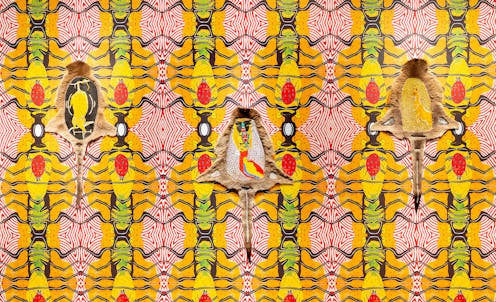
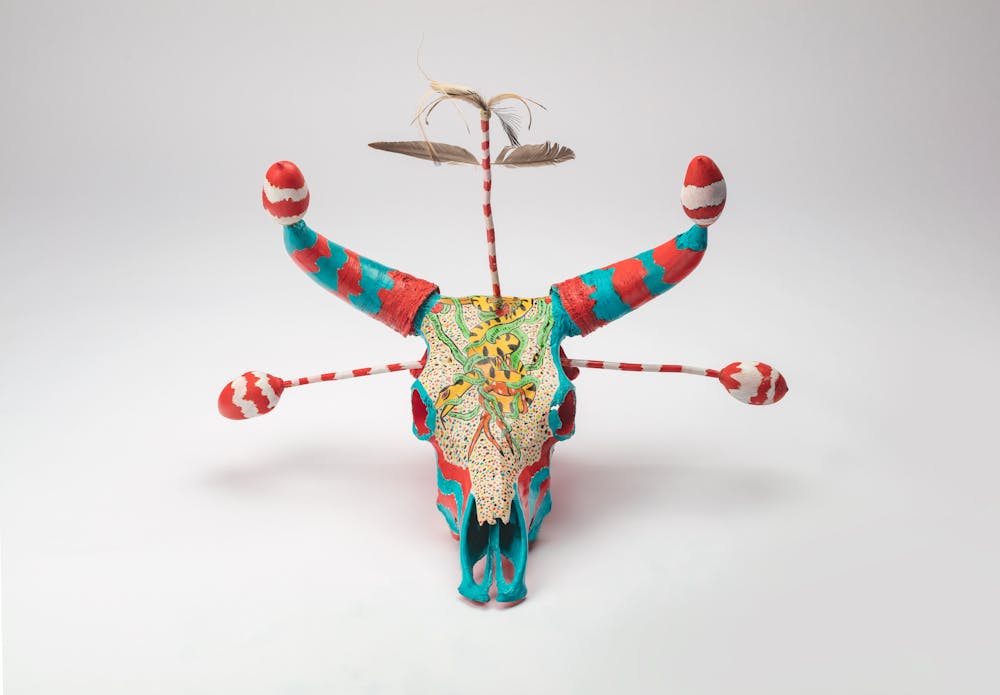
Walking down the stairs into the main gallery space, Walmajarri artist John Prince Siddon’s psychedelic desert pop imagery sets the scene. He is a former stockman from the Kimberley region who paints on the inner side of kangaroo pelts, on bullock skulls, boab nuts and on canvas imagery that is a mix of the desert, the everyday, and pressing social and political issues.
He calls it art “all mixed up”, but his imagery of people, animals and vehicles inhabiting the map of Australia – with boat people waving on – touches a very raw nerve of where our nation is at.
This is Australian art at its best.
Senior women artists
Katjarra Butler of the Ngaanyatjarra/Pintupi people in the Western Desert of Western Australia is one of the many senior women exhibiting.
Her work, Ara Katjarraku, fills a gallery space with 16 stunning canvases, as Butler shares her deep knowledge of the Tjukurrpa (or dreaming) that guided her traditional lifestyle. Viewers enter a world of knowledge transfer in which her large, multi-coloured circular forms represent ancient and sacred sites of Country and its ancestral beings.
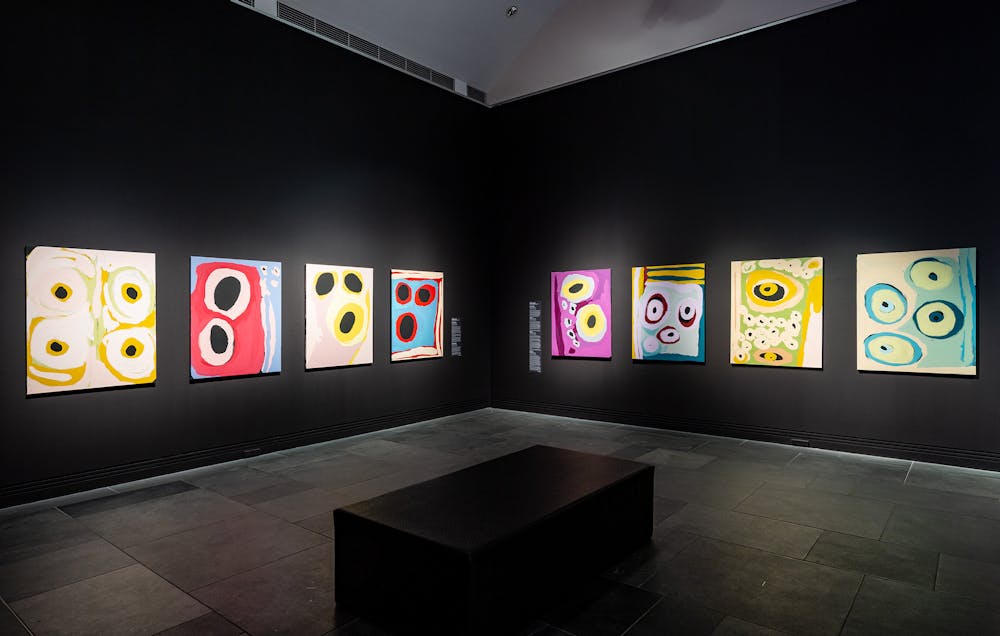 Installation view: Tarnanthi 2021, featuring works by Katjarra Butler.
Art Gallery of South Australia, Adelaide. Photo: Saul Steed
Installation view: Tarnanthi 2021, featuring works by Katjarra Butler.
Art Gallery of South Australia, Adelaide. Photo: Saul Steed
Another senior woman is Aṉangu artist Nyunmiti Burton, director of the APY (Aṉangu Pitjantatjara Yankunytatjara) Council. Her energetic and bold painting Seven Sisters (2020), portrays an ancient tale in which the eldest sister protects the other sisters from the dangers of the world. Here, Burton’s story of sisterhood is gesturing towards the leadership women offer.
Yaritji Young is a senior lawwoman and traditional owner of the Country around Amata, which she depicts in her large and energetic Tjala Tjukurpa - Honey any story (2021). This ancient story, passed down from her father, is of the women waiting for the men to come with tjuratji, the honey ants, to nourish them before setting off on a long walk south. Young’s energetic and brilliantly colourful painting shows these twisting tunnels and the changing colours of the desert.
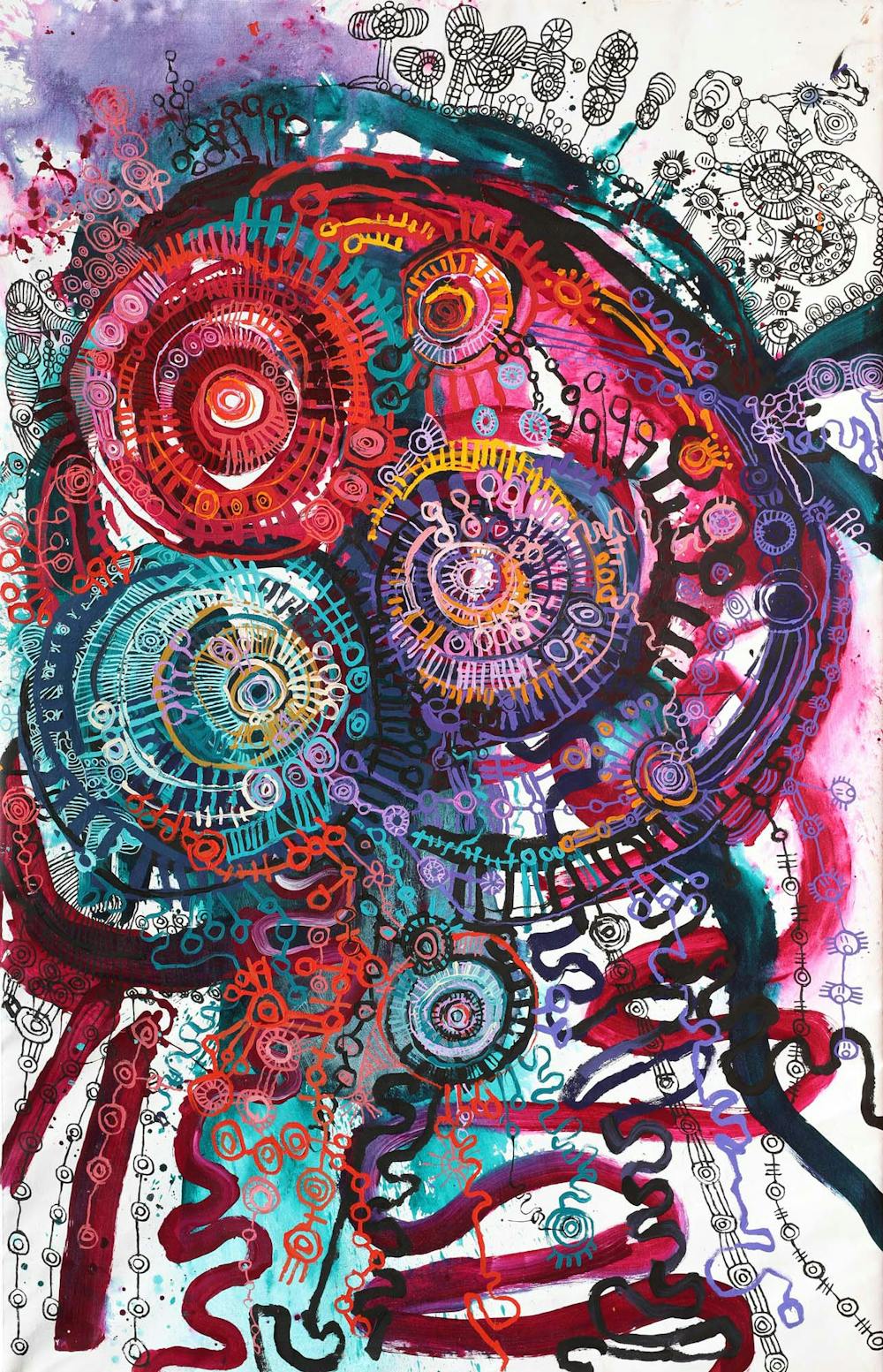 Yaritji Young, Pitjantjatjara people, South Australia, born Rocket Bore, South Australia 1956, Tjala tjukurpa – Honey ant story, 2021, Amata, South Australia, synthetic polymer paint on linen, 300.0 x 200.0 cm.
© Yaritji Young/Tjala Arts
Yaritji Young, Pitjantjatjara people, South Australia, born Rocket Bore, South Australia 1956, Tjala tjukurpa – Honey ant story, 2021, Amata, South Australia, synthetic polymer paint on linen, 300.0 x 200.0 cm.
© Yaritji Young/Tjala Arts
Art stars
A standout of the exhibition is Trawlwoolway artist Julie Gough. Her Psychoscape is an exhibition within an exhibition. Gough’s subject is the genocide committed against Lutruwita (Tasmania’s) First Nations people in the Black Wars of the late 1820s and early 1830s.
Set against selected items of colonial furniture – symbols of home for the settlers – she focuses on the shocking plight of the dispossessed Palawa people. In one piece, an upturned chair becomes a frame for a grim shadow puppet scene mirroring the actions of reprisal in Governor Arthur’s Proclamation Boards.
 Installation view: Tarnanthi 2021 featuring works by Julie Gough, Art Gallery of South Australia, Adelaide.
Photo: Saul Steed
Installation view: Tarnanthi 2021 featuring works by Julie Gough, Art Gallery of South Australia, Adelaide.
Photo: Saul Steed
In another, she places Eugene Von Guerard’s picturesque Waterfall on the Clyde River (1877) by video footage of the actual waterfall that was the site of a massacre. Its waters turn red briefly before the blood is washed away, cleansed.
Idyllic 19th century colonial artworks, sanitised by Joseph Lycett’s lack of reference to Aboriginal people, or romanticised by John Glover’s inclusion of Aboriginal people after their removal, are juxtaposed with the reality of frontier violence.
A musket sits centrally on one wall, two spears stand forlorn in a corner. They could not save their people. The video projected on the floor evokes feelings of the chase and destabilises the exhibition space as if viewers are entering a crime scene.
Another star is Pitjantjatjara artist Timo Hogan from Tjuntjuntjara in the southeast of Western Australia in the Great Victoria Desert. He paints his Country, Lake Baker, the home of the ancestral story of Wanampi, the Watersnake man, and Wati Kutjara, the Two Men. His massive painting in whites and creamy ochres set against a black landscape conveys the vast shifting terrain and dangers of the salt lake he has permission to portray.
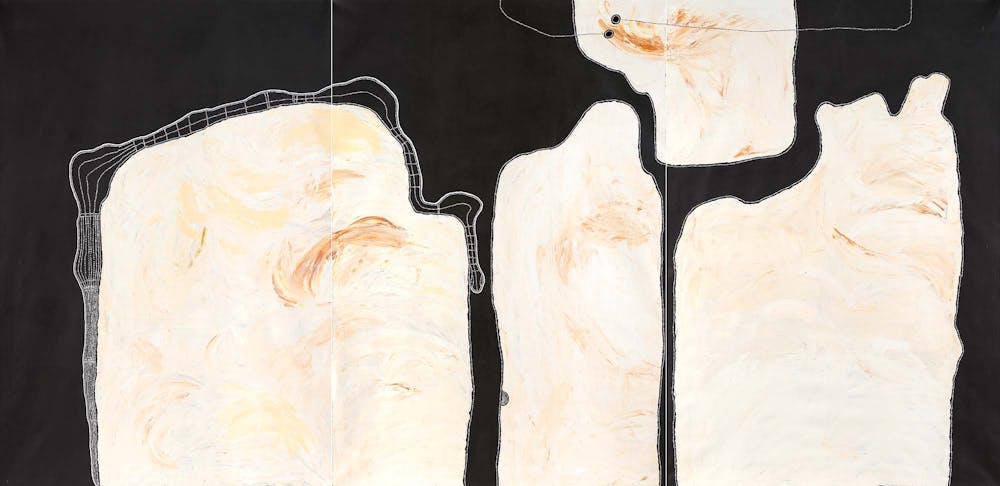 Timo Hogan, Pitjantjatjara people, Western Australia, born Kalgoorlie, Western Australia 1973, Lake Baker, 2021, Tjuntjuntjara, Western Australia, synthetic polymer paint on linen, three panels, 300.0 x 200.0 cm (each panel)
© Timothy Hogan/Spinifex Arts Project, photo: Grant Hancock
Timo Hogan, Pitjantjatjara people, Western Australia, born Kalgoorlie, Western Australia 1973, Lake Baker, 2021, Tjuntjuntjara, Western Australia, synthetic polymer paint on linen, three panels, 300.0 x 200.0 cm (each panel)
© Timothy Hogan/Spinifex Arts Project, photo: Grant Hancock
Challenging perceptions
Angelina Karadada Boona’s changing tones of Wanjina images take on an other-worldly manifestation, while Barkindji artist Kent Morris’s immersive and poetic video plays with geometric designs that rotate, segment and mirror ceremonial markings on bodies and trees.
 Angelina Karadada Boona, Wunambal people, Western Australia, born Kalumburu, Western Australia 1967, Wandjina Emerging II, 2020, Kalumburu, Western Australia, white gum sap and earth pigments on paper, 37.8 x 29.0 cm,
© Angelina Karadada Boona/Kira Kiro Artists/Waringarri Aboriginal Arts, photo: Sarah Duguid
Angelina Karadada Boona, Wunambal people, Western Australia, born Kalumburu, Western Australia 1967, Wandjina Emerging II, 2020, Kalumburu, Western Australia, white gum sap and earth pigments on paper, 37.8 x 29.0 cm,
© Angelina Karadada Boona/Kira Kiro Artists/Waringarri Aboriginal Arts, photo: Sarah Duguid
Artists from Irrunytju use abandoned oil sumps and pram wheels to make a playful series of cars and buses in their Mutaka (motor car) project.
Iltja Ntjarra Many Hands artists respond to the life-changing pipeline built to convey water from Kuprilya Springs to Ntaria (Hermannsburg) – depicted in Albert Namatjira’s pokerwork Boomerang (1935) – in a lively series of contemporary watercolours.
Tiwi artists fill yet another space with a mass hang of 145 prints in Tiwi papers, an undeniable statement of the strength of culture.
 Installation view: Tarnanthi 2021, featuring works by Minyma Kutjara artists.
Art Gallery of South Australia, Adelaide. Photo: Saul Steed
Installation view: Tarnanthi 2021, featuring works by Minyma Kutjara artists.
Art Gallery of South Australia, Adelaide. Photo: Saul Steed
Tarnanthi is full of surprises. Kaylene Whiskey’s cheeky take, in video and painting, on the cautionary tale of the Seven Sisters, with a cast from Dolly Parton to Tina Turner, sums up the energy and vitality of all the work on show.
Contemporary Aboriginal and Torres Strait Islander art has morphed from a revolutionary art movement, to the realm of the unexpected. Experimentation rules in the innovation, energy and depth of the work shown.
Tarnanthi, true to its philosophy, enables artists to challenge perceptions.
Tarnanthi: Festival of Contemporary Aboriginal and Torres Straits Islander Art is at the Art Gallery of South Australia until 30 January 2022. 24 participating galleries across Adelaide and South Australia are also showing exhibitions as part of Tarnanthi.
Authors: Catherine Speck, Professorial Fellow (Honorary), The University of Melbourne

















