

Tough carbon dioxide car emissions ceilings could get us well on the road to net-zero
- Written by Marion Terrill, Transport and Cities Program Director, Grattan Institute
The federal government’s mantra of “technology, not taxes” has left it with few options to easily reduce carbon emissions.
In many sectors of the economy, it’s a recipe for disaster — a vague slogan that keeps us waiting.
But for all its flaws, relying on technology points us in the right direction in at least one field — reducing emissions from cars.
Light vehicles are responsible for 11% of Australia’s carbon emissions.
As it stands, Australia is way behind the pack. The lowest-emitting variants of the top-selling models in Australia are more emissions-intensive than the models available overseas.
The average US passenger light vehicle is more than 100kg heavier than the average Australian light vehicle and has 30kW more power. Yet on average US vehicles emit 5 grams less carbon dioxide per kilometre travelled.
Emissions ceilings are common worldwide
A new Grattan Institute report recommends Australia quickly move to catch up to mainstream international practice.
Eighty per cent of the world imposes a carbon dioxide emissions standard, or ceiling, on new light vehicles, applied across the offering of each manufacturer.
The US, the UK and Europe all have ceilings that tighten over time, bringing down average emissions. If manufacturers breach the ceiling, they face fines.
Read more: Top economists call for measures to speed the switch to electric cars
Australia has no such standard, although it regulates other pollutants including nitrogen oxides and particulate emissions, but to a weaker standard than much of the rest of the world because our petrol is of poorer quality.
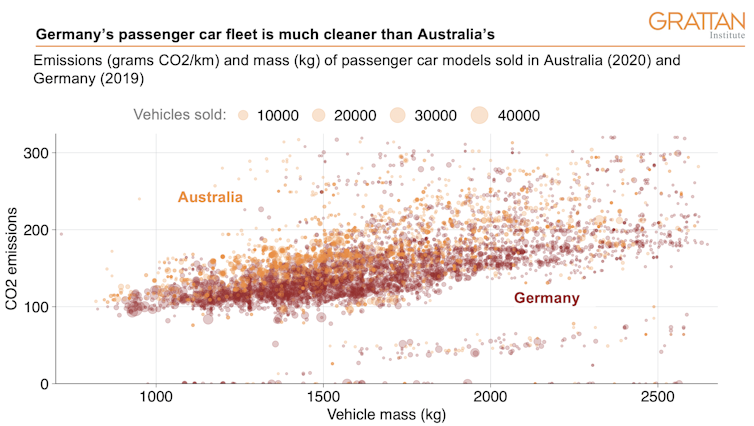
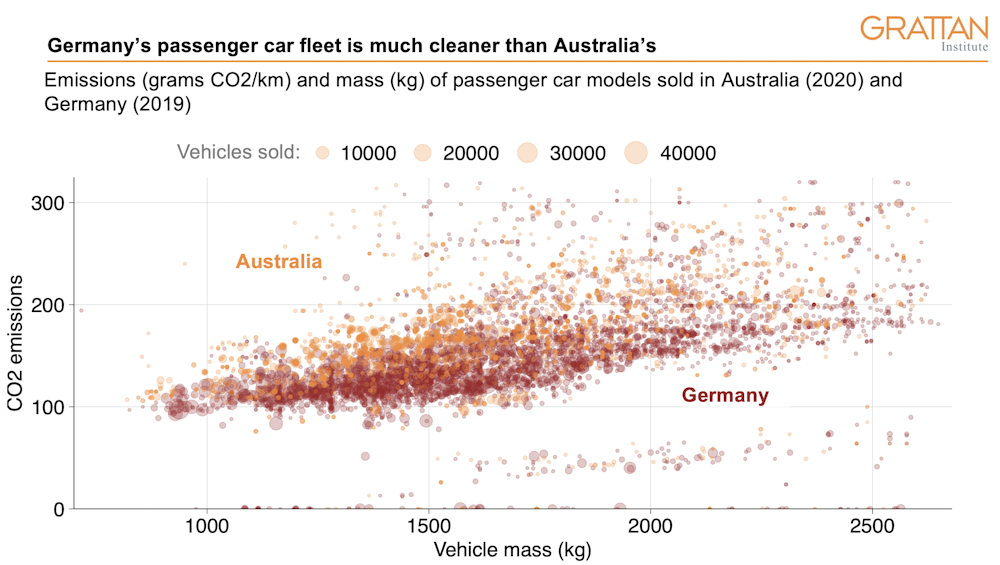
Laboratory tests in 2015 found the average new vehicle sold in Australia emitted 184 grams of carbon dioxide per kilometre driven. More than five years on, little has changed – in 2020 the average new vehicle sold emitted 180 grams per kilometre driven.
That’s much higher than in comparable countries. New passenger cars sold in Germany, for example, are similar to Australia’s in weight, yet emit significantly less carbon dioxide per kilometre.
 It would save drivers money
The change would leave drivers better off financially. It would probably increase the price of new vehicles slightly, but make them cheaper to run. The average Australian driver would save almost A$1,000 within five years of buying a new car.
It wouldn’t mean the end of the weekend. But it would change the balance of options available. There would be more low-emissions and zero-emissions vehicles, and a smaller offering of higher-emitting vehicles.
In the leadup to 2035 as more people switched to electric vehicles, there would be space under the ceiling for manufacturers to sell higher-emitting varieties to those who need or prefer them.
Read more:
China is on course to build the best cars in the world
In the UK, where there is a strong ceiling, consumers can choose from about 130 electric vehicle models across a range of prices.
Here, there are just 31 models available, few affordable to everyday Australians.
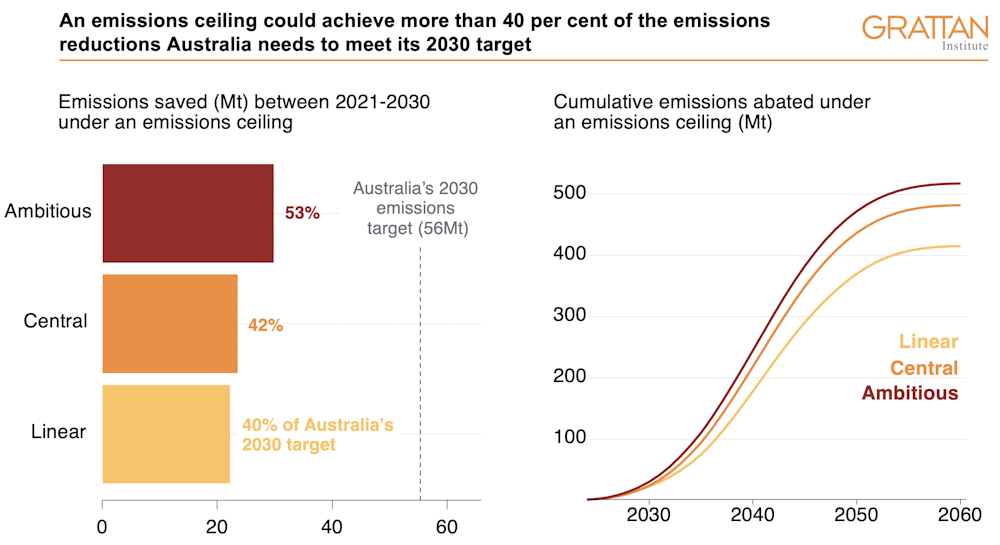
What we are proposing is a meaningful step towards net-zero at negligible cost to taxpayers. It would save drivers money, increase the range of cars on offer and cost the government little more than the cost of administering the scheme.
Authors: Marion Terrill, Transport and Cities Program Director, Grattan Institute
It would save drivers money
The change would leave drivers better off financially. It would probably increase the price of new vehicles slightly, but make them cheaper to run. The average Australian driver would save almost A$1,000 within five years of buying a new car.
It wouldn’t mean the end of the weekend. But it would change the balance of options available. There would be more low-emissions and zero-emissions vehicles, and a smaller offering of higher-emitting vehicles.
In the leadup to 2035 as more people switched to electric vehicles, there would be space under the ceiling for manufacturers to sell higher-emitting varieties to those who need or prefer them.
Read more:
China is on course to build the best cars in the world
In the UK, where there is a strong ceiling, consumers can choose from about 130 electric vehicle models across a range of prices.
Here, there are just 31 models available, few affordable to everyday Australians.
What we are proposing is a meaningful step towards net-zero at negligible cost to taxpayers. It would save drivers money, increase the range of cars on offer and cost the government little more than the cost of administering the scheme.
Authors: Marion Terrill, Transport and Cities Program Director, Grattan Institute 
















