

How Māori knowledge could help New Zealanders turn their concern for the environment into action
- Written by Scott Burnett, Research assistant, Massey University
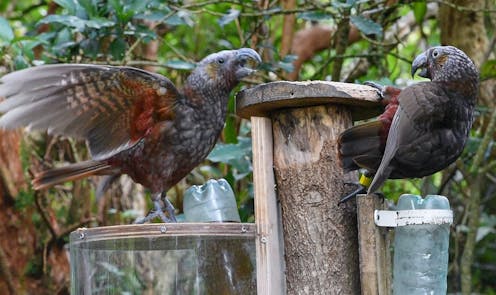
As world leaders continue negotiations at the COP26 climate summit in Glasgow, several agreements reached so far have acknowledged the connection between climate change and the global loss of biodiversity.
Half a world away, we might feel somewhat smug. Almost a third of Aotearoa New Zealand is protected as conservation land, but we nevertheless have the highest number of threatened species worldwide, with 79% of birds, bats, reptiles and frogs at risk of or threatened with extinction.
The threat to wildlife is entirely due to human impacts, including the introduction of mammal predators and land-use practices that threaten Indigenous biodiversity.
Despite more than 40,000 people in 600 community conservation groups working throughout the country, these efforts and gains are tenuous, not yet arresting the decline in biodiversity.
Surveys show New Zealanders are increasingly aware of the state of our environment, but knowledge on its own does not spur action.
We suggest mātauranga Māori, a traditional system of understanding the natural world, could help take people from awareness to action.
Te Mana o te Taiao is New Zealand’s national biodiversity strategy and lays out conservation priorities for the next three decades. It promotes the braiding of Western science and mātauranga Māori and emphasises a focus on people as much as the environment.
Regular surveys show a marked shift in public perception of the state of New Zealand’s environment. Twenty years ago, a majority believed the environment was in good health, but today, most people believe it is in poor health.
The survey also asks if respondents had participated in environmental advocacy or volunteer work, but the percentage of people who have has remained steady over two decades.
Read more: Why Indigenous knowledge should be an essential part of how we govern the world's oceans
From awareness to action
People feel increasingly disconnected from the natural world for a few key reasons, including:
a rise of individualism and the erosion of community
distraction by technology and entertainment
increasing urbanisation and inequality leading to an “extinction of experience”
poorer urban populations with fewer opportunities to connect with nature.
Awareness alone does not spur action, but research shows people who feel more connected with nature have a stronger sense of environmental responsibility.
If we wish to ensure the survival of our Indigenous biodiversity, we need to ask how we get from awareness to action. Indigenous peoples have played a strong role in conserving biodiversity over many centuries, and mātauranga Māori could hold some answers.
Read more: Indigenous knowledge and the persistence of the 'wilderness' myth
There are three main strands to how mātauranga Māori can turn knowledge into action.
Ecological science has increased our understanding of the inter-connectedness of ecosystems and has brought us closer to a mātauranga Māori concept of human relationships with the natural world. Within this concept, if the environment is not in good health, people can’t be in good health either. Seeing ourselves as inter-connected and inter-dependent with the natural world engenders reciprocity and care for the natural world.
By embedding values and beliefs into facts, knowledge becomes more memorable, meaningful and relatable. This helps people to form an identity of belonging within the natural world and a connection to place. We are far more likely to care for a place if we feel a connection to it.
Awareness of our inter-connections and dependence on the natural world helps us see the dissonance between stewardship and practices that threaten other species.
Community conservation as the answer
Community conservation groups could play a central role in achieving New Zealand’s national biodiversity strategy through use of mātauranga Māori concepts.
Ecosanctuaries like Zealandia already provide opportunities to connect with the natural world, through education and volunteering. There are more than 80 sanctuaries throughout the country, providing opportunities for people to acquaint themselves with the natural world and become involved in conservation activities.
Ecosanctuaries demonstrate environmental restoration is possible and conservation is everyone’s responsibility, not just the role of the state. They effectively build a constituency for conservation within the community.
Zealandia identifies its role as an enabler of transformation in the way people engage with the natural world. Their 20-year strategy emphasises mātauranga Māori and inspiring change through shared passion.
The biodiversity strategy is fundamentally about people […] the task that we have in front of us is fundamentally about changing the way people value the natural world.
Māori continually straddle two worlds, navigating the Māori world view and the Tauiwi (Western) world. Non-Māori rarely step into the Māori world, and its unfamiliarity can cause discomfort.
Incorporating mātauranga Māori should not mean appropriating knowledge from Māori or glossing over legitimate Māori grievances. Instead, being able to hold two world views can be likened to gaining binocular vision – people discern more depth and detail than by seeing the world through a single lens.
To maintain and improve our biodiversity, we need to practise conservation everywhere rather than only in conservation spaces. Embracing mātauranga Māori concepts could help New Zealanders to develop an identity of ecological belonging to become better kaitiaki (guardians) of our biodiversity.
This article is based on a presentation given at a Sanctuaries of New Zealand workshop earlier this year on the theme of iwi and conservation.
Authors: Scott Burnett, Research assistant, Massey University

















