

Who's the unsung architect behind Labor's climate plans? A retiring Coalition minister
- Written by Peter Martin, Visiting Fellow, Crawford School of Public Policy, Australian National University
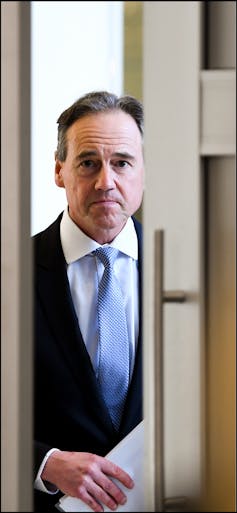
The architect of the ingenious mechanism at the heart of Labor’s plan to sharply cut carbon emissions is about to leave the parliament.
Throughout the pandemic, Greg Hunt has been best known as Australia’s health minister. But before that, when the Coalition was swept to office in 2013, he became Tony Abbott’s environment minister, charged with destroying Labor’s carbon tax.
(I’m calling it a “carbon tax” here to distinguish it from the mechanism Greg Hunt quietly slipped in to replace it, and also because the Bureau of Statistics decided it was a tax when it recorded it as a tax in the national accounts.)
Labor’s scheme taxed (or “charged” if you must) each big emitter in the industries covered A$23 for each tonne of carbon dioxide or equivalent they pumped into the atmosphere.
There were all sorts of problems with Labor’s scheme, problems Hunt was keenly aware of, having co-authored a prize-winning research paper on carbon taxes at university and having been immersed in the topic when Labor was last in power, as the Coalition’s environment spokesman under leaders Nelson, Turnbull and Abbott.
One big problem was that Australian exporters (of products such as steel and aluminum) would be placed at a disadvantage by having to pay the tax, while their overseas competitors did not.
Steel and aluminium would still be sold to the eventual customers but from a country other than Australia that didn’t charge the tax, a phenomenon known as carbon leakage.
Labor’s carbon tax had problems
And not only exporters. Australian producers of products for local consumption stood to suffer in the same way, losing sales to foreign suppliers who weren’t charged the tax, a problem the European Union is trying to fix at the moment by imposing a so-called Carbon Border Adjustment Mechanism, or “carbon tariff”.
Labor’s solution was to grant firms in “emissions-intensive trade-exposed” sectors free permits to the tune of 94.5% of industry average carbon costs in the first year (and less exposed firms free permits to cover 66% of costs), a gift that would be wound back 1.3% each year.
Another solution, being pursued by Hunt as he took soundings while in opposition, was to limit Australian facilities to emitting no more than they are now.
Over time the entitlement could be wound back.
But the problem was it would stop firms expanding.
BHP, for instance, might get a big contract that required it to double its output of steel but be unable to fulfil it without halving its emissions intensity – the amount it emitted per unit of steel produced.
Hitting on a baseline winner
Hunt’s solution, the one he and independent senator Nick Xenophon slipped into legislation being drawn up to replace the carbon tax with direct grants, was to set up “baselines” for each large emitter.
To be determined by the Clean Energy Regulator in accordance with rules set by the minister and disallowable by parliament, the baselines set the maximum amount each big plant can emit without being in breach and paying penalties.
Importantly, the baselines were to be calculated on the basis of previous emissions. Facilities were to be allowed to emit what they had, but no more.
More importantly, plants could have their baselines calculated on the basis of emissions intensity – the amount emitted per unit of production, which would mean they would be able to expand so long as they didn’t emit more per unit.
More importantly still, the Clean Energy Regulator is in the process of converting almost all baselines to emissions intensity baselines.
All Labor has to do, and what intends to do, is to make use of the mechanism Hunt and Xenophon put in place.
Business is backing baselines
Each facility that emits more than 100,000 tonnes of carbon dioxide equivalent per year – 215 of them – is subject to a baseline.
What Labor has pledged to do, and it is backed by the Business Council, is to get the Clean Energy Regulator to wind down those baselines “predictably and gradually over time” to support the transition to net zero.
Businesses that are already reducing their emissions want this, because they want other firms to be made to do the same.
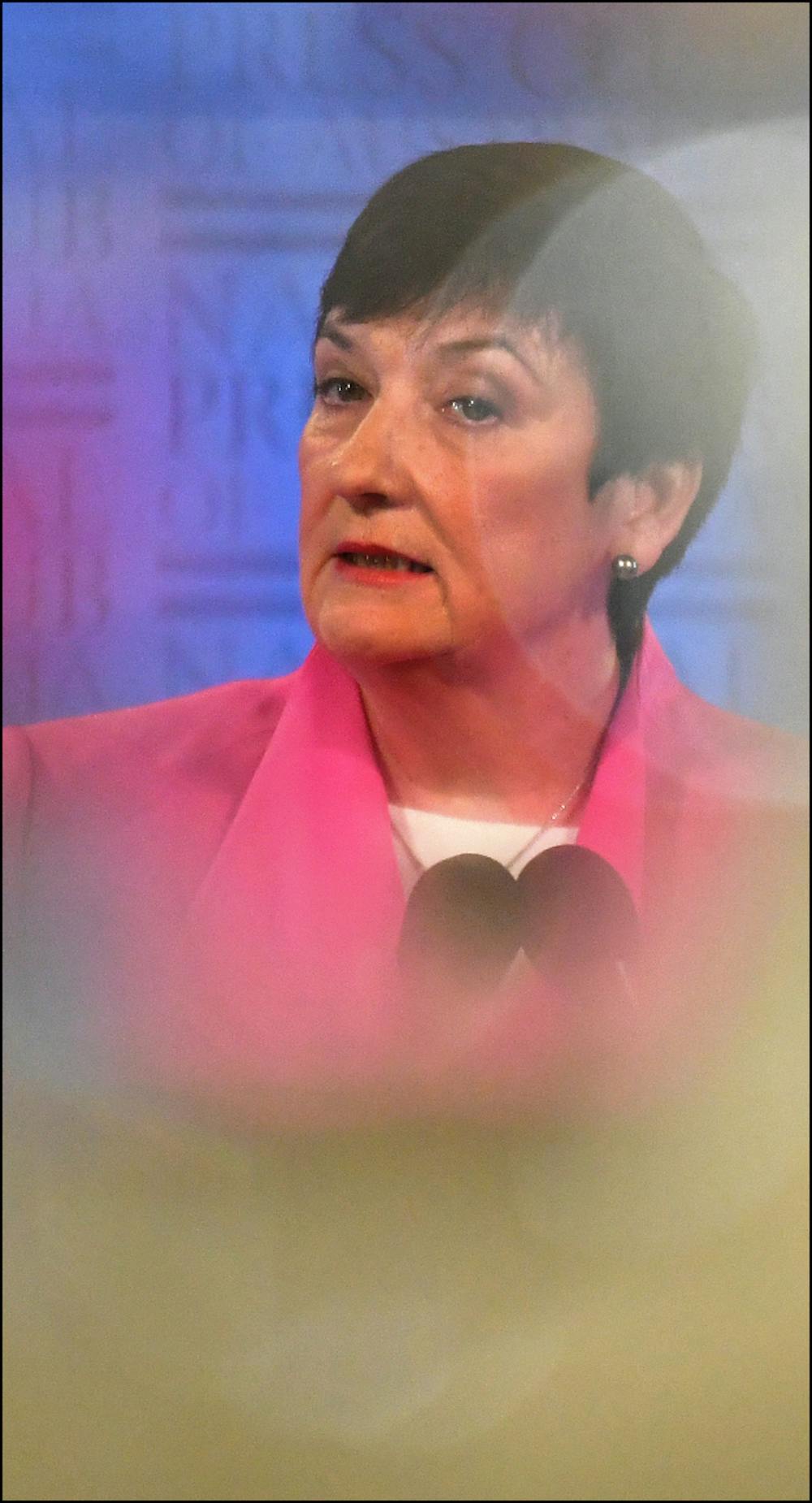 Business Council chief Jennifer Westacott backs tightened baselines.
Mick Tsikas/AAP
Business Council chief Jennifer Westacott backs tightened baselines.
Mick Tsikas/AAP
The beauty of the mechanism set up on Abbott’s watch is that each facility, each “gas well, aluminium smelter and coal line” as Labor’s Chris Bowen puts it, will have its tightened baseline calculated individually.
Each will be asked to do no more than what is needed after considering what it can cope with.
Within minutes of Friday’s announcement, Energy Minister Angus Taylor labelled it “a sneaky new carbon tax on agriculture, mining and transport”, but it is better described as a system of guidelines and penalties, one legislated by Taylor’s side of politics.
Quite a lot will be needed. Labor’s modelling, released on Friday, didn’t spell out what would be needed to get emissions to net-zero by 2050, but the Coalition’s modelling, released in November, did.
No matter what reasonable assumptions the model included, including “global technology trends”, it couldn’t get all the way to net-zero by 2050.
So the Coalition’s modellers added in something fanciful which they named “further technology breakthroughs” to get the remaining 15%.
Greg Hunt retires as health minister and retires from parliament at the next election. He has set us on the path to getting where we will need to be.
Authors: Peter Martin, Visiting Fellow, Crawford School of Public Policy, Australian National University

















