Modern Australian
The Times

Amid global crisis, how can universities be regenerated to serve the common good?

  • Written by Kristen Lyons, Professor Environment and Development Sociology, The University of Queensland
Amid global crisis, how can universities be regenerated to serve the common good?

Universities are among the many institutions that sustain settler colonialism in Australia. The public university system was, and continues, to be part of the state’s investment in its own future.

Universities emerged in Australia during the mid-19th and early 20th centuries against a backdrop of frontier violence and dispossession of First Nations’ lands, labour and relationships. While nature was privatised and commodified, universities grew in scale and influence. Knowledge hierarchies that perpetuate racial, class and gender divides were normalised.

Read more: Five shifts to decolonise ecological science – or any field of knowledge

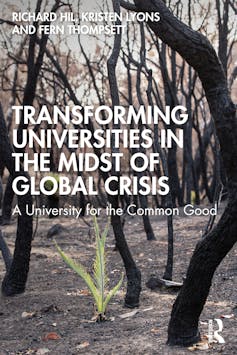
Cover of Transforming Universities in the Midst of Global Crisis, a book by the authors
Routledge Our new book, Transforming Universities in the Midst of Global Crisis: A University for the Common Good, scrutinises the role of universities today. We argue these institutions, and indeed the entire higher education sector, must be considered as not only in crisis – though they clearly are – but also as drivers of crisis. Universities have become fully integrated into the neoliberal economy. They fixate on vocational “job-ready” curriculums and commercial research agendas. They enable industries built on extracting natural resources and thereby support endless economic growth. The problems arising from this system are destructive and life-threatening. Climate chaos, biodiversity destruction, the COVID-19 pandemic, the democracy recession and deepening socio-economic inequalities have reshaped our very ways of relating, being and knowing. Transforming universities therefore demands we seek out ideas, practices and values beyond the university’s walls. Only then will universities be capable of responding to interconnected ecological, health and social challenges. Drawing from case studies and examples around the world, we show how this transformation is possible - and, indeed, already under way. Read more: After coronavirus, universities must collaborate with communities to support social transition Crisis as a catalyst for change In the 21st century, multiple mega-crises have ravaged ecological systems, human lives and livelihoods. A small but powerful lobby of political interests continues to deny, downplay or divert attention from such problems. Yet turning to face these challenges may shed light on solutions. US scholar Lauren Berlant suggested: At some crisis times like this one politics is defined by a collectively held sense that a glitch has appeared in the reproduction of life […] A glitch is also the revelation of an infrastructural failure.“ But glitches can – and must – provide the impetus to bring alternative worlds into being. For universities, the challenge now is to situate human relations and responsibilities in the web of life on Earth. The Ecoversities Alliance, for example, is working for a change of ecological consciousness. This involves a shift away from the pursuit of private interest and towards ecological integrity and the common good. The goal is to orient universities towards "service of our diverse ecologies, cultures, economies, spiritualities and life within our planetary home”. Another challenge is to decolonise universities. The Dechinta Bush University in the Northwest Territories in Canada provides an exemplar. The university has embraced Indigenous land-based practices and values. In this context, Indigenous pedagogies and practices refuse the colonial enclosures of traditional “education-based” institutions. In countless other ways, in Australia and elsewhere, Indigenous scholars, educators and activists are leading decolonising, anti-racist and ecological governance agendas. Read more: How a university can embed Indigenous knowledge into the curriculum and why it matters What will it take to transform universities? Universities, of course, cannot be transformed in isolation from the wider world. Change must engage with the values, practices and leadership of progressive movements. Examples include Black Lives Matter, #MeToo and movements for Indigenous sovereignty and treaty. Our book documents the possibilities for radically transforming the political and economic structures that universities are built on and continue to uphold. The change agenda needs to be bold, not piecemeal. We showcase activities and interventions that move beyond superficial reformism to more radical possibilities for change. Among many other things, we call for: more democratic university governance a return to the idea of the public university (as set out in state and territory legislation) decoupling from market-oriented extractivist ideas of growth resistance to “job-ready” graduate tropes genuine and inclusive communities of learning centring Indigenous rights and knowledges in curriculums and research agendas fostering cultures of appreciation, generosity and collaboration as opposed to competition, individualism and hierarchy. Read more: Honouring Te Tiriti means ‘getting into the stream together’ — so this vice-chancellor has become a student again Working for a just and resilient future These transformations are urgent if universities are to be relevant to meeting the challenges of the 21st century. A university for the common good could enable human society to connect with more-than-human communities and operate within the limits of nature. By ensuring accountability to all communities, human and more-than-human, such a university could build more sustainable and just worlds. Vanessa de Oliveira Andreotti and colleagues from the Gesturing Towards Decolonial Futures collective assert that only through the decay of the modern university will regeneration be possible. If so, the challenge for those committed to the future of the university is to ensure that, through its dwindling, a new regenerative approach – within and beyond its walls – flourishes. Authors: Kristen Lyons, Professor Environment and Development Sociology, The University of Queensland

Read more https://theconversation.com/amid-global-crisis-how-can-universities-be-regenerated-to-serve-the-common-good-172495

Hoteliers Look to Clever Value Adds to Increase Revenue

The Australian hospitality industry is still in recovery mode after a notoriously rough patch in recent years. While there has been a post-COVID tra...

Moving to Queensland? Here’s How to Prep Your Car for the Big Move North

There’s no sign of the northern migration slowing down, with thousands of southerners fleeing from chaotic lifestyles and cooler climates for a brig...

Diesel Shortage to Impact Trades and Contractors

Strait of Hormuz blockage affecting all major parts of trades and construction Trades and construction across residential, commercial and industria...

Why Holiday Home Owners Turn to Rental Management Agents

The Allure — and the Reality — of Renting Out Your Property Owning a holiday home is a dream for many Australians. Whether it's a beachside sha...

Why Finding Reliable Doctors In Bundoora Is Important For Long-Term Health

Access to quality healthcare plays an important role in maintaining overall wellbeing and managing health concerns early. Trusted Doctors in Bundoor...

Understanding the Different Types of Car Services: Minor vs Major

When it comes to car maintenance, one of the most important things every vehicle owner should understand is the difference between a minor and a maj...

How Superannuation and TPD Insurance Work Together

Superannuation is an essential part of financial planning in Australia. It is designed to provide individuals with income during retirement, helping...

Tiny Towns funding granted for Mt Hotham and Mt Buller upgrades

Alpine Resorts Victoria (ARV) has welcomed funding support from the Victorian Government’s  Tiny Towns Fund, with both Mt Hotham and Mt Buller se...

Locksmith Services: Why Professional Security Solutions Matter More Than Ever

Security is a critical concern for homeowners, businesses, and vehicle owners alike. Whether it involves protecting a property, replacing damaged lo...

Why Tooth Fillings Are Important For Protecting Damaged Teeth

Cavities and minor tooth damage are common dental problems that can worsen if left untreated. Professional tooth fillings help restore damaged teeth, ...

The Connection Between Visibility and Driver Confidence

Operating a vehicle safely requires an immediate, uncompromised stream of visual information from the surrounding road environment. A driver's decis...

Important Things To Know Before Starting An SMSF Setup

Planning for retirement requires careful financial decisions, and many Australians are now looking for more direct control over how their superannua...

Why Retail Cleaning Plays a Key Role in Customer Experience and Business Success

Professional retail cleaning services are an essential part of maintaining a welcoming, safe, and professional environment for customers and staff...

Simple Ways to Make a Commercial Property More Appealing to Buyers

Selling or leasing a commercial property isn’t just about listing the square metres, taking a few photos and waiting for the right person to appea...

What Café Owners Should Know Before Upgrading Their Display Setup

A café display fridge does a lot more than keep cakes cold and sandwiches fresh. It quietly shapes the way customers browse, the way staff move beh...

Creating a Backyard That Feels Comfortable All Year Round

A great backyard doesn’t need to be huge, expensive or perfectly styled. Most of the time, the spaces people actually use are the ones that feel e...

How Homeowners Can Make Smarter Energy Decisions Before Upgrading

Energy upgrades used to feel like something you only looked into after a power bill gave you a nasty surprise. These days, though, more homeowners a...

Why Retail CX Breaks During Peak Sales Events and How to Prevent It

Retail customer experience has become one of the most important drivers of revenue growth, especially during high-intensity sales periods. However, ev...