

A medical scan reveals the secrets of New Zealand's extinct marine reptiles, almost 150 years after the fossils' discovery
- Written by Paul Scofield, Adjunct professor, University of Canterbury
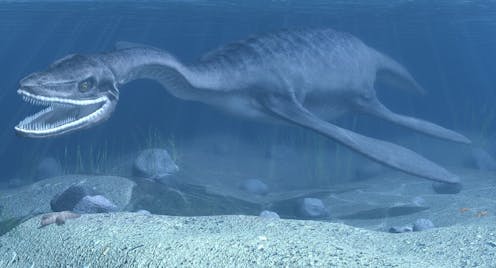
New Zealand’s fossil record of land dinosaurs is poor, with just a few bones, but the collection of ancient extinct marine reptiles is remarkable, including shark-like mosasaurs and long-necked plesiosaurs.
Plesiosaurs first appeared in the fossil record around 200 million years ago and died off, alongside dinosaurs, 66 million years ago.
They are best known for the fanciful but appealing idea, suggested by British scientist Sir Peter Scott, that the fabled Loch Ness monster was in fact a plesiosaur that somehow outlasted all other giant reptiles and remained undetected throughout human history.
In a recent research project, we used medical CT imaging to scan plesiosaur fossils collected in New Zealand back in 1872.
The scans reveal a new level of detail, confirming that plesiosaurs swam mostly with their heads down, in contrast to the Loch Ness creature, and showing a close link between the New Zealand fossils and South American specimens from 70 million years ago.
Read more: Newly discovered mass extinction event triggered the dawn of the dinosaurs
Beds of saurian fossils
In 1872, the Canterbury Museum director Julius von Haast employed self-taught Scottish geologist Alexander McKay to undertake geological surveys and collect fossils.
Von Haast had heard that explorer and amateur scientist Thomas Cockburn-Hood had discovered significant reptile fossils in the upper Waipara Gorge, in the Canterbury region. Cockburn-Hood described the area as “the saurian beds”, and we now know the marine sediments preserved fossils from 70 million years ago.
McKay went to the Waipara during the winter of 1872, and he was spectacularly successful, collecting several partial skeletons of marine reptiles and hundreds of bones.
Among this material were two rather unimpressive, compressed, semi-spherical groupings of bones. These sat in Canterbury Museum’s storerooms, unidentified and stuck inside the concretions they were excavated in, for over 120 years.
South American link
It would take until the late 1990s to realise the importance of the fossil. Museum preparator and famous fossil collector Al Mannering and his colleagues prepared these two unloved fossils, chipping away the stone to reveal the bones contained in the rocks.
Visiting English scientist Arthur Cruickshank believed these fossils were remarkable and possibly similar to plesiosaur material he had seen from South America.
In 2004, Canterbury Museum’s geology curator Norton Hiller and Mannering published a paper, in which they suggested the two groups of bones, the size of soccer balls, were actually the two sides of the skull of the same animal — one remarkably similar to plesiosaurs from South America.
Read more: Ammonite: the remarkable real science of Mary Anning and her fossils
In 2014, internationally renowned marine reptile experts Rodrigo Otero (Universidad de Chile) and Jose O’Gorman (Argentina’s Museo de La Plata) visited New Zealand and examined the specimens. They concluded Hiller and Mannering were correct. The two halves were indeed from the same animal and the Waipara fossil was most similar to a group of plesiosaurs hitherto only known from Chile and Argentina.
They described the Canterbury Museum specimens fully and gave them the scientific name Alexandronectes zealandiensis, Latin for Alexander’s swimmer from Zealandia.
A hospital checkup
Science and technology move on and O’Gorman’s team wanted to confirm the evolutionary relationships of Alexandronectes zealandiensis, using the latest technologies.
In 2019, I took the two fossils to hospital to be CT scanned, using the latest dual energy CT scanners at St George’s radiology in Christchurch. The results were extraordinary, showing previously unseen features of the anatomy.
Without the CT scanning technology, these details could only have been seen by destroying the fossil. We examined the creature’s inner ear and concluded, based on the orientation of the ear, that it maintained a posture where its head was habitually held either perpendicular to the body or just slightly below the body (not like Loch Ness monster fans would maintain, up in the air like a sock puppet).
We also saw a feature known as the stapes, also unseen in plesiosaurs up until then. The stapes is a small umbrella-shaped bone in the middle ear which transmits vibrations from the eardrum to the inner ear.
This work allowed us to conclude that Alexandronectes zealandiensis was an unusual plesiosaur.
It belonged to a unique group of southern-hemisphere plesiosaurs now called the Aristonectinae. This group was part of the Plesiosaur family known as elasmosaurs. They were the last experiment in plesiosaur evolution, with the longest necks of all plesiosaurs.
Authors: Paul Scofield, Adjunct professor, University of Canterbury


















