

Modern Australian
The Times

here's how rainbowfish survive in Australia's scorching desert

  • Written by Catherine R. M. Attard, Lecturer in Molecular Ecology, Flinders University
here's how rainbowfish survive in Australia's scorching desert

A trip into central Australia involves packing your 4WD to the brim with survival gear, water and food. Yet fish have managed to persist in that parched landscape for thousands of years – how do they do it?

We at the Flinders Molecular Ecology Lab went about finding out. Our recent research examined rainbowfish in Australia, to discover how they hold onto life in isolated pockets of water in the desert.

Pockets of water in the desert can only hold small fish populations. A small population means a small gene pool – which can lead to inbreeding and poor health, as we sometimes see in endangered species.

But we found even small populations can adapt to the harsh environments of water holes and small creeks. Life finds a way – even in one of the most extreme and unpredictable environments on Earth.

Prospering in central Australia

Native desert rainbowfish (Melanotaenia splendida tatei) live in the deserts of central Australia. They grow to about 9cm and are usually silver and iridescent, with a yellow and green chequered pattern on the fins.

Desert rainbowfish populations live in slow-flowing and still habitats, including impermanent rivers, waterholes, lakes, flowing bores and stock dams.

Their populations fluctuate during boom-bust cycles. During rare flooding events in the desert, rainbowfish breed in large numbers and spread along temporary streams and floodwaters.

Read more: Australia's smallest fish among 22 at risk of extinction within two decades

Desert rainbowfish
Desert rainbowfish live in slow-flowing and still habitats. Gunther Schmida

Our findings

Our research sought to determine how rainbowfish populations persist in desert regions of central Australia, and whether their genomes show evidence of adaptation to the local harsh conditions.

We collected 344 desert rainbowfish from 18 rivers and waterholes from across the vast and arid Lake Eyre Basin, and from semi-arid regions of the Murray-Darling Basin.

We then compared the variation in the genomes of these fish with data from satellite images about the presence of surface water in central Australia.

We found that natural selection in rainbowfish is stronger in regions of the desert that have drier conditions. Fish from the very arid western region of central Australia adapt differently to dry conditions than those from the semi-arid eastern region.

We also found these gene variations are carried by the fish as they disperse during the floods. The fish that were pre-adapted to very harsh conditions retreated with the floodwaters to wait out the often extended drought periods in small, isolated waterholes.

This suggests genes adapted to the most arid conditions may help small populations to persist in harsh environments. These adaptations might also help the species persist in future climates, which are expected to become drier and with more extreme events.

The most intriguing adaptive difference involved a mutation in a gene coding which leads to some fish producing a slightly different guanine nucleotide-binding protein. Fish use these proteins for taste and smell, to detect salinity and water flow, and to control light sensitivity for vision.

Rainbowfish in Central Australia may survive the harsh conditions because of this difference in the protein and other adaptations. This would improve their ability to sense the environment and how it varies across seasons.

The variation can be compared to the recent Omicron COVID-19 variant. Research has found mutations in the spike protein in some variants may aid its spread among humans.

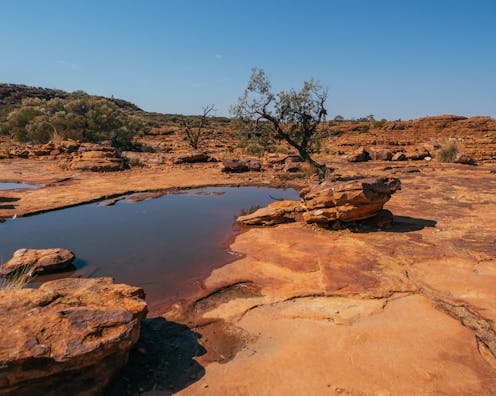
shallow pool in desert landscape
Genes adapted to the most arid conditions may help small populations persist in harsh environments. Chris Brauer

Looking ahead

Our research found the genetic variation can be maintained in small rainbowfish populations to allow the species to survive in the desert.

The findings suggest that the population size of desert rainbowfish, at least during very dry periods of the year, is less than that commonly thought necessary in nature for species conservation and for adaptation to future climate changes. This turns on its head traditional thinking that small populations are evolutionary dead ends.

As climate change worsens, our findings highlight the importance of conserving natural river flows to enable freshwater species to respond and adapt.

Read more: 2021 was one of the hottest years on record – and it could also be the coldest we'll ever see again

Authors: Catherine R. M. Attard, Lecturer in Molecular Ecology, Flinders University

Read more https://theconversation.com/life-finds-a-way-heres-how-rainbowfish-survive-in-australias-scorching-desert-173590

Your Baby's First Year: A Local Guide to Feeding, Sleep, and When to Get Extra Support

Ask ten parents in a Brisbane mothers' group how their baby is feeding or sleeping, and expect ten different answers.  Someone's baby sleeps throu...

Kitchen and Laundry Makeover Ideas That Don't Require a Full Renovation

Full kitchen renos are expensive — and most people don't actually need one.  They need the kitchen to stop looking like it's stuck in 2009, or t...

How Technology Is Reshaping the Modern Australian Commercial Kitchen

The commercial kitchen has always been shaped by technology. Refrigeration changed how ingredients could be stored, modern ventilation transformed k...

The Number on a Roller Blind Fabric That Nobody Explains

Somewhere in the fabric book, next to the colour name, there is a percentage. Three per cent. Five per cent. Ten per cent. Nobody explains it, most c...

What’s Trending in Men’s Jewellery This Father’s Day!

Finding a Father’s Day gift that feels personal, stylish and genuinely wearable is not always easy. While socks and novelty mugs have traditionall...

Road Signs: Understanding Their Role in Clear and Effective Signage

Effective signage and display hardware can help businesses communicate information, promote products and organise customer or visitor movement. Road...

Bottle Label Printing: Key Factors to Consider Before Your Next Packaging Run

Effective packaging begins with understanding the product, bottle material, artwork and production requirements when planning bottle label printing. H...

Planning a Long-Distance Move With Interstate Movers Melbourne

Moving between states involves more planning than a typical local relocation. Along with packing and transporting household belongings, you need to...

Understanding the Role of an I/O Controller in Industrial Automation

Modern industrial systems depend on accurate communication between sensors, machines and control systems. An I/O controller can help manage this commu...

How the Right Mining Hose Supports Demanding Operations

Mining environments place considerable demands on equipment used for material transfer, water management and processing. Hoses operating in these co...

Simple Ideas for Making Social Gatherings More Memorable

We have all been to those parties where everyone just stands around the kitchen island, staring at their phones, waiting for someone else to make a mo...

Outdoor Wall Lights: Improving Exterior Lighting Around Your Home

Lighting can influence how a room looks, feels and functions, so the right fitting should be selected according to both appearance and practical req...

Commercial Office Cleaning: Combining Routine Office Cleaning With Melbourne Service

Keeping a workplace clean requires a service that can accommodate everyday tasks as well as the particular needs of the business. Professional comme...

Caravan Sales in Queensland: How to Find the Right Caravan for Sale QLD

Caravan ownership is about more than having somewhere to sleep while travelling. For many Queenslanders, it is one of the best ways to explore regio...

What Sir Walter Buffalo Turf Actually Costs in 2026 (And Why Quotes Vary So Much)

Two quotes landed on a Hills District homeowner's kitchen table last spring for the exact same 80-square-metre backyard. One said $12 a metre. The o...

Nearly 1,300 NSW Hospital Beds Are Occupied By People Who Are Ready To Go Home

1,276 people in NSW hospitals have been medically cleared for discharge but remain in hospital because they're still waiting for NDIS or aged care sup...

National Survey Launched to Measure Operational Impacts of Federal NDIS Policy Reforms

The effects of recent NDIS reforms are beginning to move beyond policy papers and into day to day service delivery. A new national survey is asking ...

Beyond the Nappy Cake: Baby Shower Gifts That Get Used

What new Australian parents unwrap, keep, and quietly thank you for months later. Six weeks after my daughter was born, I did an audit of the baby sh...















