

Once a form of ‘social camouflage’, school uniforms have become impractical and unfair. Why it’s time for a makeover
- Written by Johanna Reidy, Lecturer, Department of Public Health, Wellington School of Medicine, University of Otago
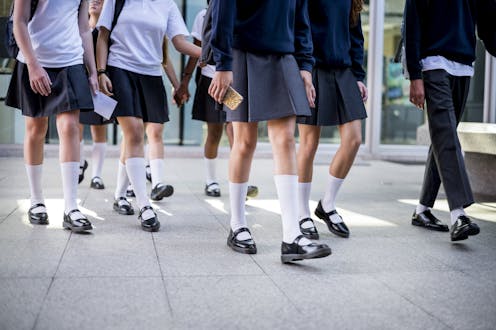
As the start of a new school year looms, school uniforms are being dusted off or new ones bought. At the same time, age-old debates about the pros and cons of school uniforms are being dusted off, too.
But questions about practicality, cost or conformity tend to overshadow the bigger underlying issue of how uniforms – and rules about wearing them – actually affect educational outcomes.
In other words, does wearing (or not wearing) a uniform contribute to students being mentally well, physically comfortable, healthy and active – and therefore better equipped to learn?
After all, academic learning is a key reason children go to school in the first place. Given the heated arguments and the insistence on particular types of garments being worn, we might expect uniforms to directly enhance academic performance.
They don’t. There is no persuasive evidence that school uniforms are among the factors that directly improve learning. However, there is evidence uniforms might indirectly support classroom management – for example, by helping remove distractions so students settle more quickly to their tasks.
Instead of arguing about whether uniforms are good or bad, then, let’s refocus our energy on making better garment designs and fairer school uniform rules, with an eye to supporting educational outcomes.
From equality to equity
Since there’s no direct link between uniforms and academic achievement, why insist on dressing students the same? History provides some of the answer.
In the 19th century, when school uniforms became common alongside compulsory education, a kind of equality was achieved by treating all students the same. Uniforms provided “social camouflage” by removing outward signs of class differences.
One enduring benefit of school uniforms is that they reduce “competitive dressing” by students – the social pressure to wear certain clothes.
Read more: Does wearing a school uniform improve student behavior?
Nowadays, however, the debate about uniforms sidesteps the issue of how treating students the same is not necessarily the same as treating them fairly. In fact, the research highlights a need for equity: to achieve more equal outcomes can require treating students differently.
Logically, if equality and sameness were directly correlated, school uniforms and school uniform policies should have a neutral or positive impact on all students. But this isn’t the case.
Garment design or policies about which garments can be worn when and by whom disadvantage poorer students, girls, religious minorities and gender-diverse students. Together, these student groups make up over half the school population.
Students are not uniform
We know uniforms are less expensive than non-uniform alternatives over a student’s total school career. But the high upfront cost of uniforms can be a significant burden for students from low-income families.
Some students even attend on alternate days because they share a uniform with a sibling, or skip school until they can buy a missing uniform item. It’s a sad irony that the very tool meant to encourage equal access to education has become a barrier for some even before they walk through the school gates.
But beyond the cost, uniform design and policy can directly affect girls’ ability to participate in physical activity or lunchtime play.
Read more: Why do schools want all students to look the same?
At a basic level, boys simply don’t risk flashing their underwear if they bike to school in regulation uniform. By contrast, girls’ uniforms often restrict a full range of movement and inhibit playtime sports or the ability to enjoy the jungle gym.
Studies have shown girls are more active when wearing a sports uniform (over and above timetabled sport) than on ordinary uniform days, and are more willing to bike or choose active transport if they have a sports-style uniform.
For older girls, feeling comfortable and not exposed is a key factor in participating in sports or games at break times. Yet some schools still offer no alternative choice to a skirt. For overweight children, unflattering clothing can create a disincentive to participating in physical activity.
Religious minority groups, despite being members of the school community, are often not accommodated by school uniform design and policy. And inflexible school uniform policies routinely ignore the needs of transgender students.
Read more: 4 reasons schools should let students wear sports uniforms every day
Better uniforms for better learning
Clearly, same treatment no longer means fair treatment. We should rethink our approach to equity and allow for flexibility to achieve similar outcomes.
Indeed, all students could benefit from a general rethink, from ensuring uniform garments are sun-safe to allowing students to dress for the weather conditions. There’s no need to freeze during an unseasonable cold snap in November simply because it’s school policy that summer uniforms must be worn in summer months.
Ultimately, we should get beyond binary debates about whether school uniforms are good or bad, and focus on improving uniform garments and policies with equity, well-being and fairness in mind.
This means designing uniforms that are comfortable to wear, allow free movement, permit physical activity and encourage active transport choices to and from school.
Above all, uniform wearing should support mental and physical comfort and, most importantly, learning.
Authors: Johanna Reidy, Lecturer, Department of Public Health, Wellington School of Medicine, University of Otago

















