

What the Ash Barty and 'Special K' tennis triumphs say about Australia and the buttoned-up sport industry
- Written by David Rowe, Emeritus Professor of Cultural Research, Institute for Culture and Society, Western Sydney University
The lead-up to the 2022 Australian Open was dominated by the unvaccinated top-ranked male tennis player Novak Djokovic’s ignominious deportation from Australia.
Djokovic’s absence prompted claims this would be an inferior Grand Slam. Enter the contrasting Australian tennis characters of Ash Barty and her supporting cast of Nick Kyrgios and Thanasi Kokkinakis to fill the vacuum.
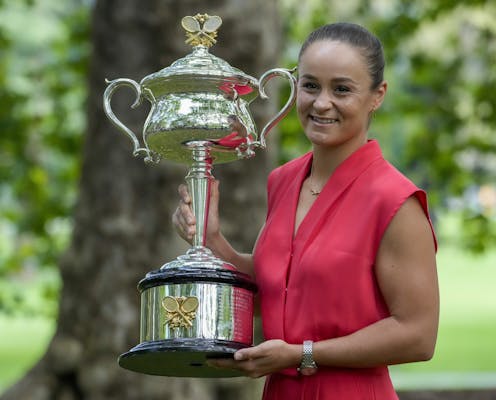
Their respective wins in the women’s singles and men’s doubles suddenly turned the tournament into a very Australian story, swamping the nation’s media with celebratory headlines like “I’m so proud to be Aussie”: emotional Barty savours win for the ages.
Was this just the last big party of the Australian summer, or did it offer more enduring lessons for the country and sport?
What these wins mean for Australia
Sport is without question hugely important in Australian society, although its advocates are prone to exaggerate its nationwide appeal. Most Australians don’t engage in organised sport and only about half go to venues as paying spectators.
The majority watch some sport on television, although often only when a much-publicised event happens, like a woman’s singles final involving a compatriot like Barty.
Research has shown that heavy users of sports media exhibit variously higher levels of Australian patriotism, nationalism and “smugness”, while also tending to be less internationalist in outlook. So, after local success at the Australian Open, some Australians really will feel they live in the world’s greatest country.
Spikes in sport participation around major events are usually short-lived. Of more pressing concern is the capacity of sporting success (like that of Barty and the so-called “Special Ks”) to attract people from historically marginalised communities as sport participants.
Read more: The numbers game: how Ash Barty became the world's best female tennis player
This is especially important in individual sports like tennis where there are significant socio-economic barriers related to the cost of training, travel and equipment.
Barty’s middle-Australia background, growing up in the Queensland city of Ipswich, offers encouragement to budding tennis players who don’t go to expensive private schools. She is a key member of the current generation of champion Australian sportswomen, alongside footballer Sam Kerr and cricketer Meg Lanning, who are making major inroads into the male-dominated institution of sport.
That she is Indigenous and was photographed after her win with renowned Aboriginal sportswomen Evonne Goolagong Cawley and Cathy Freeman, projects a powerful message that sport is – or should be – for all.
Kokkinakis (who has Greek heritage) and Kyrgios (who is half-Greek, half-Malay) had materially comfortable upbringings, but their unexpected success is a global projection of Australian multiculturalism.
The wildcard entrants geeing up a raucous crowd also symbolises a wider societal drift away from “stuffed shirt” institutions – including sport – in favour of freer, less regulated avenues of self-expression.
A message for sport
Comparing the divergent public personae of Barty and Kyrgios, their successes perhaps suggest that professional sport as an industry should reconsider the way athletes choose to project themselves. Largely because of commercial sponsorship and endorsement considerations, they have been encouraged to be cautious, scripted and bland.
Many athletes prefer to use their own social media accounts to communicate directly with fans, avoiding journalistic scrutiny where possible in favour of self-advertisement.
In their different ways, both Barty and Kyrgios have bucked the trend. Barty has charted her own course through tennis, including dropping out for a while to play cricket. A determinedly unaffected “everywoman” who sips beer while watching the Australian Football League (AFL), she rarely uses the personal pronoun “I” or talks about herself in the third person. Barty prefers the collective “we” and constantly praises the large team, including family and friends, around her.
Kyrgios has taken on the “bad boy” image pioneered by the likes of basketballer Dennis Rodman. Supremely talented but lacking the discipline of multiple Grand Slam winners such as Barty or Djokovic, he has carved out a niche as a volatile character whom crowds will come to watch.
He puts on a show involving skilled tennis play, on-court rants and off-court rows. The message here for the media-sports cultural complex is there is room for both types of sport personality in today’s crowded “attention economy”.
In being true to themselves, both Barty and Kyrgios have put their mental health ahead of their sports careers at times.
As fellow tennis player Naomi Osaka has demonstrated, the sport-media machine can swallow and spit out those who do not protect something of themselves from the constant demand to reveal all in public.
Soon the 2022 Australian Open will be in the rear-view mirror, but its lessons for sport and society will remain perpetually in play.
Read more: Nick Kyrgios on probation: can controversial athletes sell a sport or are they bad for the business?
Authors: David Rowe, Emeritus Professor of Cultural Research, Institute for Culture and Society, Western Sydney University

















