

Modern Australian
Times Advertising

Things look worse for casual workers than at any time during the pandemic

  • Written by Ariadne Vromen, Professor, Crawford School of Public Policy, Australian National University
Things look worse for casual workers than at any time during the pandemic

At the national Australia Day ceremony in 2021, Prime Minister Scott Morrison spoke of the contribution by frontline workers during the pandemic. He mentioned health workers, the defence forces, the police and farmers, as well as “the truck drivers, the wholesale and the retail workers keeping our supermarket shelves stocked”.

In his 2022 Australia Day speech only defence personnel and health workers got a mention – possibly due to the disappearing government support for retail and logistics workers during the Omicron wave.

With Omicron crippling supply chains and businesses being forced to shut due to lack of staff, eligibility rules for the last remaining COVID-related support payment (the Pandemic Leave Disaster Payment) have been tightened, and the payments available cut.

The definition “close contact” has been weakened and tens of thousands of workers have been made exempt from isolation protocols by now being classified as “essential”.

Many frontline workers – namely those on casual contracts – are facing the toughest circumstances since the the pandemic began.

With no right to guaranteed minimum hours, sick leave or the other entitlements, those employed as casual workers or as subcontractors are likely to lose income – either due to having to take time off to get tested or self-isolate, or because their workplace hasn’t got enough staff to stay open. There is also a much higher proportion of casual workers in the retail sector, than in the Australian workforce as a whole.

Our research on the effects of the pandemic on income and conditions for workers between March 2020 and September 2021 shows 55% of those working in retail, fast-food and distribution were forced to take time off work for COVID-related reasons – with a significant percentage losing income as a result.
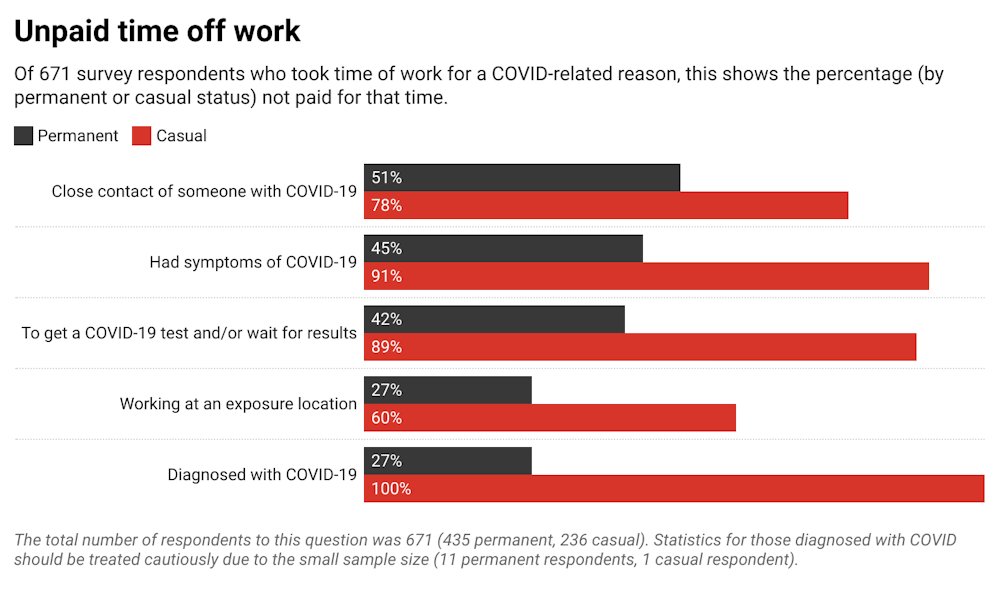

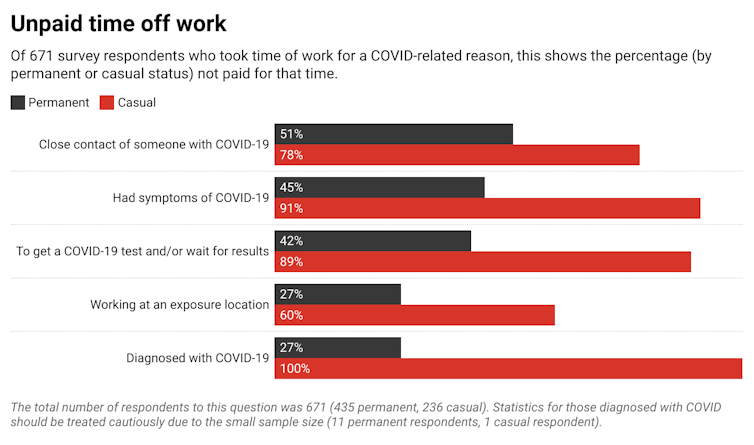
During this time just 1% of retail workers were diagnosed with COVID-19, and the the financial support available included the lockdown-specific Covid-19 Disaster Payment. Now, with infection rates running significantly higher – a quarter of Coles warehouse staff, for example, have been reported absent due to COVID-19 – there’s less support. Casual retail workers thus face losing hours, being put at greater risk of contracting COVID-19, and dealing with abusive customers over mask, QR code and other requirements. Read more: Content from confrontation: how the attention economy helps stoke aggression towards retail workers What our survey showed The purpose of our survey of nearly 1,160 retail, fast-food and distribution workers was to gauge how the pandemic had affected employment and income. Polling company Ipsos conducted the survey in September 2021, during the peak of Sydney’s Delta wave (which sparked suburb-based lockdowns in mid-July 2021) and the start of Melbourne’s Delta wave (with the Andrews government declaring a lockdown on August 5, 2021). The survey was nationally representative. About 61% of respondents were women, 44% were younger than 30, and 19% were from a non-English-speaking background. About 39% were permanent full-time, 21% permanent part-time and 38% casuals (45% of women were casual, compared with 22% of men).   Because it was nationally representative, about 40% respondents were not in an lockdown area (NSW, Victoria and the Australian Capital Territory) at the time of the survey. This make the results even more stark compared with now. From March 2020 to September 2021, 55% of retail, fast food and distribution workers had to take time off for a COVID-19 related reason: 1% did so due to having COVID-19. Of these, about a third said they took unpaid leave. 7% did so due to being a close contact of someone with COVID-19. Of these, 51% of permanent workers and 78% of casuals took unpaid leave. 11% took time off because they had COVID-19 symptoms. Of these, 45% of permanent workers and 91% of casuals took unpaid leave. 10% were absent due to working at an exposure location. Of these, 27% of permanent workers and 60% of casuals took unpaid leave. 30% took time off because they had to take a COVID-19 test and isolate while waiting for a result. Of these, 42% of permanent workers and 89% of casuals took unpaid leave. Clearly while very few workers were actually sick with COVID-19, it had a significant affect on livelihoods. This a key point to reflect on now more workers have COVID-19 and an even larger number are (or should be) isolating. Read more: Where's the meat? Employers and governments should have seen this supply crisis coming, and done something Short shift for precarious work At the time of our survey the risks of catching COVID-19 were relatively small, even for essential frontline workers. Omicron has substantially increased that risk – along with the risk of losing work hours. Registering a positive result is the only way ill, casually employed workers can access extra support when they aren’t able to work. But getting a test – and results has been difficult, with workers in NSW and Victoria only been able to officially register positive RAT results since January 10. The Pandemic Leave Disaster Payment is still available to those who don’t qualify for employer-paid leave. But to qualify you must be directed to isolate and stay at home due to having tested positive or been in close contact with someone with COVID-19. Read more: What a disaster: federal government slashes COVID payment when people need it most You also only qualify for the full $750 a week (for two weeks) if you lose 20 hours or more of paid work a week. If you lose 8-19 hours, you get $450 a week. If you lose less than eight hours, you get nothing. This highlights the precarious and unsustainable position of Australians employed on casual contracts, especially those in the retail, fast food and distribution sector. Many unwell or at-risk precarious workers are likely to have gone without income while they struggle to get access to tests or lose paid work for other reasons. Authors: Ariadne Vromen, Professor, Crawford School of Public Policy, Australian National University

Read more https://theconversation.com/things-look-worse-for-casual-workers-than-at-any-time-during-the-pandemic-175065

7 Benefits of Professional Gutter Cleaning for Australian Homeowners

Gutters aren't exactly glamorous. They sit up there on the edge of your roof, doing their job quietly - until they stop working. Clogged, overflowing ...

Pipe Floats Strengthening Pipeline Performance In Demanding Environments

Pipelines often travel through environments that are anything but predictable, water currents shift, terrain changes, and materials keep moving unde...

Why Ceiling Fans Are Essential For Comfort, Efficiency, And Modern Living

Creating a comfortable indoor environment is not just about temperature; it is about how air moves, how a room feels, and how efficiently energy is ...

Why Duct Cleaning In Melbourne Is A Smart Investment For Healthier Living Spaces

Behind your walls, ceilings, and vents lies a network quietly working every day to keep your home comfortable. Yet over time, this system can become...

Disability Service Providers Supporting Inclusive And Independent Living

Finding the right support system can feel like assembling a puzzle where every piece must fit just right. For individuals and families navigating di...

A Beginner's Guide to Owning a Caravan in Australia

Owning a caravan opens up a style of travel that's hard to match for freedom and flexibility. However, for those just starting out, the process of c...

Preparing Your Air Conditioner for Summer: What Most Homeowners Overlook

As temperatures rise, many homeowners switch on their air conditioning for the first time in months — only to find it’s not performing the way i...

What Actually Adds Value to Properties in Newcastle

Newcastle has seen steady growth over the past few years, with more buyers looking beyond Sydney for lifestyle, space, and long-term value. As dema...

What is Design and Build in Construction?

Imagine you’re about to start a new construction project, maybe it’s a custom home or a commercial building. You’ve got the idea, the land, an...

Commercial roof leak detection: why early action protects your building

Water ingress is one of the most disruptive and costly issues facing commercial properties. For property managers and facilities teams, even a minor...

Custom Photo Frames: Turning Everyday Moments into Lasting Displays

Photos capture moments, but how you display them determines how they’re experienced every day. A meaningful photograph deserves more than a generi...

Managed IT Services: A Smarter, More Predictable Way to Run Your Business Technology

If you’ve ever had your systems go down in the middle of a busy day, you’ll know how quickly things can unravel. Phones stop ringing, emails sto...

Landscaping Geelong — Coastal Elegance Meets Practical Design

A Landscape Shaped by Location Geelong occupies a unique position within Victoria’s broader landscape. It carries the energy of a growing city, y...

Electric Adjustable Beds: A Simpler Way To Sleep Better

Sleep should feel natural. It should come easily, without discomfort, without constant repositioning, and without waking up feeling sore. But for ma...

Healthy Snacking Sorted: Premium Beef Jerky

In today's fast-paced world, finding a snack that's both satisfying and genuinely good for you can feel like a mission. Many readily available optio...

What to Know Before Getting Dental Implants: A Guide for First-Time Patients

Dental implants Perth patients often look for a long-term solution for missing teeth without the hassle of dentures or bridges. If you are thinking ...

Why Protective Packaging Matters More Than Ever In Modern Shipping

In today’s fast-paced world of logistics and eCommerce, ensuring that products reach customers safely is a top priority. This is where a bubble wrap...

Pest Control Albury: Protecting Your Property From Hidden Damage And Health Risks

Pests rarely announce their arrival. They creep into spaces quietly, turning small, unnoticed corners into breeding grounds for bigger problems. Tha...















