

Modern Australian
The Times

COVID halved international student numbers in Australia. The risk now is we lose future skilled workers and citizens

  • Written by Nancy Arthur, Dean of Research, UniSA Business, University of South Australia
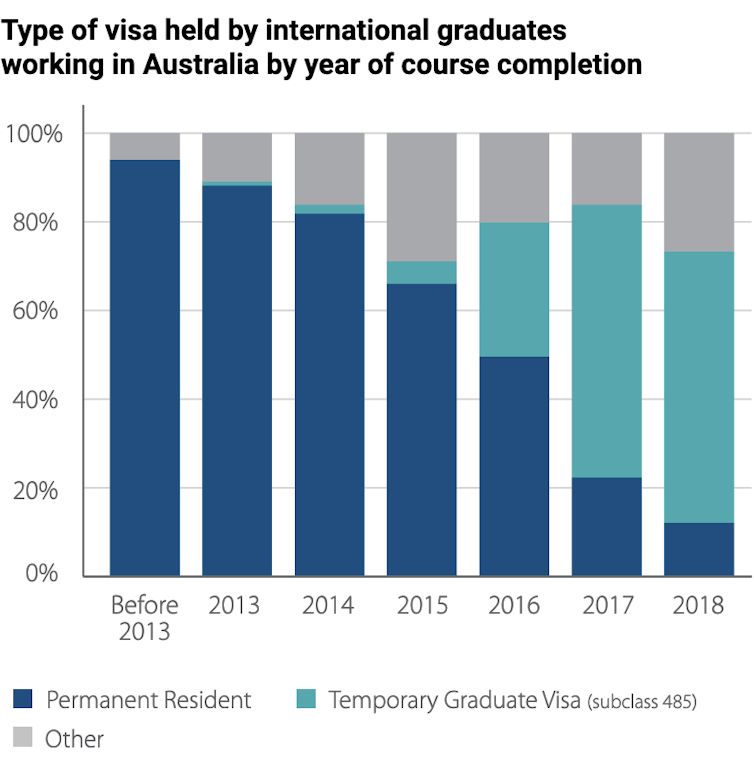
Chart showing type of visa held by international graduates working in Australia by year of course completion

The saying “you don’t know what you’ve got ’til it’s gone” reminds us not to take things for granted. It is often when we no longer have something or someone that we recognise the value of what we’ve lost. This is true of international students in Australia whose numbers halved during the pandemic.

Can hindsight help us understand what we had and help to guide our future? That question lingers as tens of thousands of new and returning international students arrive back in Australia now that borders have reopened.

Read more: Border opening spurs rebound in demand from international students

Students pursue international education for a variety of reasons. The main one is to improve their employment prospects.

International students are looking for high-quality, relevant curriculum and credentials that will best serve their career plans. While studying, they also seek social connections that help them to navigate local education and employment systems.

The pandemic created chaos and uncertainty about enrolments, border closures, flight availability and quarantine requirements. Over the past two years, many international students had to put their plans on hold. They hung on to the possibility of studying and working in Australia.

Let’s not forget, they can choose other countries that will be seeking highly educated and skilled graduates. Some have already moved on to countries where borders were open, such as Canada. These countries offered access to high-quality international education with fewer complications and greater certainty about transitioning to work visas.

Read more: International student numbers hit record highs in Canada, UK and US as falls continue in Australia and NZ

Their absence hit us hard

Consider what Australia lost when so many international students were gone. In 2019, they contributed an estimated $40.3 billion to the economy. International education supported about 250,000 jobs in Australia.

Border closures reduced enrolments by up to 70% in some parts of the higher education sector.

Read more: Australia's multilingual identity is an asset for selling our English-language teaching to the world

The financial impacts on Australian universities have been smaller than originally predicted, but the loss of billions in revenue should not be discounted. Universities were exposed to the risks of depending on a never-ending flow of new international students and their tuition fees. The pandemic’s impacts on university finances led to the loss of as many as 35,000 academic and professional jobs.

Local communities and businesses also missed the consumer power of international students and visiting family members who purchased goods and services. Employers have struggled to find enough local workers for job vacancies that these students would fill.

Australia must extend the welcome mat

The Australian government recently announced incentives for international students to return soon to help overcome labour shortages and stimulate market growth. Visa fee rebates and relaxed restrictions on allowable working hours are aimed at recovery in the international student market, while filling gaps in the workforce. What remains to be seen is how well entry-level and part-time jobs in service and hospitality will translate into future employment opportunities that match these students’ qualifications.

The fall in international student numbers also meant losing key resources for intercultural learning. Although many of us are longing to travel abroad for a dose of intercultural exposure, learning at home between local and international students is a relatively untapped resource. Increasing the numbers of international and local students studying together is part of the solution identified by the Australian Strategy for International Education.

Read more: Australia's strategy to revive international education is right to aim for more diversity

Many international students will need extra support to develop social capital – the friendships, community contacts, mentors and networks that help to build a sense of belonging now and in the future.

International students have been treated like commodities for higher education and the labour market. But they are people, whose choice of international education is connected to their hopes and plans after graduating.

The global pursuit of talent will increase graduates’ opportunities to decide which country they choose for education, for employment and for permanent migration. Not every international graduate will choose to stay in Australia. Fluctuating immigration policy makes it difficult to predict who will be allowed to stay and who will not.
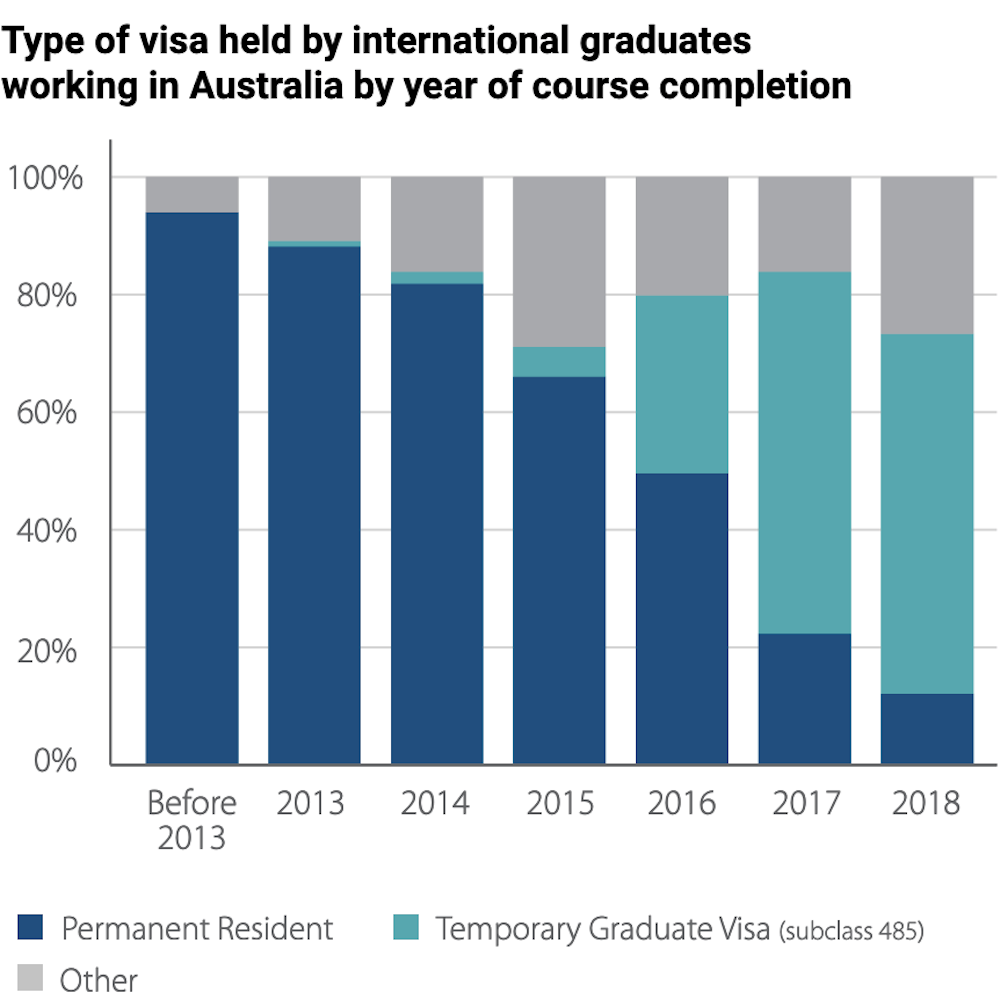

Chart showing type of visa held by international graduates working in Australia by year of course completion
Source: Australian Strategy for International Education 2021-2030, CC BY Read more: As international students return, let's not return to the status quo of isolation and exploitation This is not a short-term issue Many countries, including Australia, need to attract talented graduates to make up for low birth rates, low immigration due to the pandemic and skilled worker shortages. International students are preferred immigrants because they combine experience from their home countries with experience studying and living locally. As international students return to Australia, the welcome mat needs to stay out longer. It matters how we support them, not only upon arrival, but throughout their academic programs and as they prepare for their future employment. International students invest in their education and the country where they study. We in turn need to recognise their many contributions and invest in their potential. The longer-term view requires strategy for supporting them as students, employees and future associates, within and beyond Australia’s borders. Let’s think carefully about what can be improved as international students return to Australia. Read more: Why the international education crisis will linger long after students return to Australia Authors: Nancy Arthur, Dean of Research, UniSA Business, University of South Australia

Read more https://theconversation.com/covid-halved-international-student-numbers-in-australia-the-risk-now-is-we-lose-future-skilled-workers-and-citizens-175510

Your Baby's First Year: A Local Guide to Feeding, Sleep, and When to Get Extra Support

Ask ten parents in a Brisbane mothers' group how their baby is feeding or sleeping, and expect ten different answers.  Someone's baby sleeps throu...

Kitchen and Laundry Makeover Ideas That Don't Require a Full Renovation

Full kitchen renos are expensive — and most people don't actually need one.  They need the kitchen to stop looking like it's stuck in 2009, or t...

How Technology Is Reshaping the Modern Australian Commercial Kitchen

The commercial kitchen has always been shaped by technology. Refrigeration changed how ingredients could be stored, modern ventilation transformed k...

The Number on a Roller Blind Fabric That Nobody Explains

Somewhere in the fabric book, next to the colour name, there is a percentage. Three per cent. Five per cent. Ten per cent. Nobody explains it, most c...

What’s Trending in Men’s Jewellery This Father’s Day!

Finding a Father’s Day gift that feels personal, stylish and genuinely wearable is not always easy. While socks and novelty mugs have traditionall...

Road Signs: Understanding Their Role in Clear and Effective Signage

Effective signage and display hardware can help businesses communicate information, promote products and organise customer or visitor movement. Road...

Bottle Label Printing: Key Factors to Consider Before Your Next Packaging Run

Effective packaging begins with understanding the product, bottle material, artwork and production requirements when planning bottle label printing. H...

Planning a Long-Distance Move With Interstate Movers Melbourne

Moving between states involves more planning than a typical local relocation. Along with packing and transporting household belongings, you need to...

Understanding the Role of an I/O Controller in Industrial Automation

Modern industrial systems depend on accurate communication between sensors, machines and control systems. An I/O controller can help manage this commu...

How the Right Mining Hose Supports Demanding Operations

Mining environments place considerable demands on equipment used for material transfer, water management and processing. Hoses operating in these co...

Simple Ideas for Making Social Gatherings More Memorable

We have all been to those parties where everyone just stands around the kitchen island, staring at their phones, waiting for someone else to make a mo...

Outdoor Wall Lights: Improving Exterior Lighting Around Your Home

Lighting can influence how a room looks, feels and functions, so the right fitting should be selected according to both appearance and practical req...

Commercial Office Cleaning: Combining Routine Office Cleaning With Melbourne Service

Keeping a workplace clean requires a service that can accommodate everyday tasks as well as the particular needs of the business. Professional comme...

Caravan Sales in Queensland: How to Find the Right Caravan for Sale QLD

Caravan ownership is about more than having somewhere to sleep while travelling. For many Queenslanders, it is one of the best ways to explore regio...

What Sir Walter Buffalo Turf Actually Costs in 2026 (And Why Quotes Vary So Much)

Two quotes landed on a Hills District homeowner's kitchen table last spring for the exact same 80-square-metre backyard. One said $12 a metre. The o...

Nearly 1,300 NSW Hospital Beds Are Occupied By People Who Are Ready To Go Home

1,276 people in NSW hospitals have been medically cleared for discharge but remain in hospital because they're still waiting for NDIS or aged care sup...

National Survey Launched to Measure Operational Impacts of Federal NDIS Policy Reforms

The effects of recent NDIS reforms are beginning to move beyond policy papers and into day to day service delivery. A new national survey is asking ...

Beyond the Nappy Cake: Baby Shower Gifts That Get Used

What new Australian parents unwrap, keep, and quietly thank you for months later. Six weeks after my daughter was born, I did an audit of the baby sh...















