

Can the world stop Myanmar from becoming a failed state?
- Written by Catherine Renshaw, Professor, School of Law, Western Sydney University
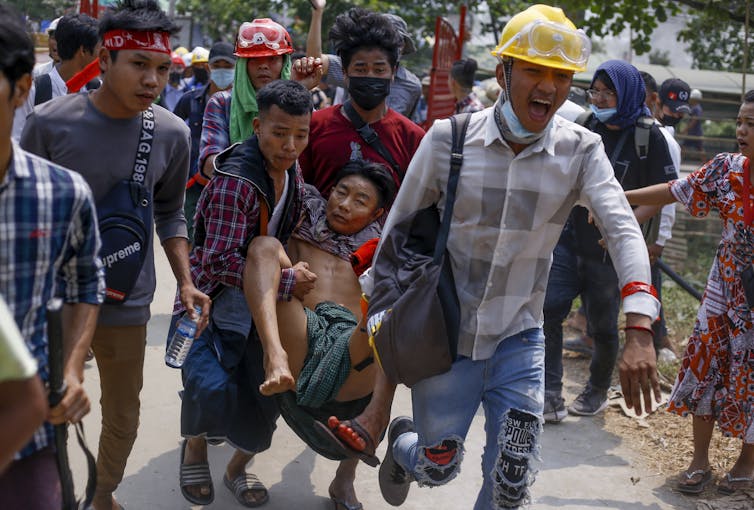
Myanmar is on the brink of collapse. One year after the coup, half the population does not have enough food. The local currency has lost 50% of its value. Foreign companies are pulling out of Myanmar. The military is shooting civilians in the streets and opponents of the military are carrying out bombings and assassinations.
With every week that passes, the suffering becomes greater, grievances mount and distrust between the military and its opponents increases. A full-scale civil war appears inevitable.
A failed state in the heart of the Indo-Pacific would be a blow to the security and economic interests of Myanmar’s neighbours (China, India, Thailand and Bangladesh). This would also be profoundly damaging to the credibility of the Association of Southeast Asian Nations (ASEAN), of which Myanmar is a member.
For the United States, Myanmar’s collapse would undermine the effort to forge an Indo-Pacific strategy capable of balancing China’s deep interests in the region.
For the United Nations, civil war would lead to further questions about its effectiveness at a time when it is already under scrutiny over its handling of the COVID-19 pandemic and the failure to avert crises in Yemen, Sudan and Afghanistan.
If Myanmar is the epicentre of stability in Southeast Asia – a region critical to the security and interests of so many nations – why has such little progress been made in resolving the conflict? Why has the world failed to act?
ASEAN’s stalled roadmap to resolution
Most commentators lay blame at the feet of ASEAN. Last April, the organisation negotiated a “five point consensus” with the Myanmar military to lead the country away from destruction. This agreement included an immediate ceasefire, the appointment of an ASEAN special envoy to Myanmar, and the start of talks between the two sides.
But days after agreeing to the consensus, the military walked back on its commitment to a ceasefire, saying it could not follow through until the country’s security situation was under control.
Then it took almost four months for the special envoy to even be named. His first visit to Myanmar was subsequently cancelled because the military refused to allow him to meet with leaders of the ousted National League for Democracy, including Aung San Suu Kyi.
In October, ASEAN won plaudits for excluding military chief Min Aung Hlaing from its biannual leader’s summit.
The summit is a prelude to the larger, annual East Asia Summit, which includes China, the US, Australia, India, Japan and Russia. The presence of the coup leader at the ASEAN summit would have been an embarrassment to the regional bloc - and possibly imperilled US involvement in the East Asia Summit to follow.
China’s leverage over the generals
Historically, ASEAN has had limited success in influencing the behaviour of Myanmar’s generals. China, on the other hand, has been vital to Myanmar’s economic survival.
During the long decades of Myanmar’s previous military dictatorship, which ended in 2011, China’s support ameliorated the punishing raft of sanctions imposed by Western powers. From China’s perspective, Myanmar provides abundant natural resources and access to oil and gas shipments through pipelines from the Bay of Bengal and the Andaman Sea, which are vital for Beijing’s energy security.
Read more: Myanmar coup: how China could help resolve the crisis
Myanmar is also a key plank of China’s Belt and Road Initiative, and the military has enjoyed Chinese (and Russian) support on the UN Security Council.
China’s interests would be served by political stability in Myanmar. Beijing also has links to both the military and the ousted National League for Democracy (and ethnic armed groups in the border region). But among ordinary people in Myanmar, anti-Chinese sentiment runs high. After the coup, there was a wave of arson attacks on Chinese businesses.
Although China’s credibility as a formal peace broker is limited, there is much it could do behind the scenes to get the generals to the negotiating table.
Japan has credibility on both sides
As potential negotiators, the US and European Union are constrained by the sanctions they have imposed on the junta leaders and their business interests.
However, Japan is in a different position. It has a historical obligation to Myanmar stemming from the second world war, when it occupied the country – and a strategic interest in limiting China’s influence in the region.
For decades, Japan has made considerable efforts to support the people of Myanmar by walking a middle path between Western sanctions – which had little effect – and China’s exploitation of Myanmar’s resources and geostrategic advantages.
Although some Japanese companies exited Myanmar following last year’s coup, Japanese aid has continued to flow into Myanmar. Unlike China and the US, Japan has a degree of diplomatic credibility with both sides to the current conflict.
All eyes remain on ASEAN
For all its shortcomings, ASEAN will remain pivotal in efforts to end the crisis.
Cambodia has assumed the chairmanship of the organisation this year, and its hardline leader, Hun Sen, has already opened a line of communication with the junta leaders, inviting them to the next ASEAN summit if progress is made on last year’s peace plan.
However, this likely won’t make him palatable to the military’s opponents as a potential peace broker.
In this context, the UN and the major powers with the most influence in the region – China, the US and perhaps Japan – must act concertedly to end the crisis in Myanmar. They must work through ASEAN, and leverage the bloc’s efforts, to bring the generals to the negotiating table.
In the year since the coup, the ASEAN strategy to resolve the crisis has paid few dividends. Nonetheless, it remains the primary hope for a political resolution.
The bloc must at least ensure humanitarian aid reaches Myanmar’s long-suffering people. That at least might be a flicker of hope in the country’s increasingly desperate conflict.
The author will be speaking on a panel about Myanmar’s future organised by the Sydney Southeast Asia Centre and ANU’s College of Asia and the Pacific on Wednesday, Feb. 2, at 12pm.
Authors: Catherine Renshaw, Professor, School of Law, Western Sydney University
Read more https://theconversation.com/can-the-world-stop-myanmar-from-becoming-a-failed-state-174868

















