

Modern Australian
Men's Weekly

.

Who'll teach all the students promised extra TAFE places? 4 steps to end staff shortages

  • Written by Darryl Dymock, Adjunct Senior Research Fellow in Education, Griffith University
Who'll teach all the students promised extra TAFE places? 4 steps to end staff shortages

Under Labor’s proposed Future Made in Australia Skills Plan, Australians studying in an industry with a skills shortage will be supported through the provision of free TAFE places. This will include 45,000 new places. If Labor does that without expanding the present depleted teaching workforce, we’re likely to see more current teachers bailing out and corners cut in teaching practices.

Our 2021 research for the National Centre for Vocational Education Research (NCVER) found the shortages of VET teachers and trainers extend to virtually every industry. If these shortages are not overcome, the result will be an inadequately trained vocational workforce. This in turn will have an impact on the country’s skill levels and productivity.

Not that the present federal government has much to be proud of in this regard. Although Vocational Education and Training (VET) significantly underpins the nation’s workforce development, it has limped along under recent national governments.

TAFE, the public provider, has remained a poor relation. Workforce shortages have continued, made worse by retirements from the ageing VET workforce and by the need to expand training to cater for new and emerging industries.

For our research we talked with key members of almost 30 registered training organisations (RTOs) across Australia about the shortage of trainers. We also surveyed over 300 practising teachers and trainers (VET practitioners) about their experiences of moving into VET.

The challenge in overcoming the shortage of VET practitioners is to encourage experienced workers from trades and the professions to move into VET.

What are the key issues?

The difference in salaries between industry and VET is a significant issue. It’s too simplistic an explanation for the lack of applicants, however.

For example, one disincentive is the nature of employment in the sector. Just over half of VET practitioners are employed in ongoing full-time roles. As one said:

“People at the top of their industry don’t leave for a temporary contract.”

Private training organisations reported they sometimes provide permanent employment for trainers simply to keep them “on the books”. One RTO principal told us:

“I can’t afford to put them off because we’ll never get them back.”

A further stumbling block is the inflexibility of the basic educational qualification as a point of entry. Trainers generally need to complete a Certificate IV in Training and Assessment (Cert IV TAE) before they can teach. There is only minimum provision for supervised practice without it.

Training organisations reported prospective trainers are reluctant to acquire the full qualification before they’re allowed to teach. Tradespeople with significant practical experience but no formal education since their apprenticeship were also anxious about “returning to study”.

Paradoxically, there was pushback from university-educated professionals in senior positions against the need for a vocational qualification.

The value of the certificate itself as a training qualification has been an ongoing contentious issue. One ex-tradie wrote:

“They want teachers to have ten years of industry experience […] but expect a six-day course to be enough to be a good teacher.”

It’s understood changes to the qualification are in the wind. Let’s hope these include ones that will make entry to VET teaching more flexible.

Training organisations and trainers alike argued for better recognition of prior learning among those who already have a training or mentoring role.

Even after they make the transition, new practitioners sometimes leave VET because their expectations don’t meet the reality. This is especially true if their employer doesn’t provide appropriate orientation and support. One trainer said:

“Day one I was given a USB with PowerPoint presentations on it and told to go into the classroom and deliver it.”

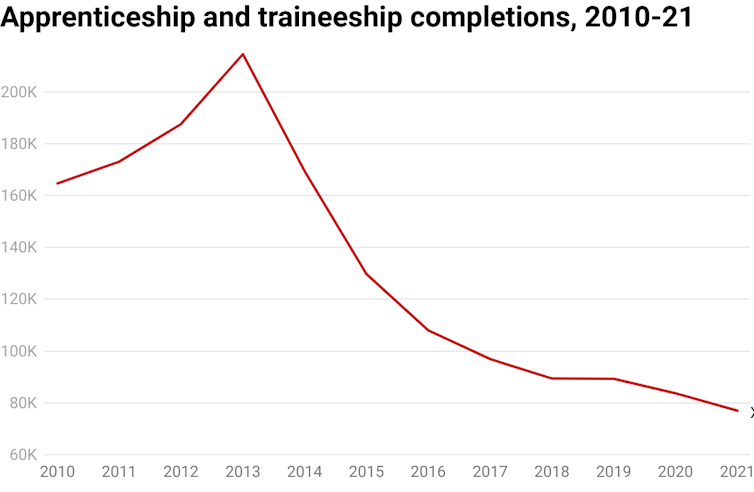
Chart showing decline in apprenticeship and traineeship completions in Australia, 2010 to 2021
Data: NCVER, CC BY What can be done to end the shortages? We identified several strategies to attract more VET practitioners. 1. Exploit career points and individual passion for teaching and training. A national media campaign could target prospective VET professionals at potential “turning points” in their careers. That might be, for example, when they are looking to move into something different from their everyday job, when family or financial responsibilities have eased, or when they are seeking an alternative work-life balance. Sell these as benefits beyond salary. 2. Smooth the entry path. Provide more options to “try before you buy”. These might include “bite-size” opportunities to experience teaching in VET before making a commitment. Industry specialists could be allowed to teach short-term with a particular training skill set, rather than the full qualification. It’s also essential to ensure prospective practitioners understand in advance how expectations in VET are different from those in their former workplaces. When they get there, give them a soft landing, especially those new to training. Show them they’re valued. 3. Involve industry more. Encourage and enable movement in and out of VET – so-called “boundary crossing”. This will enable practitioners to maintain their links and their industry currency. There is also scope and reason for industry to be more directly involved in promoting and fostering the VET practitioner career. 4. Enhance the status of VET. This can be done by promoting the uniqueness of the “dual practitioner”. Arguably even more than at university level, VET employs tradespeople and professionals who have developed expertise in one career and channels them into a second career. As a VET teacher or trainer, their initial expertise is highly valued. Our research showed many people in VET are passionate about its potential but some despair about its future. Whichever party is in power, expanding and equipping the VET workforce is a vital step forward.

Authors: Darryl Dymock, Adjunct Senior Research Fellow in Education, Griffith University

Read more https://theconversation.com/wholl-teach-all-the-students-promised-extra-tafe-places-4-steps-to-end-staff-shortages-175523

Someone Trips at Your Fundraiser. Now What? Understanding Public Liability for NFPs

Three months of planning. Volunteers giving up their weekends. Sponsorships chased, catering sorted, tables decorated. And then, about an hour into ...

Stainless Steel Tube: A Complete Specification Guide for Engineers, Project Managers, and Industrial Buyers

Few materials in the industrial and manufacturing world are as universally relied upon — or as frequently misspecified — as stainless steel tube...

How to Choose the Right Barber Shears Scissors for Professional Results

Since a barber is only as good as their tool, choosing the right barber shear scissor must not be taken lightly. Most barbers end up buying the first ...

Why Commercial Construction Companies Play A Critical Role In Modern Urban Development

Urban development requires highly organised planning, engineering expertise, and professional construction teams capable of delivering complex build...

Essential Features for Comfortable Family Caravan Trips

Choosing the right van for family travel requires careful consideration of how the space will be used on a daily basis. Families have specific needs...

Chatswood Tutor: Helping Students Achieve Academic Success With Personalised Learning

Education plays a crucial role in shaping a student’s future, and many students benefit from additional academic support outside the classroom. A pr...

How External Consulting Can Guide Enterprise IT Strategy and Procurement

Internal IT teams carry deep operational knowledge, but that familiarity can create blind spots in strategic decisions. An external IT consultant br...

Why Sports Nutrition Australia Is Important for Performance and Recovery

Athletes and fitness enthusiasts place significant demands on their bodies during training and competition. Maintaining energy levels, supporting mu...

How Body Contouring Bundoora Helps Improve Shape And Confidence

Modern aesthetic treatments have made it possible to refine body shape without the need for invasive surgery. One of the most popular non-surgical o...

Why Plantation Shutters Are a Stylish and Practical Choice for Modern Homes

Window coverings play a major role in the comfort, privacy, and overall design of a home. Homeowners often look for solutions that provide both visu...

Why a Retractable Hose Reel Is Essential for Efficient Water Management

Managing hoses efficiently is important for both residential and commercial environments. Whether watering gardens, cleaning outdoor areas, or maint...

Best Ways to Trade In Your Old Tech for Cash in Australia

Upgrading your mobile is exciting, but many Australians are left wondering what to do with the device they no longer use. Instead of leaving it in a...

Why Doctors in Bundoora Play an Important Role in Community Health

Access to quality healthcare is essential for maintaining a healthy lifestyle and managing medical conditions effectively. Visiting experienced doctor...

Backyard Aesthetics Decoded: Mediterranean, Coastal, Retro, Rustic, and Beyond

Backyard design has come a long way from a patch of lawn, a barbecue in the corner, and a few chairs chosen purely for practicality. Today, outdoor ...

What Stops a Home From Feeling Flat-Pack Generic

There is nothing wrong with convenience. Flat-pack furniture, fast styling decisions, and online checkouts have made it easier than ever to furnish ...

5 Best Dental Clinics in Beecroft, NSW

The best dental clinics in Beecroft, NSW are Beecroft Smiles Dental Surgery, Beecroft Elegant Dental Clinic, McConnell Dental, Dentistry for Life, a...

Executive Recruitment: Finding Leadership Talent That Drives Organisational Success

Hiring the right leadership team can significantly influence the direction and performance of any organisation. Strong executives bring strategic thin...

Understanding the Importance of Abrasive Blasting in Industrial Surface Preparation

Surface preparation is an essential step in many industrial processes. Whether preparing metal structures, removing old coatings, or cleaning equipmen...















