

Why Ukrainians are ready to fight for their democracy
- Written by Olga Boichak, Lecturer in Digital Cultures, University of Sydney
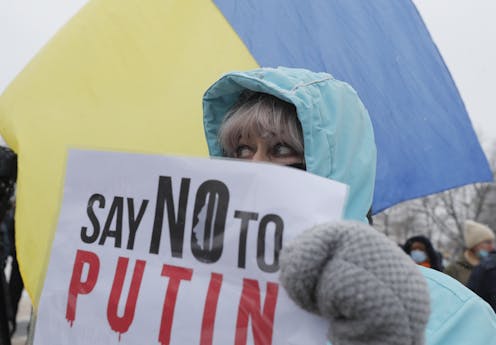
Eight years since the Russian annexation of Crimea, Ukraine is facing another threat from its eastern neighbour. Russia has amassed an estimated 130,000 troops and military equipment along its borders in recent weeks.
Ukraine is literally surrounded by Russian troops: along its northern border with Belarus, in Russian-occupied eastern Ukraine (Donetsk and Luhansk), in Crimea to the south, and in Transnistria, the Russian-occupied part of Moldova to the west.
Despite these disturbing developments, Russia continues to deny any planned aggression towards Ukraine. Russia is not only the second-largest natural gas producer in the world – it is also extremely good as gaslighting.
Russia’s ‘reflexive control’ strategy
As the official Russian rhetoric goes, Ukraine and Russia are “one people” belonging to the same historical and spiritual space.
However, this claim is a historical fabrication. It is strategically deployed to de-legitimise Ukraine’s claims to nationhood – and by extension, sovereignty – and bring it back into Russia’s orbit of influence.
The significant military buildup on Ukraine’s border is part of a larger coordinated geopolitical offensive called “reflexive control”.
Read more: How Russian is Ukraine? (Clue: not as much as Vladimir Putin insists)
Reflexive control involves a wide variety of hybrid warfare tactics, such as deception, distraction, deterrence and provocation. We’ve seen these tactics playing out in the rising number of cyber attacks on Ukraine’s government servers and energy grid, to the Russian state-sponsored disinformation campaigns aimed at sowing distrust and discord in the country.
In many cases, these disinformation campaigns have originated online with the help of the Internet Research Agency, a troll factory in Russia.
Reflexive control also involves the potential for so-called false-flag operations – terrorist acts allegedly committed by Ukraine on Russian territory or involving Russian citizens. These types of incidents can be used to justify a military incursion into a sovereign state.
A history of interference and disinformation
The roots of Russian interventions in Ukraine go much deeper than its illegal annexation of Crimea and occupation of large parts of Donetsk and Luhansk in 2014, and its actions on the border today. In fact, Ukraine has been subjected to Russian interference since becoming an independent state in 1991.
This influence has manifested in myriad ways, from economic and political coercion to cultural conformism. This includes weaponising Ukraine’s energy dependency on Russia, a near-complete russification of Ukraine’s media, attempts to install pro-Kremlin governments, and even high-profile assassinations of journalists and political activists.
Ukraine has seen two major waves of popular protests against rising Russian influence. The first was the Orange Revolution of 2004 following Russian attempts to rig Ukraine’s presidential election to try to ensure the pro-Russian candidate, Viktor Yanukovych, won.
Another protest broke out in 2013 after Yanukovych, then president, refused to sign a political association agreement with the European Union, opting instead to join a customs union with Russia. This was known as the Revolution of Dignity, or the Maidan Revolution.
In both cases, Russian official rhetoric used these revolutions as evidence of Ukraine being subverted by the West. This effectively de-legitimised their true causes and the public sentiment around them.
One of the most prominent Russian narratives was that Ukraine was a “failed state” – a country governed by chaos, swarming with radicals and fascists, and on the brink of a civil war. Conveniently, this vilification also served as a cautionary tale to prevent any pro-democratic protests from erupting in Russia.
The Maidan Revolution eventually succeeded in Yanukovych being removed from office. But Russia took advantage of the transition of power by sending uniformed men with no insignia to covertly take over government buildings in Crimea. It was the most significant breach of territorial integrity in Europe since the second world war.
A secession referendum was then held in Crimea that was the exact kind of “democracy” the Ukrainian people have fought so hard to overthrow.
It does not take a mathematical genius to question the validity of a near-unanimous vote to secede (96.77%) in a region comprised of only 60% ethnic Russians, many of whom had Ukrainian citizenship and did not support the secession.
Russian-orchestrated “insurgency” in the east
Russia’s next move was to orchestrate an insurgency in eastern Ukraine stoked initially by Russian special operations units and paramilitary groups.
I have written extensively on how a handful of citizens in the eastern Ukrainian city of Mariupol were able to successfully counter a so-called “insurgency” after seeing their city suddenly flooded by strangers who spoke an unfamiliar dialect of Russian, had a hard time paying in Ukrainian currency and repeatedly asked locals for directions.
These strangers – locals called them “political tourists” – were sent to Mariupol from the Russian city of Rostov-on-Don to instigate pro-Russian demonstrations. Similar operations took place throughout 2014 in many other Ukrainian cities.
In hindsight, Ukrainian activists were perhaps the only reason the Russian army couldn’t advance further into the country eight years ago. They quickly identified these patterns across the country and organised against the interlopers.
Yet, as is often the case with gaslighting, the burden of proof is on the victim – many in the West still repeat Russia’s “civil war” narrative to this day.
Read more: Don't call it a civil war – Ukraine's conflict is an act of Russian aggression
Reasons for hope
In the face of such an existential threat, Ukraine has experienced profound social, political and cultural transformations.
Over the past eight years of occupation, hundreds of grassroots volunteer initiatives have stepped up to help the country recover from the humanitarian crisis stemming from the long-running conflict and counteract a full-scale military invasion.
This type of civil society activism is the cornerstone of democracies around the world. There is still a long way to go in Ukraine, but these emerging foundations can now be observed in nearly every aspect of public life.
Ukrainians do not want democracy because they are being “subverted” by the West, as Russia claims. Ukrainians want democracy because it paves the way from an imperial Russian borderland to a sovereign statehood.
Allowing Russia to thwart these aspirations and re-invade Ukraine sets a dangerous precedent for other sovereign states trying to break away from their violent and traumatic past.
Authors: Olga Boichak, Lecturer in Digital Cultures, University of Sydney
Read more https://theconversation.com/why-ukrainians-are-ready-to-fight-for-their-democracy-175649

















