

Modern Australian
The Times

What's wrong with Australian mortgages? They're fixed for shareholders, not home owners

  • Written by Richard Holden, Professor of Economics, UNSW

What's wrong with Australian mortgages? They're fixed for shareholders, not home owners

If you’re paying off a mortgage – or aspiring to – imagine if you didn’t have to worry so much about rising interest rates.

That’s already the reality for US home buyers. Unlike in Australia, most mortgages in the US have a fixed-interest rate, locked in for 30 years.

Instead of having to wait and see if their central bank (the Federal Reserve) raises rates each month, a US 30-year fixed mortgage at 2% will still have the same monthly repayment – even after a rate rise.

In contrast, when the Reserve Bank of Australia lifts rates it has huge implications for household budgets, because most borrowers still have variable-rate mortgages.

Every time the cash rate increases and banks inevitably pass through that increase, our mortgage payments go up too – adding thousands of dollars to average annual repayments.

This is one reason why RBA governor Philip Lowe has been so cautious about following the US Federal Reserve’s strong signal about lifting interest rates.

So why don’t Australian lenders offer 30-year fixed-rate mortgages too, like their US counterparts?

Every extra 1% can cost thousands

Here in Australia, an extra 1% on a A$600,000 mortgage means $6,000 a year more in interest payments. And these are post-tax dollars. So if you earn $100,000 and hence pay an average tax rate of 25%, that’s like taking a roughly $8,000 pay cut. Ouch.

A 3% rise in official rates over two to three years is not impossible. On a $600,000 mortgage that would mean an extra $18,000 a year in interest payments.

The RBA knows this, of course. It looks at Australian household debt of more than 120% of GDP and knows raising rates too aggressively risks putting a significant number of Australian households into financial distress.

Read more: Top economists expect RBA to hold rates low in 2022 as real wages fall

In one sense this is good news. It means the RBA has large-calibre ammunition to fire in pursuit of its monetary policy goals (to keep unemployment low and inflation between 2% and 3%).

But it would be better if the Australian mortgage market involved less risk for consumers.

There is no reason why Australian lenders couldn’t offer 30-year fixed-rate mortgages. After all, there’s an active government bond market with maturities from one year to 30 years. This provides a benchmark to price mortgages.

Two fixes for more affordable mortgages

Fixed-rate mortgages have become much more popular in Australia in the past few years: the proportion of new mortgages that were fixed jumped from about 15% in June 2019 to more than 45% by September 2021.
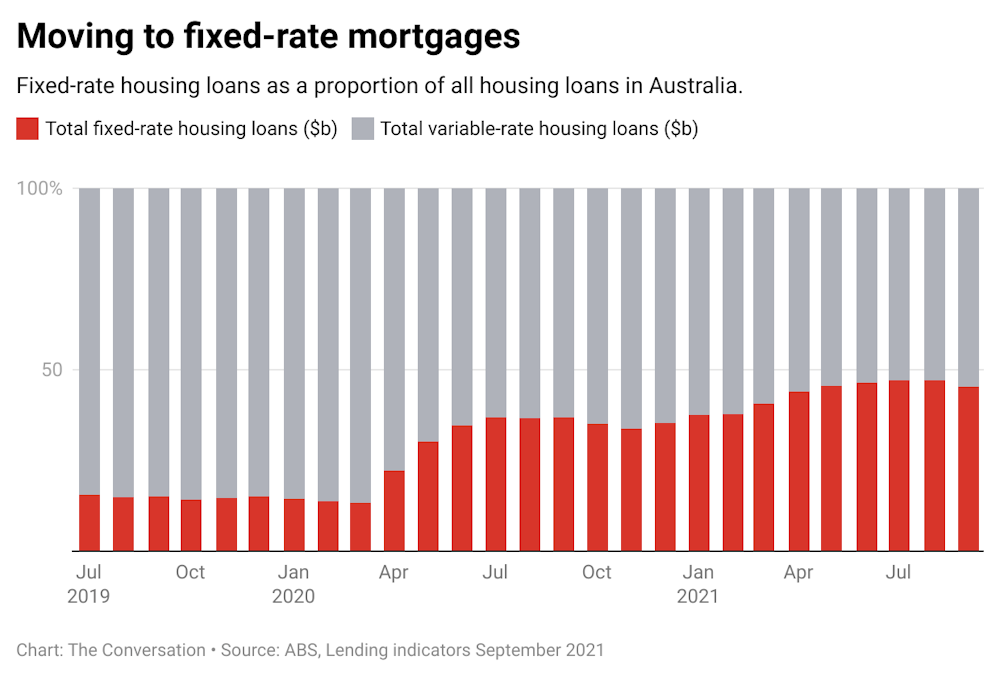

CC BY But even those loans are typically fixed for only three years – sometimes as short as one year, sometimes as long as five years. After that, the rate reverts to the variable rate. Longer fixed-rate loans would insulate Australian borrowers from big swings in interest rates. In the US you can refinance a 30-year fixed mortgage if long-term rates drop. So you benefit if rates go down but are protected if they go up. Read more: Building back better: how RBA Governor Lowe sees the year ahead Another idea to improve loan contract terms for borrowers – long advocated by University of Melbourne economist Kevin Davis – is the so-called “tracker mortgage”. These contracts limit borrowers to paying a certain “spread” over a benchmark interest rate. Such offerings depend in large part on competition in the banking sector. The US has lots of competition in banking. Australia has very little. When costs go up, two groups can bear that cost: customers or shareholders. In Australia when bank funding costs go up, customers bear pretty much all of the cost, and shareholders zero. That’s the best evidence you’ll ever get of true market power. Threading the needle The Reserve Bank is well positioned to drive the official unemployment rate down from 4.2% to the lowest levels in 50 years while keeping inflation under control. It knows when it does increase interest rates this will transmit very directly to the real economy. The challenge for Lowe is to use his interest-rate firepower in true Goldilocks fashion: not too little but not too much. That will be the great central banking challenge of the next several years. If we could restructure the Australian mortgage market to better protect borrowers from swings in interest rates, the job of future RBA governors need not involve such a delicate balancing act. Authors: Richard Holden, Professor of Economics, UNSW

Read more https://theconversation.com/whats-wrong-with-australian-mortgages-theyre-fixed-for-shareholders-not-home-owners-176234

Your Baby's First Year: A Local Guide to Feeding, Sleep, and When to Get Extra Support

Ask ten parents in a Brisbane mothers' group how their baby is feeding or sleeping, and expect ten different answers.  Someone's baby sleeps throu...

Kitchen and Laundry Makeover Ideas That Don't Require a Full Renovation

Full kitchen renos are expensive — and most people don't actually need one.  They need the kitchen to stop looking like it's stuck in 2009, or t...

How Technology Is Reshaping the Modern Australian Commercial Kitchen

The commercial kitchen has always been shaped by technology. Refrigeration changed how ingredients could be stored, modern ventilation transformed k...

The Number on a Roller Blind Fabric That Nobody Explains

Somewhere in the fabric book, next to the colour name, there is a percentage. Three per cent. Five per cent. Ten per cent. Nobody explains it, most c...

What’s Trending in Men’s Jewellery This Father’s Day!

Finding a Father’s Day gift that feels personal, stylish and genuinely wearable is not always easy. While socks and novelty mugs have traditionall...

Road Signs: Understanding Their Role in Clear and Effective Signage

Effective signage and display hardware can help businesses communicate information, promote products and organise customer or visitor movement. Road...

Bottle Label Printing: Key Factors to Consider Before Your Next Packaging Run

Effective packaging begins with understanding the product, bottle material, artwork and production requirements when planning bottle label printing. H...

Planning a Long-Distance Move With Interstate Movers Melbourne

Moving between states involves more planning than a typical local relocation. Along with packing and transporting household belongings, you need to...

Understanding the Role of an I/O Controller in Industrial Automation

Modern industrial systems depend on accurate communication between sensors, machines and control systems. An I/O controller can help manage this commu...

How the Right Mining Hose Supports Demanding Operations

Mining environments place considerable demands on equipment used for material transfer, water management and processing. Hoses operating in these co...

Simple Ideas for Making Social Gatherings More Memorable

We have all been to those parties where everyone just stands around the kitchen island, staring at their phones, waiting for someone else to make a mo...

Outdoor Wall Lights: Improving Exterior Lighting Around Your Home

Lighting can influence how a room looks, feels and functions, so the right fitting should be selected according to both appearance and practical req...

Commercial Office Cleaning: Combining Routine Office Cleaning With Melbourne Service

Keeping a workplace clean requires a service that can accommodate everyday tasks as well as the particular needs of the business. Professional comme...

Caravan Sales in Queensland: How to Find the Right Caravan for Sale QLD

Caravan ownership is about more than having somewhere to sleep while travelling. For many Queenslanders, it is one of the best ways to explore regio...

What Sir Walter Buffalo Turf Actually Costs in 2026 (And Why Quotes Vary So Much)

Two quotes landed on a Hills District homeowner's kitchen table last spring for the exact same 80-square-metre backyard. One said $12 a metre. The o...

Nearly 1,300 NSW Hospital Beds Are Occupied By People Who Are Ready To Go Home

1,276 people in NSW hospitals have been medically cleared for discharge but remain in hospital because they're still waiting for NDIS or aged care sup...

National Survey Launched to Measure Operational Impacts of Federal NDIS Policy Reforms

The effects of recent NDIS reforms are beginning to move beyond policy papers and into day to day service delivery. A new national survey is asking ...

Beyond the Nappy Cake: Baby Shower Gifts That Get Used

What new Australian parents unwrap, keep, and quietly thank you for months later. Six weeks after my daughter was born, I did an audit of the baby sh...















