

7 reasons Australia is the lucky country when it comes to snakes
- Written by Christina N. Zdenek, Lab Manager/Post-doc at the Venom Evolution Lab, The University of Queensland
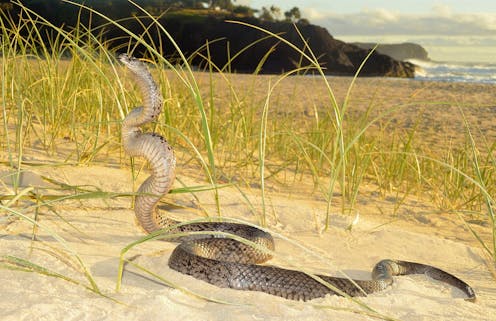
Australia has a global reputation as a land full of danger, where seemingly everything is out to kill you. Crocodiles lurk in estuaries, large spiders hide in bathrooms, and we share our suburbs with some of the world’s most venomous snakes.
Snakes hold a particular fear and fascination for many people. The bite of an eastern brown snake can kill an adult in under an hour. And that’s just one of more than 150 venomous snakes inhabiting the island continent across land and sea. Australian snakes are well and truly overrepresented out of the world’s top 25 most venomous snakes.
Terrifying, right? Not quite. Australians are actually extremely lucky when it comes to snakes. Here are seven reasons why.
1) Our snakes bolt away from us
The best way to survive a snakebite is of course not to be bitten. Keeping your distance is the easiest way to avoid a bite.
But what if you’re walking through the bush and don’t see the snake? Luckily, most Australian snakes will rapidly slither away from us.
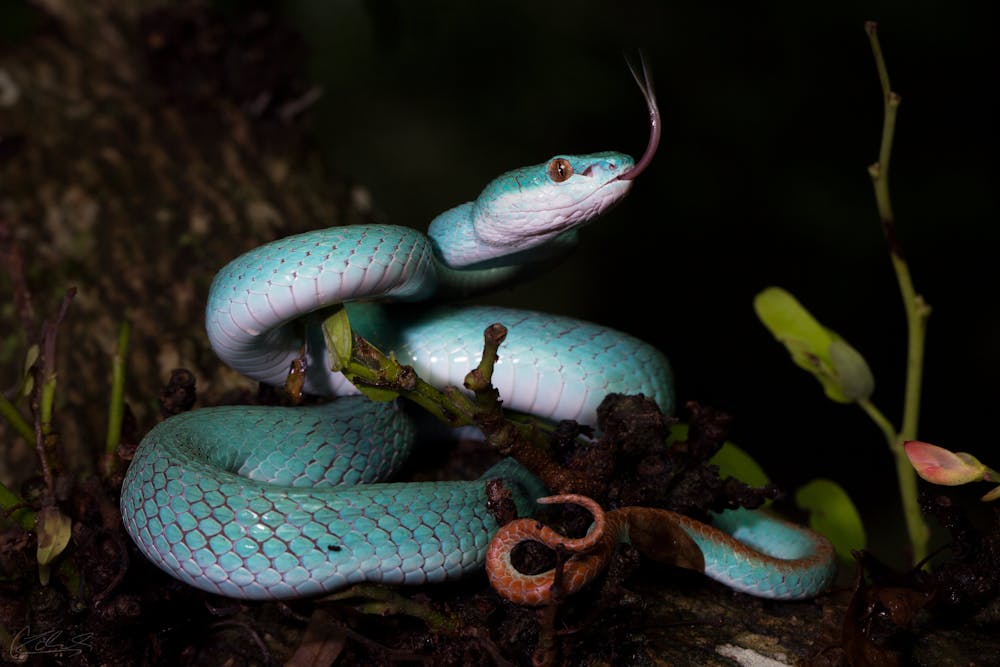
It could be much worse. Imagine if most of our snakes were like vipers or rattlesnakes, which hold their ground and can be easily trodden on. And imagine if our venomous snakes could sense our body heat, as pit vipers and rattlesnakes do with their heat-sensing pits. For Australians, simply staying still can keep you safe.
2) We have very few snakebite deaths
Compared to other countries with many snake species, Australia has orders of magnitude fewer snakebites and related deaths. South Africa has 476 snakebite deaths on average every year. By contrast, Australia has two or three.
3) If you do get bitten, you’re very unlikely to lose a limb
Most snakebites in Australia are completely painless. This is in part due to the short fangs of our brown snakes (Pseudonaja spp.), who are responsible for most bites in Australia, but mainly because most Australian snakes have venom which works internally, rather than locally at the bite site. This means snakebites in Australia very rarely result in amputations.
By contrast, across sub-Saharan Africa it is sadly common, with almost 2400 amputations reported in Africa’s most populous country, Nigeria, every year. Unfortunately, the people most at risk of snakebite are the ones least able to afford the high treatment costs.
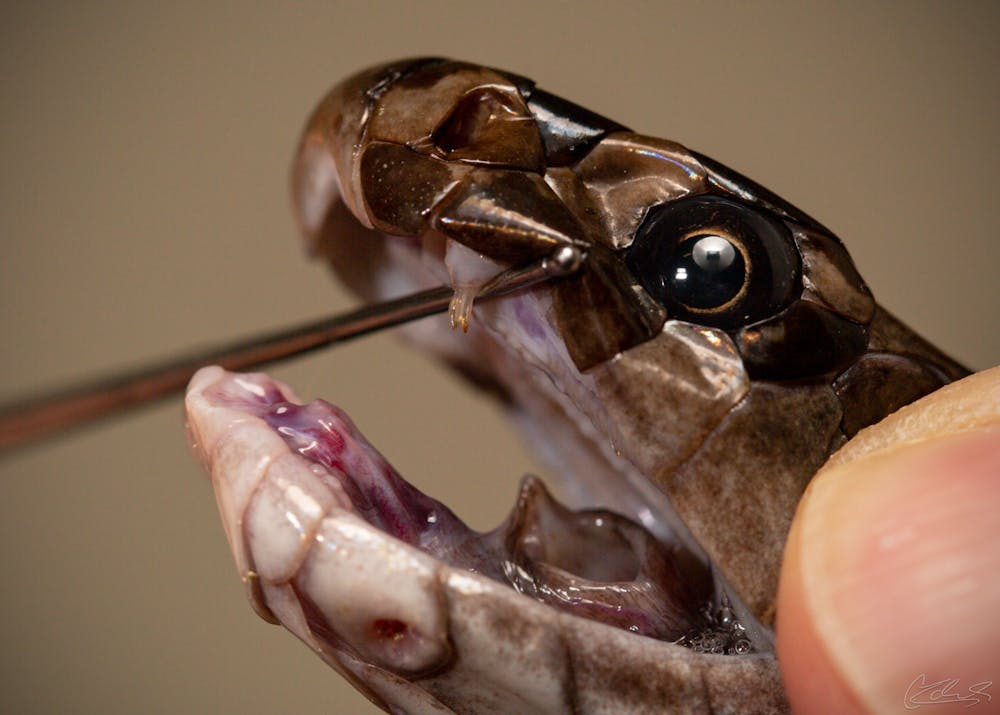 Brown snakes like this dugite (Pseudonaja affinis) have small fangs.
Christina N. Zdenek & Chris Hay
Brown snakes like this dugite (Pseudonaja affinis) have small fangs.
Christina N. Zdenek & Chris Hay
4) We have great access to excellent antivenom and other treatments
For snakebites, antivenom is the only specific treatment. If you’re unlucky enough to be bitten by a highly venomous snake, getting the antivenom as quickly as possible is vital. Luckily, antivenoms work quickly, and ours are high quality.
Antivenom is often produced from purified horse antibodies. It’s well known antivenom can cause anaphylaxis, which occurs around 10% of the time in Australia. These reactions can be quickly reversed by adrenaline administered in a hospital.
By contrast, some other countries have alarmingly ineffective antivenoms as well as triggering anaphylaxis 57% of the time.
Read more: Does Australia really have the deadliest snakes? We debunk 6 common myths
You can get antivenom at 750 hospitals across Australia. For more remote regions, snakebite victims benefit from proven pressure-immobilisation which should be applied before the Royal Flying Doctors come to the rescue.
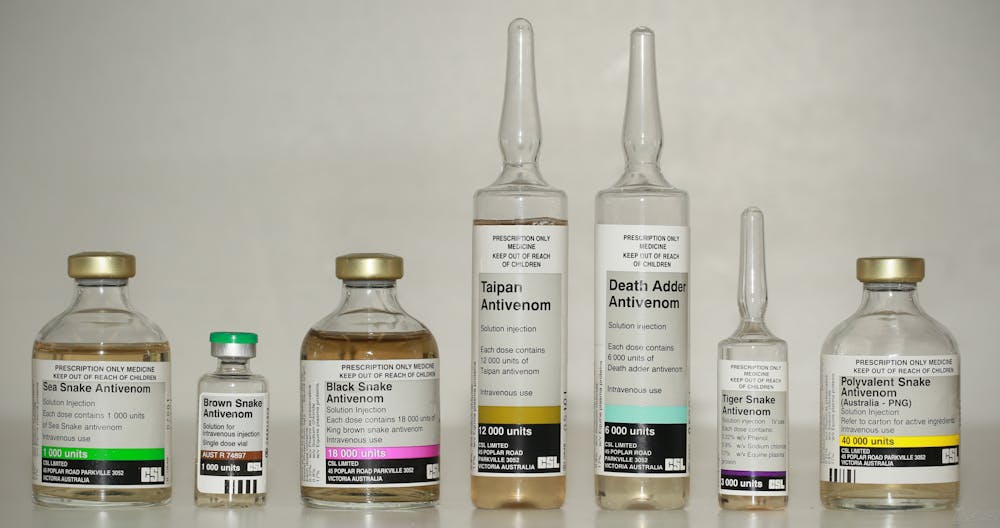 Many quality snake antivenoms are available in Australia.
Christina N. Zdenek
Many quality snake antivenoms are available in Australia.
Christina N. Zdenek
5) We have the world’s only snake venom detection kits
Using the wrong antivenom can lead to the treatment failing. So how do doctors know which antivenom to administer? It’s not via snake identification by the victim because, more often than not, Australians get it wrong.
In 1979, Australia became the first country in the world to have a commercial snake venom detection kit to make antivenom choice more accurate. Even now, we’re the only ones with this option.
Every other country has to rely on more dangerous options. Either the victim brings the snake to hospital for a professional ID, or doctors have to rely on the patient’s symptoms and location where they were bitten to take an educated guess as to which antivenom will work.
As you’d expect, this can be a challenge. Why? Because there can be a great deal of overlap of symptoms caused by venom from unrelated species. Plus, picking the species responsible can take years of experience treating snakebite which many doctors do not have.
In Australia, there’s another option if the kit is unavailable: polyvalent antivenom, effective against all our most dangerous snakes.
6) Snakebites are covered by Medicare
Antivenom can be prohibitively expensive, costing thousands of dollars per dose.
Our nearest neighbour, Papua New Guinea, is a snakebite hotspot. But many people simply do not have the money to pay for the antivenom. In some areas, taipans kill more people than malaria due to the cost of treatment.
In Australia, treatment for a bite may cost around AUD$6,000, but this cost is covered by Medicare. In my lab, we’re working to make snakebite treatment more affordable by testing next-generation snakebite treatments.
7) Snake venom is actually saving lives
To top it all off, snake venom is saving lives. There are six therapeutic drugs on the global market derived from snake venoms, with another two in clinical trials.
Our many venomous snake species hold in their venom glands a mini drug library, a cornucopia for scientists to trawl through looking for promising new therapeutic drugs. In fact, a toxin from the venom of eastern brown snakes (P. textilis) is being tested as a drug used to reverse life-threatening bleeding complications.
Rather than fearing our venomous snakes, let’s try seeing them as they are.
They pose little risk to us. They flee from us. Their bites can usually be cured quickly. Their venom holds therapeutic promise. And they play a vital role in keeping down the numbers of introduced rats and mice.
So let’s take a moment to appreciate Australia’s wealth of beautiful snakes.
Authors: Christina N. Zdenek, Lab Manager/Post-doc at the Venom Evolution Lab, The University of Queensland
Read more https://theconversation.com/7-reasons-australia-is-the-lucky-country-when-it-comes-to-snakes-175188

















