

shutting down immigration did not kickstart the economy
- Written by Brendan Coates, Program Director, Economic Policy, Grattan Institute
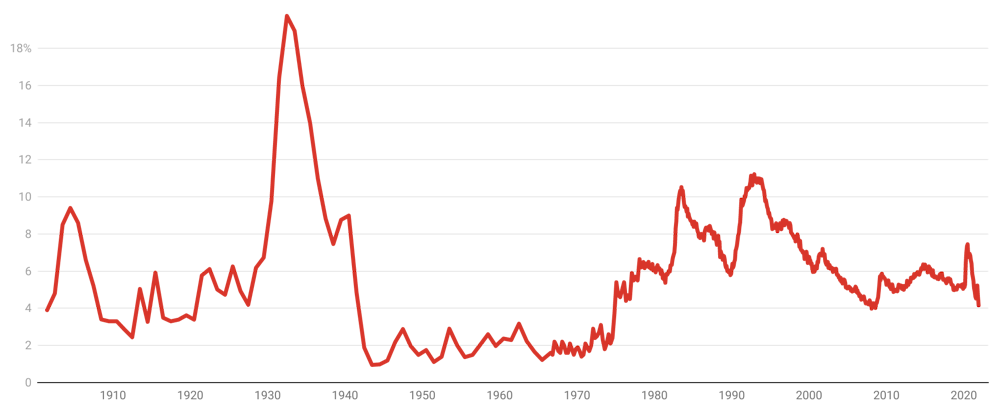
Australia’s unemployment rate – now at 4.2% – is at its lowest in more than a decade. It’s not too far off slipping below 4%, something that hasn’t happened for the best part of half a century.
This good news story has ignited fierce debate over who deserves the credit.
The prime minister and the Reserve Bank governor believe it is them. They delivered both the biggest government stimulus package in history and the lowest interest rates in history.
Australia’s unemployment rate, 1901 to February 2022
But others disagree, most notably ACTU Secretary Sally McManus who tweeted last week that the reason unemployment rates were low was closed borders.
It had “nothing to do” with economic management.
So who’s right? No matter how we run the numbers we find it’s economic management. On balance, closed borders might have helped us, but because they prevented Australians from leaving, rather than others from arriving.
Arrivals boost demand as well as supply
New arrivals (often migrants) most certainly do add to the supply of labour. They compete with pre-existing Australians for jobs.
But that’s only half the story.
The other half is that new arrivals consume goods and services, for a while at a greater rate than Australians who have been here longer. They save less or run down savings in order to do it.
Read more: The government is right – immigration helps us rather than harms us
By buying more, they add to the demand for goods and services, and for workers to produce them.
If migrants enter Australia to work, but then spend more than they are paid, they might even create more jobs than they ‘take’.
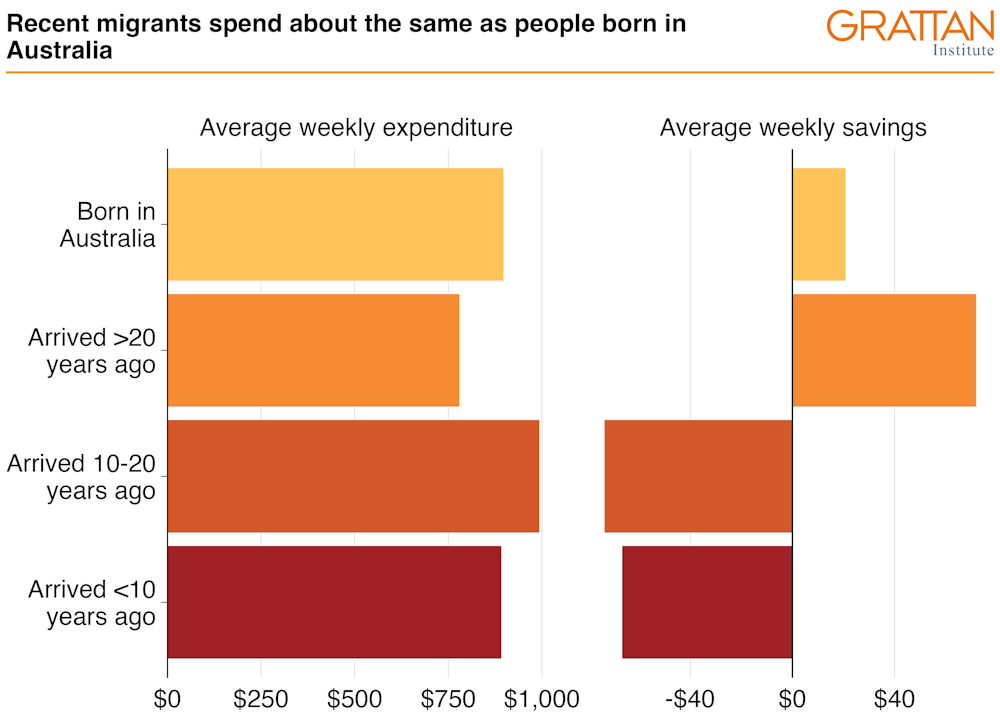 Grattan Institute analysis of ABS household Expenditure Survey 2016
The net effects are small
Most recent research confirms that migrants both take and create jobs, finding little overall impact on the employment or wages of existing workers.
One study even found temporary skilled migrants boosted the wages of lower-skilled Australians by prompting them to move up into higher-paid jobs.
In an in-depth study conducted in 2016, the Productivity Commission concluded
there was almost no evidence that immigration is associated with worse (or better) labour market outcomes for Australian-born people
Of course, the pandemic is a unique event. Research only takes us so far.
But in Europe and the United States where borders remained open, unemployment also fell to near historic lows, suggesting it was something other than closed borders that did it.
But staff shortages are real
The number of migrants fell dramatically after COVID began. This reduced both the supply of and demand for labour, but the composition affected some industries more than others.
Before the pandemic, about one in six workers in hospitality were temporary migrants, many of them international students.
Read more:
COVID halved international student numbers in Australia. The risk now is we lose future skilled workers and citizens
There are roughly half as many international students in Australia now as in 2019. Working holiday makers, who made up about 4% of the agriculture workforce, are almost entirely absent.
The staff shortages are real. Labour supply in those sectors has dramatically shrunk while demand for their services has continued. Eventually those employers will make other arrangements or the supply of backpackers and international students will resume.
Closed borders helped, by keeping Australians here
Oddly, there was an aspect of closed borders that boosted GDP.
As it happens, Australians spend more overseas each year than Australia makes from tourists coming here.
As economist Saul Eslake points out, banning our population from leaving has been a perverse windfall. Money that would have otherwise been spent overseas has been spent at home.
Bureau of Statistics figures suggest that closing the border might have contributed $28 billion to Australia’s trade balance compared to 2019.
It’s stimulus that mattered
Putting the story together in the chart below, it’s clear that stimulus (both “fiscal” from the government, and “monetary” from the Reserve Bank) boosted the economy far more than did closed borders.
The dark-blue bar captures the decline in spending overseas on travel and education as fewer Australians travelled, while the light-blue bar captures both the decline in spending on Australian education and travel, and the effects of fewer working migrants, as fewer visitors arrived.
Both are swamped by stimulus, which is marked in dark and light orange.
Grattan Institute analysis of ABS household Expenditure Survey 2016
The net effects are small
Most recent research confirms that migrants both take and create jobs, finding little overall impact on the employment or wages of existing workers.
One study even found temporary skilled migrants boosted the wages of lower-skilled Australians by prompting them to move up into higher-paid jobs.
In an in-depth study conducted in 2016, the Productivity Commission concluded
there was almost no evidence that immigration is associated with worse (or better) labour market outcomes for Australian-born people
Of course, the pandemic is a unique event. Research only takes us so far.
But in Europe and the United States where borders remained open, unemployment also fell to near historic lows, suggesting it was something other than closed borders that did it.
But staff shortages are real
The number of migrants fell dramatically after COVID began. This reduced both the supply of and demand for labour, but the composition affected some industries more than others.
Before the pandemic, about one in six workers in hospitality were temporary migrants, many of them international students.
Read more:
COVID halved international student numbers in Australia. The risk now is we lose future skilled workers and citizens
There are roughly half as many international students in Australia now as in 2019. Working holiday makers, who made up about 4% of the agriculture workforce, are almost entirely absent.
The staff shortages are real. Labour supply in those sectors has dramatically shrunk while demand for their services has continued. Eventually those employers will make other arrangements or the supply of backpackers and international students will resume.
Closed borders helped, by keeping Australians here
Oddly, there was an aspect of closed borders that boosted GDP.
As it happens, Australians spend more overseas each year than Australia makes from tourists coming here.
As economist Saul Eslake points out, banning our population from leaving has been a perverse windfall. Money that would have otherwise been spent overseas has been spent at home.
Bureau of Statistics figures suggest that closing the border might have contributed $28 billion to Australia’s trade balance compared to 2019.
It’s stimulus that mattered
Putting the story together in the chart below, it’s clear that stimulus (both “fiscal” from the government, and “monetary” from the Reserve Bank) boosted the economy far more than did closed borders.
The dark-blue bar captures the decline in spending overseas on travel and education as fewer Australians travelled, while the light-blue bar captures both the decline in spending on Australian education and travel, and the effects of fewer working migrants, as fewer visitors arrived.
Both are swamped by stimulus, which is marked in dark and light orange.
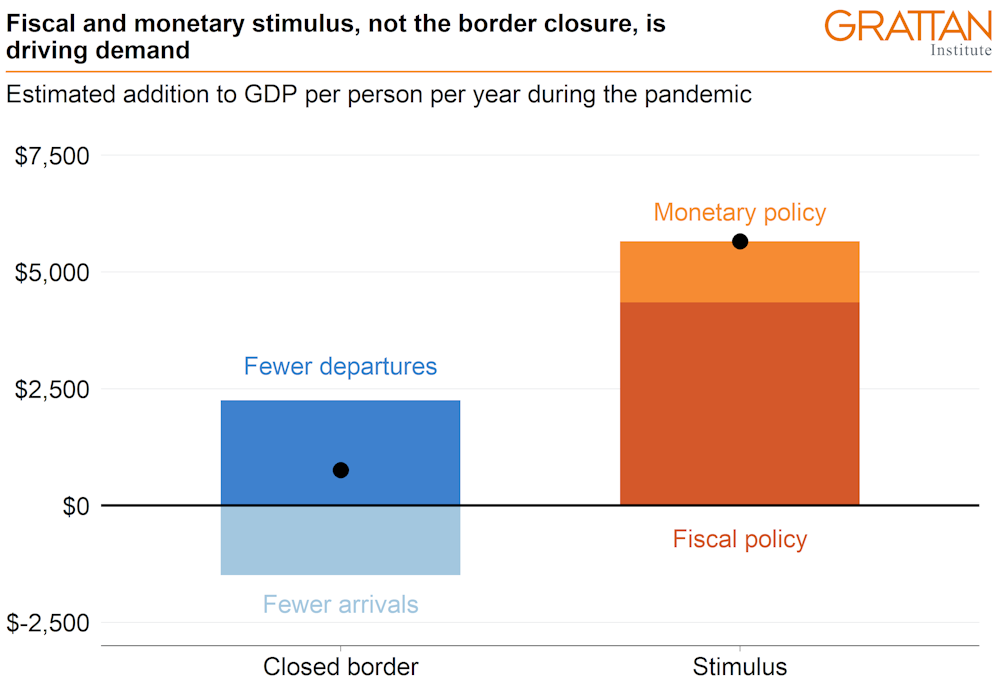 Estimates are current Australian dollars per person per year and subject to revision. Grattan analysis of ABS 5302.0 and IMF and various RBA publications. Click on link for detailed notes
The Federal Government set aside $291 billion for stimulus payments. Including tax breaks and state government support, the International Monetary Fund comes up with a total of $362 billion.
While some JobKeeper ended up in the hands of shareholders, the scale of the stimulus cannot be denied. Assuming a relatively conservative fiscal multiplier of 60 cents for each dollar of fiscal support, these supports are set to boost Australian gross domestic product by $217 billion, or roughly $8,600 per person.
The Reserve Bank’s actions might have added $70 billion to GDP over two years. Without these supports the economy would have found itself in a huge hole during the pandemic.
Read more:
Unemployment below 3% is possible – if Australia budgets for it
Our low unemployment today is a testament to the success of economic policy.
Attributing it to closed borders runs the risk of leaving us with the wrong lesson the next time the economy turns down.
Authors: Brendan Coates, Program Director, Economic Policy, Grattan Institute
Estimates are current Australian dollars per person per year and subject to revision. Grattan analysis of ABS 5302.0 and IMF and various RBA publications. Click on link for detailed notes
The Federal Government set aside $291 billion for stimulus payments. Including tax breaks and state government support, the International Monetary Fund comes up with a total of $362 billion.
While some JobKeeper ended up in the hands of shareholders, the scale of the stimulus cannot be denied. Assuming a relatively conservative fiscal multiplier of 60 cents for each dollar of fiscal support, these supports are set to boost Australian gross domestic product by $217 billion, or roughly $8,600 per person.
The Reserve Bank’s actions might have added $70 billion to GDP over two years. Without these supports the economy would have found itself in a huge hole during the pandemic.
Read more:
Unemployment below 3% is possible – if Australia budgets for it
Our low unemployment today is a testament to the success of economic policy.
Attributing it to closed borders runs the risk of leaving us with the wrong lesson the next time the economy turns down.
Authors: Brendan Coates, Program Director, Economic Policy, Grattan Institute 
















