

Oceans are better at storing carbon than trees. In a warmer future, ocean carbon sinks could help stabilise our planet
- Written by Rupert Sutherland, Professor of tectonics and geophysics, Te Herenga Waka — Victoria University of Wellington
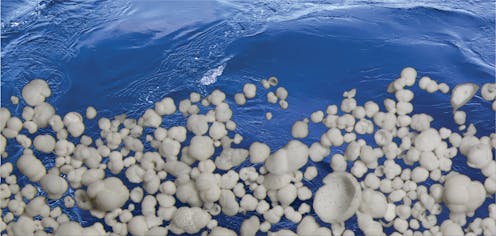
We think of trees and soil as carbon sinks, but the world’s oceans hold far larger carbon stocks and are more effective at storing carbon permanently.
In new research published today, we investigate the long-term rate of permanent carbon removal by seashells of plankton in the ocean near New Zealand.
We show that seashells have drawn down about the same amount of carbon as regional emissions of carbon dioxide, and this process was even higher during ancient periods of climate warming.
Humans are taking carbon out of the ground by burning fossil fuels deposited millions of years ago and putting it into the atmosphere as carbon dioxide. The current rate of new fossil fuel formation is very low. Instead, the main geological (long-term) mechanism of carbon storage today is the formation of seashells that become preserved as sediment on the ocean floor.
The continent of Zealandia is mostly submerged beneath the southwest Pacific Ocean but includes the islands of New Zealand and New Caledonia.
Carbon dioxide emissions from burning fossil fuels on the continent add up to about 45 million tonnes per year, which is 0.12% of the global total.
Our work documents a project that was part of the International Ocean Discovery Program (IODP). Expedition 371 drilled into the seabed of Zealandia to investigate how the continent formed and to analyse ancient environmental changes recorded in its sediments.
Drawing carbon to the ocean floor
Organic carbon in the form of dead plants, algae and animals is mostly eaten by other creatures, mainly bacteria, in both the ocean and in forest soils. Most organisms in the ocean are so small (less than 1mm in size) they remain invisible, but as they die and sink, they transport carbon to the deep ocean. Their shells can accumulate on the seabed to make vast deposits of chalk and limestone.
Read more: Tiny plankton drive processes in the ocean that capture twice as much carbon as scientists thought
The sediments we cored were many hundreds of metres thick and formed during warmer climates that might resemble the decades and centuries to come. We know the past environments from analysis of fossils.
Seashells, which are made of calcium carbonate, sequester significant amounts of carbon. The accumulation rate of shells averaged over the last million years was about 20 tonnes per square kilometre per year.
The total area of the Zealandia continent is about 6 million square kilometres, so the average rate of calcium carbonate storage was about 120 million tonnes per year, which is equivalent to 53 million tonnes of carbon dioxide per year.
This is about the same as emissions from burning fossil fuels on the continent today, within errors of calculation. However, a much larger area than just Zealandia is accumulating microscopic seashells.
The planetary carbon cycle
Earth naturally expels carbon dioxide from mineral springs and volcanoes, as rocks are cooked at depth. This is unlikely to be affected by climate change. The Earth stores carbon dioxide when rocks are altered at the surface and as seashells accumulate on the seabed. Both these mechanisms might be affected by climate change.
The biosphere and oceans also hold significant carbon stocks that are sure to change. It is a complex system and many scientists are trying to understand how it will respond to human activities.
Different parts of the carbon system will respond in different ways and at different rates. Our work provides clues as to what might happen in the ocean.
About 4-8 million years ago, the climate was warmer, carbon dioxide levels were similar or even higher than today, and the ocean was more acidic. However, we found the average accumulation rate of seashells on Zealandia was more than double that of the most recent million years.
This is a pattern seen elsewhere around the world. Warmer climates during this period had oceans that produced more seashells, but these data are average accumulation rates over million-year time scales.
The mechanism by which these ancient warmer oceans produced more seashells remains a subject of ongoing research (including ours).
Rivers and the wind deliver nutrients to the ocean, especially during extreme weather events, and changes can occur over short time scales. At the other extreme, fully integrated climate models show that large-scale reorganisation of ocean currents to enhance the supply of nutrients from deep waters could take centuries or even millennia.
Our work highlights and quantifies the important role the ocean, and particularly the microscopic life within it, will eventually play in restoring balance to our planet. The rate at which dead plankton draw carbon to the deep ocean and small seashells permanently store it on the seabed is a significant proportion of human carbon dioxide emissions and it is likely to increase in the future.
Our work reveals that a warmer ocean may eventually produce more calcium carbonate shells than today’s ocean does, even though ocean acidification will almost certainly occur.
How quickly natural carbon sequestration in the ocean might change remains highly uncertain. It will take many centuries before we reach an ocean state similar to that found 4-8 million years ago.
More work is needed to understand how this transition might occur and whether it is possible and sensible to enhance biological productivity in our oceans to mitigate climate change and maintain or increase biodiversity.
Authors: Rupert Sutherland, Professor of tectonics and geophysics, Te Herenga Waka — Victoria University of Wellington

















