

Modern Australian
Times Advertising

the high-tech tools helping scientists save our wildlife

  • Written by Darcy Watchorn, PhD Candidate, Deakin University
the high-tech tools helping scientists save our wildlife

Around the world, Earth’s natural environments are being destroyed at a truly shocking scale. It means places animals need to shelter and breed, such as tree hollows, rock crevices and reefs, are disappearing.

The only long-term way to protect these animals is to stop destroying their homes. But political resistance, financial interests and other factors often work to prevent this. So scientists must get creative to try and hold off extinction in the short term.

One way they do this is to create artificial habitat structures. Our new research, released today, examines how ingenious, high-tech innovation is making some structures more effective.

But artificial habitats are not a silver bullet. Some can harm animals, and they can be used by developers to distract from the damage their projects cause.

albatross chick in artificial nest
Technology is making some artificial habitat structures more effective. Matthew Newton, WWF Australia

What are artificial habitat structures?

Animals rely on specific environmental features to survive, grow, reproduce and sustain healthy populations. Artificial structures seek to replicate these habitats.

Some artificial homes provide habitat for just one species, while others benefit entire ecological communities.

They’ve been built for a huge variety of animals across the world, such as:

  • boxes which mimic tree hollows, for beetles

  • nests made of coconut husks, for seabirds

  • nests made from mud brick and aerated concrete for the shy albatross

  • “hotels” based on fish traps, for seahorses

  • ceramic poles that provide a surface for spotted handfish to lay eggs

  • textured tiles attached to seawalls that provide habitat for up to 85 marine species.

moss-covered tiles attached to sea wall
Artificial habitat, such as these tiles added to a seawall, can help a species’ short-term prospects. Alex Goad, Reef Design Lab

How do new technologies help?

More recently, wildlife conservationists have partnered with engineers and designers to incorporate new and exciting technologies into artificial habitat design.

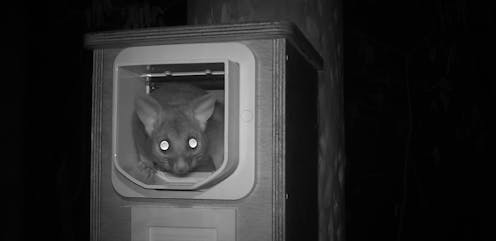
For example, researchers in Queensland recently installed microchip-automated doors on nest boxes for brushtail possums.

The doors opened only for microchipped possums as they came close, and most possums were trained to use them in about 11 days. Such technology may help to keep predators and other animals out of nest boxes provided for threatened species.

In New Zealand, small, native lizards hide from predatory house mice in the crevices of rock piles. Researchers used video game software to visualise these 3D spaces and create “Goldilocks” rock piles - those with crevices big enough to let lizards in, but small enough to exclude mice.

3D printing to create artificial habitats is also becoming increasingly common.

Scientists have used a combination of computer simulation, augmented reality and 3D-printing to create artificial owl nests that resemble termite mounds in trees.

And researchers and designers have created 3D-printed rock pools and reefs to provide habitat for sea life.

Read more: Urban owls are losing their homes. So we're 3D printing them new ones

A 3D-printed, modular artificial reef structure designed by Alex Goad.

It’s not all good news

Collaboration between scientists and engineers has enabled amazing new homes for wildlife, but there’s still lots of room for improvement.

In some instances, artificial habitats may be detrimental to an animal’s health. For example, they may get too hot or be placed in areas with little food or lots of predators.

And artificial habitats can become ineffective if not monitored and maintained.

Artificial habitat structures can also be used to greenwash environmentally destructive projects, or to distract from taking serious action on climate change and habitat loss.

Further, artificial habitat structures are often only feasible at small scales, and can be expensive to build, deploy and maintain.

If the root causes of species decline - including habitat destruction and climate change - aren’t addressed, artificial habitat structures will do little to help wildlife in the long-term.

remains of a logged forest
The root causes of species decline, such as habitat destruction, must be addressed. Darcy Watchorn

What next?

It’s great that conservationists can create high-tech homes for wildlife – but it would be better if they didn’t have to.

Despite the dwindling numbers of countless species, environmental damage continues apace.

Native forests are cut down and rivers are dammed. Ocean shorelines are turned into marinas or seawalls and greenhouse gases are pumped into the atmosphere.

Such actions are the root cause of species decline.

We strongly encourage further collaboration between scientists and engineers to improve artificial habitat structures and help animal conservation. But as we help with one hand, we must stop destroying with the other.

Read more: Artificial refuges are a popular stopgap for habitat destruction, but the science isn't up to scratch

Authors: Darcy Watchorn, PhD Candidate, Deakin University

Read more https://theconversation.com/microchips-3d-printers-augmented-reality-the-high-tech-tools-helping-scientists-save-our-wildlife-176018

Interstate Car Transporter Urges Buyers to Book Early

As the conflict in the Middle East continues to put increasing pressure on local fuel supply, Australian transport companies are experiencing increasi...

Digital Minimalism for Business Owners: Fewer Tools, Better Systems

Be honest. How many apps are open right now? One for scheduling, another for invoices, a third for customer notes, plus a spreadsheet someone email...

The Importance Of Proactive NDIS Renewal Preparation For Sustaining Your Provider Business

Your NDIS renewal notice is not a signal to start preparing. By the time it arrives, preparation should already be well underway. For new providers, s...

Why Fire Extinguisher Testing in Sydney Is Becoming a Records Game, Not Only a Maintenance Job

A fire extinguisher used to feel like one of the simpler parts of building safety. It hung on the wall, wore a service tag, and sat there quietly unle...

The Switchboard Upgrade Question Every Melbourne Renovator Should Ask Before the Walls Close Up

Renovations have a funny way of making people think on surfaces first. Splashback, stone, joinery, tapware, paint. Fair enough too. That is the exciti...

Winter Sanitation Gaps in Parramatta Kitchens: A Hidden Pest Risk

Winter brings a host of changes to our homes, from the chill in the air to the cozy warmth indoors. However, this season also introduces sanitation ch...

When to Seek Advice from Employment Lawyers in Melbourne

Australian employment law is detailed and, at times, complex, with rights and obligations that aren't always obvious to employees or employers witho...

7 Benefits of Professional Gutter Cleaning for Australian Homeowners

Gutters aren't exactly glamorous. They sit up there on the edge of your roof, doing their job quietly - until they stop working. Clogged, overflowing ...

Pipe Floats Strengthening Pipeline Performance In Demanding Environments

Pipelines often travel through environments that are anything but predictable, water currents shift, terrain changes, and materials keep moving unde...

Why Ceiling Fans Are Essential For Comfort, Efficiency, And Modern Living

Creating a comfortable indoor environment is not just about temperature; it is about how air moves, how a room feels, and how efficiently energy is ...

Why Duct Cleaning In Melbourne Is A Smart Investment For Healthier Living Spaces

Behind your walls, ceilings, and vents lies a network quietly working every day to keep your home comfortable. Yet over time, this system can become...

Disability Service Providers Supporting Inclusive And Independent Living

Finding the right support system can feel like assembling a puzzle where every piece must fit just right. For individuals and families navigating di...

A Beginner's Guide to Owning a Caravan in Australia

Owning a caravan opens up a style of travel that's hard to match for freedom and flexibility. However, for those just starting out, the process of c...

Preparing Your Air Conditioner for Summer: What Most Homeowners Overlook

As temperatures rise, many homeowners switch on their air conditioning for the first time in months — only to find it’s not performing the way i...

What Actually Adds Value to Properties in Newcastle

Newcastle has seen steady growth over the past few years, with more buyers looking beyond Sydney for lifestyle, space, and long-term value. As dema...

What is Design and Build in Construction?

Imagine you’re about to start a new construction project, maybe it’s a custom home or a commercial building. You’ve got the idea, the land, an...

Commercial roof leak detection: why early action protects your building

Water ingress is one of the most disruptive and costly issues facing commercial properties. For property managers and facilities teams, even a minor...

Custom Photo Frames: Turning Everyday Moments into Lasting Displays

Photos capture moments, but how you display them determines how they’re experienced every day. A meaningful photograph deserves more than a generi...
















