
in rural Australia, digital coercive control can be inescapable
- Written by: Bridget Harris, Associate professor, Queensland University of Technology
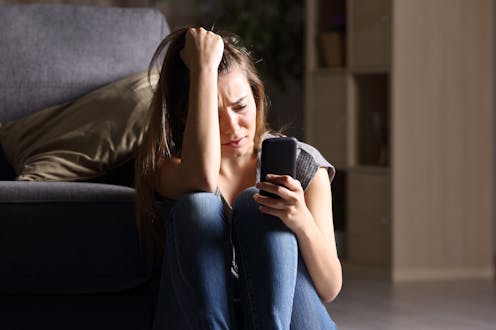
Domestic and family violence perpetrators commonly use technology such as phones and other devices as a weapon to control and entrap victims and survivors, alongside other forms of abuse. This “digital coercive control” is not bound to a particular location and can follow targets anywhere, any time they access devices or digital media.
For women outside urban Australia, technology-enabled abuse can pose more risk than for those in cities. In research funded by the Australian Institute of Criminology, we spoke to 13 such women who have been subjected to digital coercive control to understand what it is like.
The disturbing side of technology
… you see a side of a phone that you probably wish you didn’t know about [Shelly]
The women reported that abusers used technology to harass and stalk. The majority experienced image-based sexual abuse (the creation and/or release of intimate images without consent) or recordings made of victims or survivors, overtly or covertly.
Some experienced doxxing (release of personal and identifiable information). Perpetrators in some cases impersonated real or fake people and initiated contact with women or their children. Authorised functions of phones and other devices and accounts were sometimes impaired, or unauthorised functions enabled.
I think you can feel a lot safer knowing they are not in proximity; they can’t hurt me. When it comes to technology it can – I guess you’re more hyper-vigilant because they can come any time and you can’t stop it. Even if you block someone, they find another way. They do; he always found other means to make contact with me. I never – I guess you never got to escape, which I hadn’t experienced before, because every other type of abuse I was able to – it ended at some point. [Kira]
It is different outside the cities
These behaviours have also been observed in urban settings in Australia. Also, like in cities, we found that violence persisted (and often increased) after separation.
However, women outside cities face higher barriers when seeking help and responding to family violence, and they can also be at greater risk.
Read more: Technology-enabled abuse: how 'safety by design' can reduce stalking and domestic violence
Domestic violence agencies are further from women’s homes in non-urban areas, as we have observed in this study and in other work. Legal services can be limited and there are shortages in alternative and crisis accommodation.
Complicated financial arrangements and pressures may hinder women’s ability to exit violent relationships, such as where they work on farms or other small businesses and there may be few employment and educational opportunities in the region.
No anonymity
Numerous survivors spoke of the lack of anonymity in rural areas, so they and/or their abusers were more likely to be known when disclosing and reporting violence. This can be confronting, especially when perpetrators are well-known and well liked.
He is established - he knows people and he’s well liked … he’s in a boys’ club and knows lots of people … whereas I don’t. [Fiona]
This could be heightened for women with family and networks out of the region or overseas, culturally and linguistically diverse women, criminalised women, or those viewed as “different” outsiders.
Read more: Migrant women are particularly vulnerable to technology-facilitated domestic abuse
As well as actively destroying women’s social networks, abusers would challenge women’s accounts of abuse and attempt to gather allies, as Claire explains:
He went around the streets telling people that I’m crazy … Because we’re in a small country town he was going in and out of shops … He affiliated himself with one of the local churches and got them on his side.
Isolation and fear
Abusers socially isolate women, and those in non-urban areas are often socially further from family, friends and support services than those urban areas. We found too, that some abusers sought to extend geographic isolation, by moving women to more remote locations.
Technology could provide channels to communicate with others and to seek assistance and support. Natalie had “a good amount of friends” and so would be “on the phone, or I’d be texting, and that was my outlet for a crazy situation”. However, some women felt this was not always possible when devices had been taken over or were monitored by abusers.
[I was] too scared to use it [technology]. I just couldn’t reach out to people … I didn’t want to use it just in case [Lola]
Fear loomed large in women’s accounts of digital coercive control. All those we spoke to had contact with police.
Some had positive encounters, most commonly with specialist (domestic and family violence liaison officers, who are less available in many rural areas) but more spoke of negative encounters. Women who were dissatisfied with police felt that officers were dismissive of digital coercive control.
‘Homicide flags’
We believe digital coercive control warrants attention. Coercive control, obsessive tendencies, stalking, and threats to kill or self-harm have all been noted as signals of fatal violence by death review teams.
The women we interviewed reported all these behaviours. Non-fatal strangulation is another “homicide flag” and was reported by 46% of our participants.
Firearm ownership and threats to use firearms also signal high risk. Firearm ownership is common on farms and in many rural areas.
An assault can become a homicide in rural areas, because of the sheer distance between the site of an attack and a hospital or medic.
It is imperative that we acknowledge and address how technology is used against survivors and the impact that technology-facilitated abuse has on women across landscapes. We must also recognise that women in rural locations face elevated risks, and that digital coercive control can provide evidence and signal risk of fatal violence.
Pseudonyms have been used for the women quoted in this article.
The National Sexual Assault, Family & Domestic Violence Counselling Line – 1800 RESPECT (1800 737 732) – is available 24 hours a day, seven days a week for any Australian who has experienced, or is at risk of, family and domestic violence and/or sexual assault.
Authors: Bridget Harris, Associate professor, Queensland University of Technology


















