
An international treaty to curb plastic pollution risks being watered down — New Zealand needs to take a stand
- Written by: Trisia Farrelly, Associate Professor, Massey University
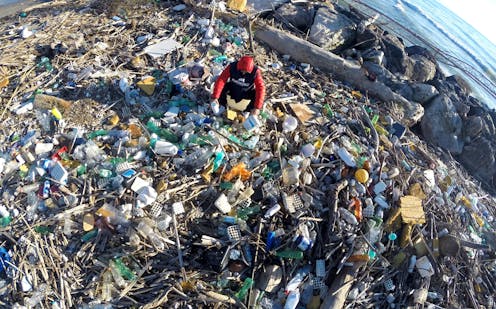
Following years of discussions, support for a global treaty to stem the tide of plastic pollution is now widespread, with 75% of UN member states backing the idea.
Next week, countries will negotiate two competing resolutions in the lead-up to the UN Environment Assembly. Both resolutions call for the establishment of an intergovernmental negotiating committee to start work on a legally binding treaty.
The negotiations are a crucial moment for the New Zealand government. More than 750 groups — including civil society, Indigenous peoples, trade unions and youth groups — are calling for a binding treaty that captures the full life cycle of plastics.
New Zealand has so far only expressed general support for a plastics treaty, but has not co-sponsored either of the two resolutions. More than 300 scientists and research organisations are calling on all UN member states to accept nothing less than the key elements of the stronger Rwanda-Peru resolution.
Global production of plastics is set to double and marine plastic pollution is predicted to triple by 2040.
Both resolutions call for quick negotiations, a legally binding agreement, national action plans, technical support and innovations.
But there are fundamental differences between the Rwanda-Peru and Japan resolutions in terms of the mandate and overall vision.
Read more: We need a legally binding treaty to make plastic pollution history
Solutions to match the severity of the plastic crisis
The Peru-Rwanda resolution is commensurate with the gravity of the plastic pollution crisis. It has the backing of more than 70 countries, including 27 from the European Union. It was the result of a consultative process and has widespread support among civil-society organisations.
Japan’s resolution has only three co-sponsors to date: Cambodia, Palau and Sri Lanka. It has been described as the “skin” of the Rwanda-Peru resolution “without the muscle” — a significantly diluted version.
The Rwanda-Peru resolution proposes a legally binding agreement which addresses the full life cycle of plastics. This covers the extraction of fossil fuels for the production of plastics, manufacture and consumption, end-of-life management and the safe retrieval of legacy plastics.
Read more: Plastic is part of the carbon cycle and needs to be included in climate calculations
It sets out an open mandate for the intergovernmental negotiating committee. This means negotiators could work on a broad range of issues relevant to plastic pollution as discussions progress.
The Rwanda-Peru resolution also requires a scientific advisory committee to ensure all countries have free and open access to the latest science and best practice, financial support for developing countries and coordination with pre-existing international agreements.
Cleaning up ocean plastics is not enough
Japan’s resolution proposes a closed mandate which severely limits what diplomats can consider. This significantly undermines the ability of the intergovernmental negotiating committee to prepare an effective treaty.
This resolution refers to plastics’ “life cycle” but its text prioritises waste management interventions over preventative measures, while further limiting its scope to marine litter.
New Zealand’s government should support the key elements of the Rwanda-Peru resolution. It presents the absolute minimum needed to ensure the global community operates within the safe space of the planetary boundary for “novel entities”, including plastics.
Plastic pollution crosses borders and lasts for generations. This is an opportunity for New Zealand and other UN member states to meet their moral obligation to protect people from its wide range of impacts.
Plastics are threat multipliers. They can act together with other stressors, such as climate change and over-exploitation of marine resources, to cause far greater damage than if they occurred in isolation.
An effective treaty would dramatically reduce the volume of persistent toxic plastics released into the biosphere. Simultaneously, it would also reduce the impacts of escalating plastic pollution on the climate, human health, human rights and biodiversity.
Read more: Plastic in the ocean kills more threatened albatrosses than we thought
The Ministry for the Environment says the New Zealand government supports a global treaty, but “the overall scope, level of ambition, and nature of commitments of a global agreement all remain subject to negotiations”.
If we are to realise a treaty with long-term and effective outcomes, New Zealand will need to negotiate hard for an agreement with a sufficiently wide scope and high ambition.
The international scientific community is clear. Efforts focusing only on waste management will not scale up to the crisis. The priority must be prevention and product redesign.
Turning off the tap at the point of production offers the largest reduction of plastic pollution. It often represents net savings to consumers and producers, while providing the best opportunity to reduce greenhouse gas emissions.
The last thing we want is to come out of negotiations with a treaty that can only respond to waste management and marine litter. This would fail to address the source and impacts of rapidly increasing volumes of global plastic pollution.
Authors: Trisia Farrelly, Associate Professor, Massey University


















