Modern Australian
Times Advertising

Perceptions of corruption are growing in Australia, and it's costing the economy

  • Written by Tony Ward, Fellow in Historical Studies, The University of Melbourne
Perceptions of corruption are growing in Australia, and it's costing the economy

The Australian government has decided not to establish a federal anti-corruption watchdog this parliamentary term, despite a promise in December 2018 to deliver an integrity commission

with teeth, resources and proper processes that will protect the integrity of Australia’s Commonwealth public administration

In the three years since that promise was made, Australia has slipped further down the international corruption league tables.

On the respected Corruption Perceptions Index compiled by Transparency International, it is now in 18th position, down from 13th in 2018.

A decade ago Australia was seventh.

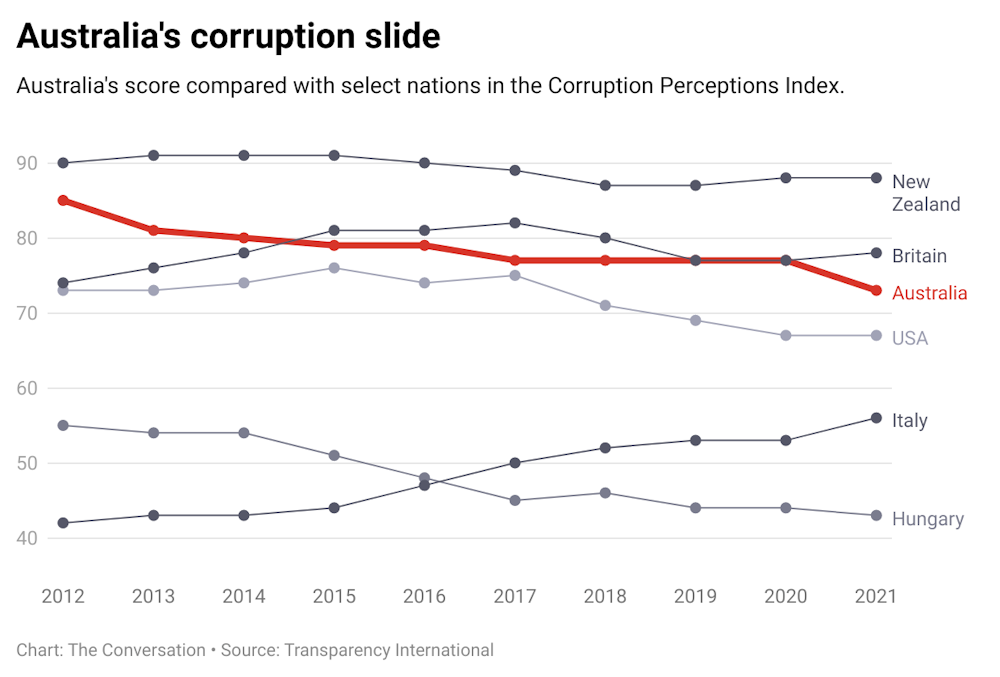
The Corruption Perceptions Index both ranks and rates countries on a scale out of 100. Australia’s score in 2012 was 85. In 2021 it was 73.

This 12-point drop is, along with Hungary’s fall from 55 to 43, equal worst among the 38 nations in the OECD – the economies with institutions and cultures most comparable to Australia.

New Zealand, by comparison, has consistently been in the top three, with scores between 88 and 91.

CC BY Does Australia’s decline in this index really matter? Its score is, after all, still comparatively high, and the Corruption Perceptions Index is only a proxy measure of corruption. Yes, it does. Dozens of studies have demonstrated the corrosive economic effect of corruption, and perceptions are almost as important as reality in guiding economic decisions. Read more: Australia and Norway were once tied in global anti-corruption rankings. Now, we're heading in opposite directions Based on studies correlating corruption indices with economic impacts, I estimate the difference between Australia’s 2012 and 2021 ratings equates to 0.6% lower economic growth. This translates to about 60,000 extra new jobs and an extra A$10 billion in government revenue a year. The value of measuring perceptions Because corruption is hard to measure – not least because it’s generally illegal – the Corruption Perceptions Index does the next best thing. Measuring perceptions is useful, particularly when considering economic impacts. Perceptions are critical in investment decisions – whether it be a major corporation investing in a billion-dollar project, a small business borrowing money to expand, or an individual taking on a debt to get a university degree. Any impression a system is “rigged”, and that “who you know” is more important than how hard or smart you work, acts as a disincentive against taking risks. Read more: It's the luxuries that give it away. To fight corruption, follow the goods The Corruption Perceptions Index’s credentials are strengthened by it being a survey of expert surveys, drawing on 13 different data sources from 12 authoritative institutions. These include the World Economic Forum’s Executive Opinion Survey, the World Justice Project’s Rule of Law Index, the Economist Intelligence Unit’s Country Risk Ratings and the World Bank’s Policy and Institutional Assessment. In June 2021, 59 former judges, lawyers and 'eminent Australians' signed an open letter to Prime Minister Scott Morrison calling for the urgent establishment of a National Integrity Commission. In June 2021 an open letter to Prime Minister Scott Morrison signed by 59 former judges, lawyers and ‘eminent Australians’ called for the urgent establishment of a National Integrity Commission, as promised in 2018. Mick Tsikas The index is focused on public-sector corruption – from misusing public institutions for private or political gain to outright fraud and bribery. Many of its sources also incorporate perceptions of broader corruption. According to a 2018 World Bank review of eight major corruption measures, this “composite methodology” makes the Corruption Perceptions Index the most valid measure of the magnitude of overall corruption in many countries. Calculating economic impacts To estimate the economic impact of Australia’s falling score, I’ve drawn on the extensive body of economic research done over the past 30 years quantifying the impact of corruption on economic growth. A useful overview of these many studies came from a 2011 meta-analysis for the United Kingdom government by University of London economists Mehmet Ugur and Nandini Dasgupta. They sorted through more than 1,000 papers, analysing 115 of those studies in detail to calculate concrete numbers for the relationship between corruption index scores and economic performance. Read more: Equality: our secret weapon to fight corruption They created a six-point corruption scale from “0” (very corrupt) to “6”. Every one-point change on this six-point scale, they calculated, increased or reduced per capita economic growth by, on average, 0.86% a year. Each one-point change on their scale equals a 17-point change on the Corruption Perceptions Index 100-point scale, meaning Australia’s 12-point decline suggests 0.6% less income per capita. What this means for Australia It suggests that if Australia had the same Corruption Perceptions Index score as in 2012, therefore, it would enjoy GDP per capita growth of 2.2% over the next few years instead of Treasury’s forecast 1.6%. In terms of jobs, the Treasury forecasts 1.6% annual growth between 2022 to 2025 – about an extra 200,000 jobs per year. An extra 0.5% would lift that growth by 60,000 jobs per year. The calculations are necessarily rough. International averages don’t automatically translate to a specific nation’s circumstances. However, Ugur and Dasgupta’s study finds higher economic effects apply in wealthier countries, meaning applying the average effect to Australia might produce an underestimate. The result is also broadly consistent with an International Monetary Fund study, published in 2016 linking a 22-point improvement on the Corruption Perceptions Index to a tax revenue increase equal to 0.88% of GDP. Applying this to Australia’s performance would suggest its 12-point decline is costing government revenue some 0.5% of GDP - that’s $10 billion - a year. Perceptions of corruption do matter. These results suggest they go well beyond integrity and good governance. Simply put, an effective integrity commission and other steps tackling corruption are both sensible economic management and good budget repair. Authors: Tony Ward, Fellow in Historical Studies, The University of Melbourne

Read more https://theconversation.com/perceptions-of-corruption-are-growing-in-australia-and-its-costing-the-economy-176562

Interstate Car Transporter Urges Buyers to Book Early

As the conflict in the Middle East continues to put increasing pressure on local fuel supply, Australian transport companies are experiencing increasi...

Digital Minimalism for Business Owners: Fewer Tools, Better Systems

Be honest. How many apps are open right now? One for scheduling, another for invoices, a third for customer notes, plus a spreadsheet someone email...

The Importance Of Proactive NDIS Renewal Preparation For Sustaining Your Provider Business

Your NDIS renewal notice is not a signal to start preparing. By the time it arrives, preparation should already be well underway. For new providers, s...

Why Fire Extinguisher Testing in Sydney Is Becoming a Records Game, Not Only a Maintenance Job

A fire extinguisher used to feel like one of the simpler parts of building safety. It hung on the wall, wore a service tag, and sat there quietly unle...

The Switchboard Upgrade Question Every Melbourne Renovator Should Ask Before the Walls Close Up

Renovations have a funny way of making people think on surfaces first. Splashback, stone, joinery, tapware, paint. Fair enough too. That is the exciti...

Winter Sanitation Gaps in Parramatta Kitchens: A Hidden Pest Risk

Winter brings a host of changes to our homes, from the chill in the air to the cozy warmth indoors. However, this season also introduces sanitation ch...

When to Seek Advice from Employment Lawyers in Melbourne

Australian employment law is detailed and, at times, complex, with rights and obligations that aren't always obvious to employees or employers witho...

7 Benefits of Professional Gutter Cleaning for Australian Homeowners

Gutters aren't exactly glamorous. They sit up there on the edge of your roof, doing their job quietly - until they stop working. Clogged, overflowing ...

Pipe Floats Strengthening Pipeline Performance In Demanding Environments

Pipelines often travel through environments that are anything but predictable, water currents shift, terrain changes, and materials keep moving unde...

Why Ceiling Fans Are Essential For Comfort, Efficiency, And Modern Living

Creating a comfortable indoor environment is not just about temperature; it is about how air moves, how a room feels, and how efficiently energy is ...

Why Duct Cleaning In Melbourne Is A Smart Investment For Healthier Living Spaces

Behind your walls, ceilings, and vents lies a network quietly working every day to keep your home comfortable. Yet over time, this system can become...

Disability Service Providers Supporting Inclusive And Independent Living

Finding the right support system can feel like assembling a puzzle where every piece must fit just right. For individuals and families navigating di...

A Beginner's Guide to Owning a Caravan in Australia

Owning a caravan opens up a style of travel that's hard to match for freedom and flexibility. However, for those just starting out, the process of c...

Preparing Your Air Conditioner for Summer: What Most Homeowners Overlook

As temperatures rise, many homeowners switch on their air conditioning for the first time in months — only to find it’s not performing the way i...

What Actually Adds Value to Properties in Newcastle

Newcastle has seen steady growth over the past few years, with more buyers looking beyond Sydney for lifestyle, space, and long-term value. As dema...

What is Design and Build in Construction?

Imagine you’re about to start a new construction project, maybe it’s a custom home or a commercial building. You’ve got the idea, the land, an...

Commercial roof leak detection: why early action protects your building

Water ingress is one of the most disruptive and costly issues facing commercial properties. For property managers and facilities teams, even a minor...

Custom Photo Frames: Turning Everyday Moments into Lasting Displays

Photos capture moments, but how you display them determines how they’re experienced every day. A meaningful photograph deserves more than a generi...