

Please excuse me, is there a place for politeness in Australian politics?
- Written by: Katherine (Kate) Power, Lecturer in Management, School of Business, The University of Queensland
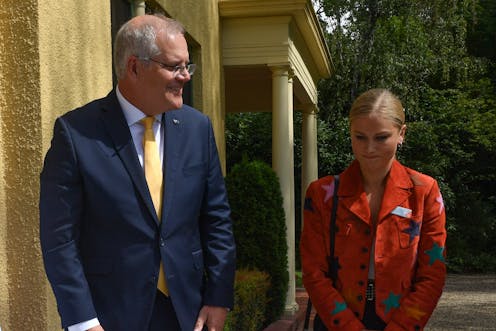
Since former Australian of the Year Grace Tame declined to smile in a photo opportunity with Prime Minister Scott Morrison, debate has raged about what counts as politeness and impoliteness in Australian political debate.
Jenny Morrison recently told 60 Minutes she wants her daughters to grow up “fierce and strong” but also “be polite and have manners”.
Meanwhile, the gloves are well and truly off in Canberra. As Labor claimed Aged Care Services Minister Richard Colbeck had “failed in his job” and should be sacked, Morrison accused opposition leader Anthony Albanese of “clearly [being] on the side of criminals” (during debate about deportation legislation) and labelled deputy leader Richard Marles, a “Manchurian candidate” (over past comments on China).
As we head towards another federal election, the temperature of debate will only increase. Is politeness compatible with politics? And what standards should we expect from our leaders?
Defining “politeness”
In 1978, American linguists Penelope Brown and Stephen C Levinson developed “politeness theory”. This is the most influential scholarly work dealing with politeness. At its heart lies the notion of “face” or the public image we want for ourselves.
There are two types of “face”:
“positive face” – our desire to be “appreciated and approved of”. It can be threatened by accusations, insults and expressions of criticism or contempt.
“negative face” – our desire for autonomy, including both freedom to act and freedom from other people telling us what to do. It can be threatened by orders, requests, advice and threats.
Politeness might mean giving someone approval or praise, or minimising our imposition on them. But there are times when this is not possible or practical. In emergencies, for example, we might yell sharply at someone to get out of harm’s way, or to protect ourselves. As linguistic anthropologists Horst Arndt and Richard W. Janney observe,
To not do this would require a radical suppression of one’s own interests and feelings, and an almost slavish acceptance of those of others. The result would be a total loss of personal face.
In situations such as these, a lack of conventional politeness is not only understandable, it just might be essential.
Defining impoliteness
Politeness theory focuses on what we say, but impoliteness can also be communicated by non-verbal behaviour, such as facial expressions, eye contact, voice quality and body movements. So, not smiling in a photo opportunity may express positive impoliteness. Meanwhile, shaking someone’s hand when they don’t want you to arguably shows negative impoliteness.
Linguist Jonathan Culpeper says impoliteness involves “the absence of politeness […] where it would be expected”. And the more powerful and/or unfamiliar someone is to us, the more polite we are expected to be. He also explains that some behaviours can be perceived as impolite if they just clash with how someone expects or wants them to be.
So, who decides what counts as politeness? And what happens when we disagree?
Context matters
There is a longstanding consensus amongst linguists that nothing is inherently polite or impolite. Rather, the things we communicate take on these meanings from the cultures and contexts in which they happen.
For example, recent research suggests Australia’s brand of politeness prioritises “positive face,” with a high value placed on “being welcoming and showing solidarity and sympathy”. We also have an emphasis on what scholars call, “jocular mockery.” This includes various forms of teasing based on the view that people shouldn’t take themselves too seriously – or what is more commonly known as “taking the piss”.
Read more: From 'Toby Tosspot' to 'Mr Harbourside Mansion', personal insults are an Australian tradition
But ideas about gender also play a significant role in our expectations here. For example, men who don’t smile when they are expected to might be seen as “tough” or “serious”, while women are labelled “rude” or “disrespectful”.
Politeness in politics
Politics is not a warm and fuzzy profession by any means. But in recent years, researchers have tracked a “shameless normalisation” of verbal aggression, insults, racist and misogynistic attacks and hostile forms of humour from leaders such as Donald Trump and Silvio Berlusconi.
Closer to home, last week outgoing Liberal MP Nicolle Flint decried the abuse she has received during her time in politics.
Men on the left, some of whom are public figures of influence, have done the following: they’ve stalked me, suggested I should be strangled, criticised the clothes I wear and the way I look, called me a whiny little bitch repeatedly, repeatedly called me weak, a slut […]
More generally, politicians and scholars have both observed that rudeness is not only expected but rewarded in parliamentary debates.
The risk here is that voters just tune out and turn off (as any regular viewer of parliamentary question time can attest).
Caution: election ahead
Of course there is a difference in how politicians or political opponents behave towards each other and how they behave towards the people whose votes they want.
Politeness can play a potentially important role in image-management. While he was opposition leader, for example, Tony Abbott was quick to distance himself from placards belittling then Prime Minister Julia Gillard, after speaking in front of them at a public rally.
But here voters should take note of linguist Manfred Keinpointner’s warning:
some forms of politeness, such as manipulative or insincere politeness, should be seen as […] impolite.
And as we reflect on what behaviour we expect and want from our political leaders and those who shape the national debate, we also need to ask to whose benefit it is to be - or seem to be - polite. Perhaps what we want more than conventional etiquette is what political scientists call civility – or “respect for the traditions of democracy”.
Authors: Katherine (Kate) Power, Lecturer in Management, School of Business, The University of Queensland


















