

How sport can help young people to become better citizens
- Written by: Vaughan Cruickshank, Program Director – Health and Physical Education, Maths/Science, Faculty of Education, University of Tasmania
Most Australians have followed health advice to wear face masks and have COVID-19 vaccinations. Actions like these that benefit others are known in psychology as prosocial behaviours. In a COVID context, prosocial behaviours reduce the spread of the virus and keep health-care institutions functioning.
The likelihood of prosocial behaviour by an individual is affected by their values. In particular, their social and civic values influence their concern for the welfare of others.
We recently undertook research on possible connections between sport and promoting thinking about social issues and the common good. Working with health and physical education student teachers, we explored shared learning opportunities between two areas of the Australian Curriculum, Health and Physical Education, and Civics and Citizenship Education. Fair play, ethical debates and dilemmas, community involvement, identity and inclusivity are areas where sport and civic values intersect.
Civic values help keep people happy and secure in a functional society. In democracies such as Australia, these values include freedom, equality, responsibility, accountability, respect, tolerance and inclusion.
When young people learn these values it helps create a cohesive society. This has become increasingly important in light of COVID misinformation and conspiracy theories, and the various threats to democracy around the world in recent years.
What does sport have to do with civic values?
Adolescence is an important time for developing civic values. Personal life experiences, relationships and social contexts all influence this development. These contexts can include home, school and extracurricular activities such as sport.
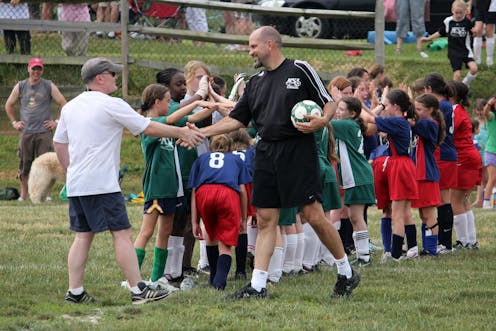
Sport is a big part of the lives of many young people. It provides opportunities for:
- participation
- breaking down cultural barriers
- building community identity
- making friends, developing networks and reducing social isolation.
Sport requires us to work with others to achieve team goals. In this way, it can help children to develop attributes such as altruism and empathy.
In one study, for example, young people taking part in organised sport were more accepting of migrants. Those who did not have contact with migrant children through sport had more negative attitudes.
Read more: Pushing casual sport to the margins threatens cities' social cohesion
Research has noted parents describing sport as a “school of life”. It teaches their children tolerance, teamwork, a sense of duty, the value of hard work, and socialisation skills.
Sport’s development of character and understanding of values such as fair play and respect can benefit young people in their wider lives.
More broadly, by fostering prosocial behaviour, sport can make significant contributions to the common good.
For example, a 2021 review of 13 international studies investigated the effects of sports programs on crime prevention and re-offending. It found participants in these programs had greatly reduced aggressiveness and antisocial behaviour. Their self-esteem and mental well-being improved significantly. The result was a decrease in criminal behaviour.
The creator of basketball, James Naismith, believed the sport taught players values and moral attributes. He developed basketball not just as an indoor game football players could play through the winter, but as a context for young people to learn teamwork, co-operation, fair play, sportsmanship and self-sacrifice. He believed team sports taught the skills essential for a functioning community.
It’s not all rosy
Unfortunately, in elite sports, gamesmanship, greed, cheating and a win-at-any-cost mentality can sometimes be elevated above positive virtues such as courage, co-operation and sportsmanship. In our study, many student teachers referred to news reports with negative messages about cheating, doping and racism.
Read more: Can the cricketers banned for ball tampering ever regain their hero status? It's happened before
Yet our data also highlighted sporting contexts as positive catalysts for reflection and pro-social behaviours. Participants noted examples such as:
“equal pay for men and women (e.g. surfing)”
“evolving attitudes towards mental health issues in sport”
“sportspeople taking the knee in support of the Black Lives Matters movement”
“sport as a breath of fresh air in the context of the restrictions of COVID-19”
“great sporting moments have arisen with the inclusion of disabled or disadvantaged people”.
Sport has recently been a victim of the COVID-19 pandemic. Events have been cancelled and games played in empty stadiums. But sport has also been a shining light for people struggling in lockdown.
Read more: Missing out on PE during lockdowns means students will be playing catch-up
This was particularly true of the 2021 Tokyo Olympics. The International Olympic Committee (IOC) described the event as a beacon of hope after so much of normal life was brought to a standstill. Other commentators have similarly said Tokyo “made sport a shining light in the gloom” and described the Games as “such a welcomed distraction, really highlighted how much sport can bring a smile to people’s faces”.
So, how do we maximise the benefits?
Teaching students about civic values and sport as part of the school curriculum isn’t the only way to foster prosocial behaviour. We can reap its broader benefits for a healthier society by encouraging young people to play sport at school and in the community. Ways to do this include:
governments, schools and community groups promoting physical activity benefits such as better health, increased energy and improved mood and sleep
increasing opportunities to be physically active in school programs, including activities they can enjoy for years after school such as bushwalking and cycling
making students more aware of community clubs and facilities by inviting club staff or volunteers to talk to students and run practical sessions
allowing girls to wear sports uniforms that make them more comfortable and confident, such as clothing that’s stretchy, dark-coloured and hides sweat
helping parents to get involved in their children’s physical activity by offering family activities and providing take-home bags of basic play equipment and activity suggestions
removing barriers to participation such as the cost of club fees and equipment and an overemphasis on competition. This can be done by providing vouchers and promoting other reasons people play sport such as personal achievement and satisfaction, and social interaction.
Read more: Bushwalking and bowls in schools: we need to teach kids activities they'll go on to enjoy
Authors: Vaughan Cruickshank, Program Director – Health and Physical Education, Maths/Science, Faculty of Education, University of Tasmania
Read more https://theconversation.com/how-sport-can-help-young-people-to-become-better-citizens-173733


















