

why fusion won't help us decarbonise
- Written by: Ian Lowe, Emeritus Professor, School of Science, Griffith University
I first heard the standard joke about fusion as an undergraduate physics student in the 1960s: Fusion power is fifty years away – and probably always will be.
More than fifty years later, we still don’t have fusion. That’s because of the huge experimental challenges in recreating a miniature sun on earth.
Still, real progress is being made. This month, UK fusion researchers managed to double previous records of producing energy. Last year, American scientists came close to ignition, the tantalising moment where fusion puts more energy out than it needs to start the reaction. And small, fast-moving fusion startups are making progress using different techniques.
A limitless, clean source of baseload power might be within reach – without the nuclear waste of traditional fission nuclear plants. That’s good, right?
Not quite. While we’re closer than ever to making commercial fusion viable, this new power source simply won’t get here in time to do the heavy lifting of decarbonisation.
We are racing the clock to limit damage from climate change. Luckily, we already have the technologies we need to decarbonise.
How much progress is being made on fusion?
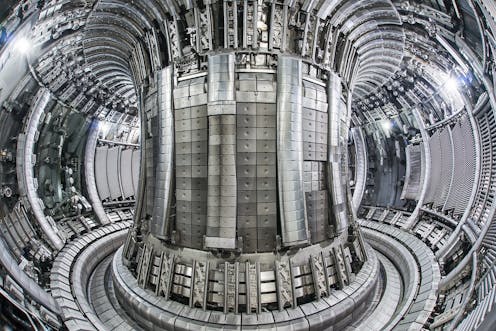
Five seconds. That’s how long the UK’s Joint European Torus was able to sustain a fusion reaction, producing enough energy to run a typical Australian household for about three days. That’s a small fraction of the energy needed to make the fusion reaction happen, which used two 500 megawatt flywheels. That amount of power would meet the peak needs of 100,000 average Australian households. So we are still a long way from getting a net energy benefit from fusion.
On a technical front, achievements like this are incredible. Nuclear fusion is the process that powers stars like the sun, and we are working to harness this for our own use.
Read more: Nuclear fusion: how excited should we be?
At very high temperatures, light atoms such as hydrogen can combine to produce another element such as helium, releasing enormous quantities of energy in the process.
In the sun, these fusion reactions take place at temperatures about 10 million degrees. We can’t do it at that temperature, because we don’t have access to the enormous gravitational pressure at the centre of the sun.
To achieve fusion on earth, we need to go hotter. Much hotter. Experiments like the one in the UK are able to superheat a body of gas called a plasma to inconceivable temperatures, reaching as high as 150 million℃. The plasma has to be confined by incredibly strong magnetic fields and heated by powerful lasers.
This temperature is far hotter than anywhere else in our solar system – even the centre of the sun.
While the recent progress represents a major step forward, sober reflection suggests the dream of limitless clean energy from hydrogen is still a long way off.
On the megaproject front, the next step is the International Thermonuclear Experimental Reactor (ITER) being built in southern France. Far too big for any one country, this is a joint effort by countries including USA, Russia, China, the UK and EU member countries.
The project is enormous, with a vessel ten times the size of the UK reactor and around 5,000 technical experts, scientists and engineers working on it. Famously, the project’s largest magnet is strong enough to lift an aircraft carrier.
Even this enormous project is only expected to produce slightly more power than it uses - around 500 megawatts. The first experiments are expected by 2025.
To me, this illustrates how far away commercial fusion really is.
 Construction of the International Thermonuclear Experimental Reactor megaproject seen from a drone as of October 2021.
ITER Organization, CC BY
Construction of the International Thermonuclear Experimental Reactor megaproject seen from a drone as of October 2021.
ITER Organization, CC BY
Fusion won’t get here in time
It will take decades yet to go from these promising experiments to a proven technology powering modern society. That means it simply will not get here in time to make a real contribution to slowing and reversing climate change.
To have a decent chance of keeping climate change below 2℃, we have to get to net zero emissions worldwide in under 30 years.
Read more: Nuclear fusion breakthrough: what do new results mean for the future of 'infinite' energy?
We can’t wait. We have to decarbonise energy supply and energy use as quickly as possible.
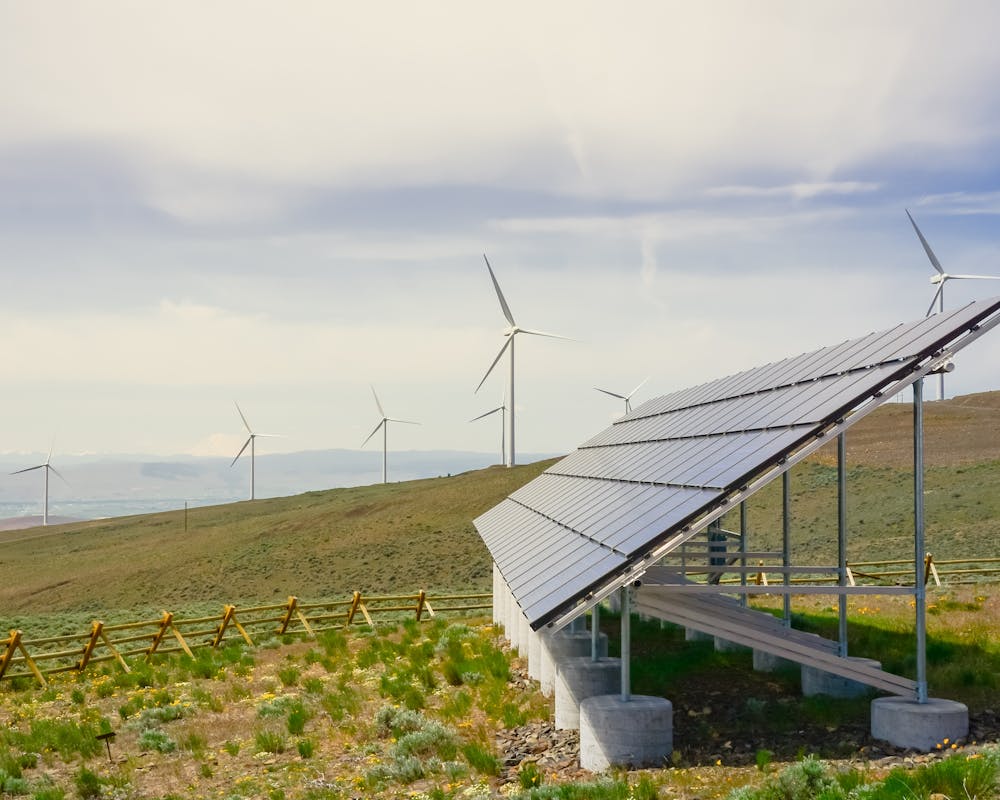
Many countries are already moving at speed. The UK is planning to get to zero-emissions electricity within 12 years. States like South Australia and New South Wales should get there around the same time. The International Energy Agency predicts renewables will become the largest source of electricity generation worldwide by 2025.
The shift away from baseload
Even if fusion arrives, it would face major challenges due to the cost of the plants and the changing nature of the grid.
In the second half of the twentieth century, power stations became larger to achieve economies of scale. That worked, until recently. Only ten years ago, large coal-fired or nuclear power stations produced cheaper electricity than solar farms or wind turbines.
This picture has changed dramatically. In 2020, global average prices of power from new large wind turbines was 4.1 cents per kilowatt-hour, while solar farms were even cheaper at 3.7 c/kWh. The average for new coal? 11.2 c/kWh.
Ever more favourable economics drove a massive investment in renewables in 2020: 127 gigawatts of new solar, 111 of new wind and 20 of hydro-power. By contrast, only 3GW of net nuclear power came online, while coal-fired power actually dropped.
As a result, we’re seeing a global shift away from old models of baseload power, where power is generated in large power stations and transported to us by the grid.
These shifts are driven by cost. The price of electricity from renewables is now falling below the running costs of old coal-fired or nuclear power stations. Coal power requires digging the stuff up, transporting it, and burning it. Renewables get their power source delivered free of charge.
The idea of fusion power is alluring. There’s a real appeal in the idea we could replace large coal and gas stations with one large clean fusion power plant. That, after all, is the selling point of the International Thermonuclear Experimental Reactor: to produce baseload power.
But will we need it? The pattern of power supply is changing. The massive take-up of solar power by households means we have now permanently shifted from the old model of large power stations to one where supply is distributed around the network.
It will be a technological marvel if we are finally able to build fusion plants in the second half of this century. It’s just that they won’t be in time.
Luckily for us, we don’t need fusion. We already have what we need.
Authors: Ian Lowe, Emeritus Professor, School of Science, Griffith University


















