

We want to know where COVID came from. But it’s too soon to expect miracles
- Written by: Hamish McCallum, Director, Centre for Planetary Health and Food Security, Griffith University
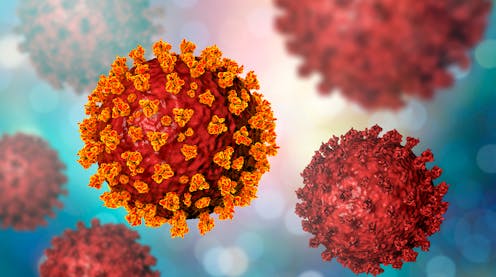
About two years into the pandemic, we’re still trying to find where and how it all started. Only last week, we heard bats in Laos may hold a clue about the origin of SARS-CoV-2, the virus that causes COVID.
Our interest in viral origins, especially pandemic viruses, is understandable. But we need to remember one key lesson from history. It can take years to pin down their animal source.
Here’s why it’s important to keep trying and – in the case of the origin of SARS-CoV-2 – why it’s too soon to expect miracles.
We can learn from the past
Emerging infectious diseases like COVID are becoming an increasing problem. Most are zoonotic. In other words, they originate in non-human animals, mainly wildlife.
However, identifying these animal sources and how the viruses entered human populations is difficult. This is a major problem.
If we can identify sources and routes of spillover, then we should be better able to understand the processes driving emergence of new diseases. This means we could better predict when and where spillover is likely to occur in the future.
Understanding the underlying processes would also help us devise strategies to either reduce the risk of wildlife diseases transferring to humans, or to nip spillover in the bud before an epidemic or pandemic occurs.
Read more: How do viruses mutate and jump species? And why are 'spillovers' becoming more common?
This is all very hard, but predictably so
In the case of SARS-CoV-2, some people say scientists’ inability so far to identify the source wildlife population and to definitely say how the virus entered human populations suggests the virus originated in a laboratory. Yet the lab origin theory has been thoroughly debunked.
However, this delay in finding definitive answers is not unusual. For many recently emerged human viruses, the wildlife source (the natural reservoir) took years to identify, or is still rather unclear.
For example, Ebola has caused devastating outbreaks of deadly haemorrhagic disease in Africa since the 1970s.
Most scientists think bats are the reservoir. Yet no one has yet successfully isolated Ebola virus from a wild bat, despite lots of circumstantial evidence.
How about bats and COVID?
The closest known animal virus to SARS-CoV-2 occurs in a species of horseshoe bat found throughout China and Southeast Asia. That virus is called RaTG13.
Although RaTG13 and SARS-CoV-2 are 96.1% similar in their genetic code overall, this does not necessarily mean the human SARS-CoV-2 came directly from those bats.
In the same way, while chimpanzees are the closest living relatives of humans, we definitely did not descend from chimpanzees, nor did chimpanzees descend from us.
Genetic similarity between two species tells us they are connected in a “family tree” to a common ancestor. The extent of that similarity gives some information about how long it was since the two species arose from that ancestor.
For SARS-CoV-2 and the bat coronavirus RaTG13, this separation likely occurred some decades ago.
Viral family trees have ‘tangles’
To make things more complex, some viruses can also acquire genetic changes via recombination. This occurs when two different virus strains or species infect the same cell. They can swap bits of genetic code with each other, producing a “mosaic” virus. This means the “family tree” becomes more like a tangle of brushwood.
So, rather than looking for a single coronavirus as the ancestor of SARS-CoV-2, we need to look at a whole range of related viruses that might co-occur in nature.
More evidence for this came just last week, in a paper published in the prestigious journal Nature.
It found previously unknown bat viruses in Laos that are not quite as closely related to SARS-CoV-2 as RaTG13 overall. But some of these bat viruses from Laos are more closely related to SARS-CoV-2 than RaTG13 at the particular region that allows the virus to bind to human cells.
This means SARS-CoV-2 likely arose from mixing of different bat coronaviruses in natural bat populations. This is likely how SARS-CoV-2 acquired the genetic sequence that allows it to bind to human cells and infect humans.
Read more: Why it will soon be too late to find out where the COVID-19 virus originated
What about pangolins?
Pangolins are scaly mammals considered a delicacy in parts of Asia and are severely endangered by the wildlife trade. There has been a lot of discussion about the possibility pangolins may have been a bridge species that enabled the transfer of this coronavirus from bats to humans.
These ideas arose because we know some highly pathogenic (disease causing) emerging viruses in humans do indeed have a bridge host. Bats infect them and they, in turn, pass the virus to humans.
For example, we work on Hendra virus in Australia, where horses act as a bridge host. Flying foxes (a type of bat) infect horses, which in turn, infect humans.
Similarly, MERS (Middle East respiratory syndrome) is caused by a coronavirus of bats which has passed to camels and then on to humans.
With the new coronaviruses detected in bats in Laos, our understanding of the role of pangolins has changed. It appears both pangolins and humans are infected by coronaviruses derived from bats, but the human virus did not come via pangolins.
How did a coronavirus get from bats in caves to humans in Wuhan?
This critical question remains a mystery. People go into the caves where these horseshoe bats live, often to collect guano (bat faeces) for fertiliser. But the nearest bat caves are some distance from Wuhan.
No bats were sold in the Wuhan wet market that many of the earliest cases were linked to.
However, Wuhan is a major city and transport hub. So an infected person who had been in those caves may well have passed through Wuhan, and visited the wet markets.
SARS-CoV-2 is now known to infect a wide range of other mammals. So it is also possible a bat or a human may have infected another mammal, which then passed through the Wuhan wet market.
Read more: New preliminary evidence suggests coronavirus jumped from animals to humans multiple times
What do we still want to know?
Lessons learnt from other viruses meant that early on in the SARS-CoV-2 outbreak, we had a solid basis for hypothesising the virus had links to bats and quite possibly arose through a bridging host in the wildlife market.
We still have unanswered questions about the path the virus took from bats to humans. But the more we continue to look in bat populations, the more we find these pieces of SARS-CoV-2 genetic code already exist in nature.
As with other emerging viruses, if we keep looking, we may eventually find all the missing pieces we need to close the case on where SARS-CoV-2 came from. If we’re smart, we’ll use this information to take action to prevent the next pandemic.
Authors: Hamish McCallum, Director, Centre for Planetary Health and Food Security, Griffith University


















