

How the Russian military remade itself into a modern, efficient and deadly fighting machine
- Written by: Alexey D Muraviev, Associate Professor of National Security and Strategic Studies, Curtin University
Russian President Vladimir Putin has described his country’s invasion of Ukraine as a “special military operation”. But from the start, this has not been a narrow, limited military campaign.
The operation has been referred to by some as “Operation Z”, based on the distinctive letter “Z” markings on the Russian military and support vehicles. And it’s the largest and most complex military campaign staged by Moscow since its invasion of Afghanistan in 1979.
It’s also the first chance the world has had to see the full force of Russia’s new-look military machine – a modernised, professional fighting force that has been completely revamped since Russia’s 2008 war with Georgia.
Despite winning that war, the Russians were very critical of their combat performance and embarked on a decade-long defence modernisation campaign, fuelled by a massive increase in military spending of about US$700 billion.
So, what did Russia learn from that conflict militarily, and how are we seeing it play out on the battlefield in Ukraine?
The Z force and Chechen commandos
Russia’s current offensive is being carried out by two new “combined arms” army groups in Russia’s western and southern districts near the Ukrainian border, which were created after Russia’s annexation of Crimea in 2014. These forces integrate different arms of the military – such as armour, infantry, missile and artillery, aviation and engineering – and were prioritised in the reform campaign.
The initial wave of Russia’s invasion force comprised some 60 tactical battalion groups (up to 60,000 personnel), as well as elite airborne troops and special operations forces, the long-range aviation branch of the airspace force (which delivers nuclear or conventional strikes), and the Russian navy.
Read more: Ukraine's military is outgunned but can still inflict a great deal of pain on Russian forces
In addition, the Russians have utilised the so-called people’s militias of the breakaway Donetsk and Luhansk regions – two army corps comprising about 40,000 personnel as their main strike force in eastern Ukraine.
Just like in Syria, the Russians are also using special operations units to perform reconnaissance missions, stage sabotage operations behind enemy lines, and target key political and military leaders, possibly including Ukraine President Volodymyr Zelenskyy.
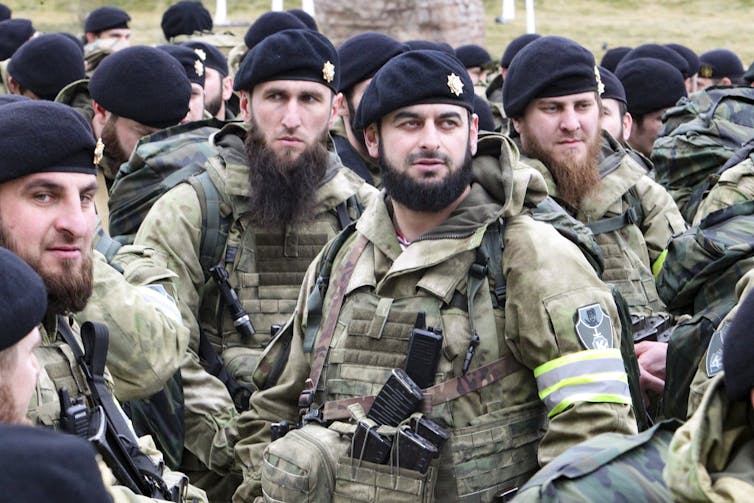
Also noteworthy is the Russians’ extensive use of Chechen special commando units, popularly known as kadyrovtsy.
Known as notorious, battle-hardened, highly motivated and ruthless fighters, the kadyrovtsy are often used to strike fear in opposing forces. The Chechen units have supported most of Russia’s recent military campaigns abroad, including Lebanon, Georgia and Syria. In 2014-15, some Chechen “volunteers” were fighting alongside the pro-Russian separatists in eastern Ukraine.
In the current war, the kadyrovtsy will likely be used in urban operations and during systematic “security sweeps” inside Russia-occupied territories, which will no doubt result in numerous detentions and persecutions.
Russian military objectives so far
The first phase of the offensive has focused on several military objectives, including
multiple waves of coordinated cruise missile attacks and artillery strikes against Ukraine’s military infrastructure (including airfields, radar installations, military command and intelligence headquarters, ammunition depots, oil refineries and army and naval facilities)
large-scale cyber attacks and electronic warfare
simultaneous airborne assaults and raids by special forces deep inside Ukraine, including the capture of the strategically important Hostomel airfield on the outskirts of Kyiv
a massive frontal assault in Donetsk and Luhansk aimed at embroiling Ukrainian forces into a prolonged defensive fight
a partial naval blockade of Ukrainian ports
the capture of several Ukrainian towns.
Although the Russians have faced stiff resistance from Ukrainian forces, they have crucial advantages on the battlefield, including air superiority and control over some strategic zones. The simultaneous military advance on several fronts has also forced the Ukrainian military to respond in a more sporadic way and focus on defensive operations, namely in major urban centres.
Lessons from the Georgian conflict
Such a multi-pronged attack using sophisticated combat systems was not possible in Russia’s five-day war with Georgia in 2008. Although Russia won the war quickly, it sustained significant losses. The conflict revealed glaring deficiencies in its armed forces, which were largely a holdover from the days of the Soviet Union.
For example, the Russian military barely used high-precision munitions or cruise missiles in that conflict. Instead, it was forced to deploy tactical and strategic aircraft in response to a strong Georgian air defence, which shot down a number of Russian aircraft.
In Ukraine, Russia is now relying on long-range, high-precision strikes – from air, sea and land – which have minimised risks to Russian aircraft.
In Georgia, Russia’s ageing tanks and other armoured vehicles entered major urban areas and were forced to engage in protracted street battles. There were other logistical failures on the way to the conflict, with many vehicles breaking down or having road accidents.
In Ukraine, the Russian forces have initially tended to encircle major cities in an attempt to pressure the Ukrainian military to withdraw. The Russians are also intensifying their missile strikes and aerial attacks against urban targets.
And back in 2008, the Russians could do little to prevent the US from docking a warship in a Black Sea port as a show of strength near the theatre of war.
Now, Russian naval battle groups in the eastern Mediterranean are effectively deterring US and NATO fleets from pressuring the Russians on the ground in Ukraine.
What could happen next?
The Russians and Ukrainians have agreed to talks on the Belarus-Ukraine border, but Russia says it will not stop its offensive.
Indeed, its announcement overnight that it was putting its nuclear deterrence forces on high alert signalled a readiness to ramp up its military offensive. The Kremlin is trying to deter the West from supporting Ukraine and applying severe economic pressure on Russia.
Read more: Russia is using an onslaught of cyber attacks to undermine Ukraine's defence capabilities
As part of accelerating its advance, the Russian military is also likely to resort other deadly assets, among them the TOS-1, a heavy flamethrower capable of firing thermobaric weapons. Such weapons, which were used by Russia in the Chechnya and Syria conflicts, use oxygen to generate a high-temperature explosion.
So, what could happen next from a military perspective? Russia’s aims will likely be to:
solidify its strategic control over territory in eastern Ukraine
encircle and defeat Ukrainian forces in Donetsk and Luhansk and overtake Kharkiv, Ukraine’s second-largest city, which is under direct assault
isolate Ukraine from the rest of the world with a full naval blockade and the destruction of remaining airfields, which would slow down the accelerating foreign military assistance
and the main political objective, capture the capital, Kyiv, and install a pro-Russian regime.
The growing resistance of the Ukrainian military will no doubt force the Russians to intensify the tempo of their operations. We should also expect the ferocity of fighting to shift more into urban areas.
Elevating Russia’s strategic nuclear deterrent forces to the “special regime of combat duty” (a near-war condition) increases the risk of the war going beyond Ukraine’s borders, as well.
Authors: Alexey D Muraviev, Associate Professor of National Security and Strategic Studies, Curtin University


















