

Coastal cities are sentinels for climate change. It's where our focus should be as we prepare for inevitable impacts
- Written by: Bruce Glavovic, Professor, Massey University
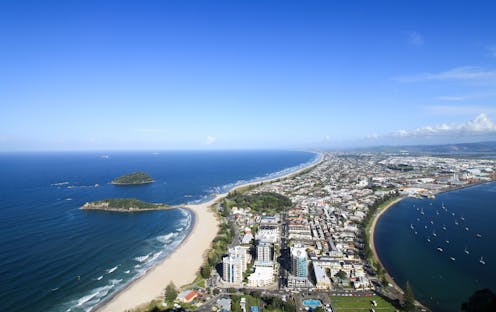
Coastal cities and settlements are on the climate change frontline. They are our first line of defence, facing some of the highest climate risks. But they are also where transformative climate-resilient development can happen.
This is one of the key findings in the Intergovernmental Panel on Climate Change (IPCC) Sixth Assessment Report on Impacts, Adaptation and Vulnerability, released overnight.
I have contributed to the section on coastal cities, which concludes:
Realising global aspirations for climate resilient development depends on the extent to which coastal cities and settlements […] close the coastal adaptation gap, and take urgent action to mitigate greenhouse gas emissions.
This is especially relevant for Aotearoa New Zealand and Australia because our people, the things we value and our economies and livelihoods are concentrated along the shoreline.
Resilient and sustainable coastal livelihoods depend on maintaining diverse, productive and healthy coastal ecosystems in the face of global change.
Severe disruption to coastal livelihoods is inevitable
A large proportion of the world’s population and critical infrastructure is already concentrated along shorelines. Nearly 11% of the global population, about 896 million people, live on low-elevation coasts directly exposed to climate and non-climate coastal hazards. These cities and settlements are growing rapidly as people move to the coast.
Prospects for climate-resilient development are dismal because of accelerating sea-level rise and rapidly worsening climate-driven risks in a warming world. But coastal settlements nonetheless play a key role in advancing climate-resilient development because they are critical for national economies and global maritime trade.
The IPCC’s earlier report showed that global mean sea level has risen faster since 1900 than during any preceding century in at least the last 3000 years. This latest report reiterates that unavoidable sea-level rise will cause cascading and compounding impacts. This includes the loss of coastal ecosystems and their services, groundwater salinisation, flooding and damage to coastal infrastructure.
Globally, we expect about a billion people will be at risk from coast-specific climate hazards under all emissions scenarios. In coming decades, the risk of coastal flooding will increase rapidly. It could be two to three orders of magnitude greater by 2100, without effective adaptation and mitigation.
Historically rare extreme sea-level events (that occurred once in 100 years in the past) will happen annually by 2100. Some atolls will become uninhabitable by 2050. If global mean sea level rises by 0.15m relative to current levels, the population at risk of a 100-year coastal flood increases by about 20%. This number doubles at 0.75m and triples at 1.4m, assuming present-day population and protection.
Sea-level rise as existential threat
By 2100, the value of global assets within one-in-100-year coastal floodplains is projected to reach US$7.9 to $12.7 trillion under a mid-range emissions scenario. In a high-emissions world, it could rise up to $14.2 trillion.
These impacts will be felt well beyond coastal cities. Damage to ports could severely compromise global supply chains and maritime trade, with potentially major geo-political and economic ramifications.
Sea-level rise constitutes a chronic adaptation challenge. It requires dealing with slow-onset changes in parallel with increasing frequency and magnitude of extreme events that will escalate in coming decades. At centennial timescales, projected sea-level rise constitutes an existential threat for many island nations, low-lying coastal zones and their communities, infrastructure and cultural heritage.
Even if we stabilise global warming at 2–2.5℃ above pre-industrial levels, coastlines will continue to reshape over millennia. This will affect at least 25 megacities and, by 2100, inundate low-lying areas currently home to 0.6–1.3 billion people.
Global aspirations for climate-resilient development
Extensive adaptation planning has taken place since the IPCC’s previous assessment. But widespread implementation is lacking and this has created a pronounced “coastal adaptation gap”.
We need to close this gap quickly. The report finds we already have effective ways to prepare for impacts and to cut emissions, but they must be embedded in development planning to reduce vulnerability and restore ecosystems.
This depends on governments, civil society and the private sector making inclusive choices that prioritise risk reduction, equity and justice. We will also need to integrate decision-making processes, finance and actions across all governance levels and timeframes.
International cooperation will be crucial. We will need to strengthen partnerships with traditionally marginalised groups, including youth, Indigenous peoples, local communities and ethnic minorities.
This will require us to reconcile divergent interests, values and worldviews. We need to reduce structural vulnerabilities to climate change through carefully designed and implemented legal and policy interventions, from the local to global level, that take into account prevailing inequities.
Rights-based approaches that focus on capacity building, meaningful participation of the most vulnerable groups and their access to key resources, including finance, play a crucial role in reducing climate risk and enabling transformative adaptation.
Planning and decision-making processes should identify “low regrets” options that allow us to reduce emissions and prepare for impacts in the face of deep uncertainty and contestation. Governance for climate-resilient development is most effective when supported by formal and informal institutions and practices that remain flexible enough to respond to emergent risks.
As sentinels on the climate change frontline, coastal cities and settlements play a pivotal role in global efforts to adapt to unfolding climate change impacts and to navigate perilous times ahead.
This report deepens the findings of the IPCC’s earlier report about the world’s oceans and icescapes. It identifies five core conditions for coastal cities and settlements to fulfil their role in climate-resilient development.
Take a long-term perspective when making short-term decisions by keeping options open to adjust as sea-level rises and avoiding new development in high-risk locations
enable more effective coordination by establishing networks across different governance levels and policy domains to build trust and legitimise decisions
reduce social and climate injustice by taking historical conditions, including past emissions, and prevailing political realities into account and proactively reducing vulnerability and inequity
strengthen local democracy by facilitating participation, involving stakeholders early and consistently through to implementation, with particular attention to engaging Indigenous people and marginalised and vulnerable groups
develop governance capabilities to tackle complex problems by drawing on multiple knowledge systems, including Indigenous, local and scientific knowledge to co-design more acceptable and effective responses.
Authors: Bruce Glavovic, Professor, Massey University


















