

FIFA has finally acted against Russia, but it doesn't undo a long history of cosying up to Putin
- Written by: Keith Rathbone, Senior Lecturer, Modern European History and Sports History, Macquarie University
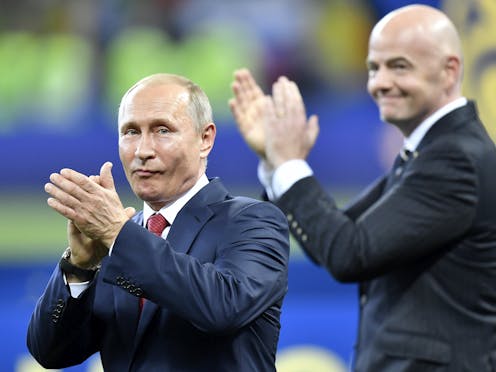
Under intense international pressure, FIFA made an abrupt about-face this week and suspended Russia’s teams from international football. The move means Russia will not have a chance to compete in the 2022 World Cup in Qatar.
For decades, soccer’s global governing body has avowed sporting neutrality, preferring not to politicise sporting events. The federation’s decision to punish Russia for its aggressive war-making represents a small step towards a more politically forward-thinking policy, but its actions fall far short of redressing the harm it has caused in the past.
It also came after international outcry over its initially weak response to Russia, in which it said the team would still be allowed to compete under the name “Football Union of Russia”, at neutral venues and without its flag or anthem.
It took bold steps by countries like Sweden, Poland and the Czech Republic, which flat-out refused to play against any Russian team, for FIFA to change its mind.
What FIFA’s leadership still fails to realise is banning Russia does not introduce politics into sports – it removes the stench of it. FIFA has long allowed dictators – especially Russian President Vladimir Putin – to politicise the game. It now has a responsibility to clean up its own mess.
A long history of Russian sportwashing
FIFA has taken action against belligerent nations before. Following the second world war, both Germany and Japan were prevented from taking part in the 1950 World Cup in Brazil.
FIFA also excluded South Africa from the World Cup during the apartheid era and removed Yugoslavia from qualifying for the 1994 tournament during the war in the Balkans.
But FIFA has had a long history of working alongside Putin and looking the other way when it comes to Russia’s human rights abuses.
The 2018 World Cup, for which FIFA awarded hosting rights to Russia, allowed Putin to trumpet his country’s post-Soviet modernisation. But it came at great cost to soccer’s legitimacy.
After a bribery scandal in the bidding process for the 2018 and 2022 World Cups shook the soccer world, FIFA hired a former US attorney to investigate. He didn’t last long; he resigned in protest and suggested FIFA was incapable of reform.
FIFA refused to move the tournament from Russia even after Russian-backed rebels shot down a Malaysia Airlines plane, the Russian military occupied Crimea, and a former Russian spy was poisoned in the United Kingdom.
Read more: Is Russia worthy of hosting the World Cup?
FIFA had been perfectly placed to make an important statement about the centrality of human rights to the sport. The Russian soccer world was (and still is) deeply connected to Putin and his oligarch backers. Vitaly Mutko, the deputy prime minister of Russia, for instance, was the former chairman of the Russian Football Union and head of the 2018 World Cup organising committee.
But FIFA failed to act then, and was slow to act again this week.
In the face of Russia’s brutal invasion of Ukraine, FIFA President Gianni Infantino could only offer embarrassingly milquetoast comments when questioned by reporters.
Asked if he regretted allowing Putin to host the 2018 World Cup and whether sport had helped “embolden” the Russian leader, Infantino offered cliches. “I firmly believe in sport to bring people together,” he said.
He offered no condemnation of the Russian invasion and refused to comment on whether he would return the Medal of Friendship that Putin awarded him in 2019.
Other sports move quickly to isolate Russia
While FIFA and Infantino prevaricated, other sporting federations acted to isolate Russia.
The Polish Football Association called FIFA’s stance “totally unaccepteable” and said the Polish national team would not play Russia. UEFA, the European football governing body, ended its lucrative sponsorship deal with the Russian energy company Gazprom and moved the Champions League final in May from St Petersburg to Paris.
And French Football Federation President Noël Le Graët told Le Parisien:
The world of sport, and in particular football, cannot remain neutral.
Even the International Olympic Committee, no stranger to working with dictators accused of human rights violations, strongly condemned Russia for violating the Olympic Truce immediately after the invasion.
The IOC went a step further this week, recommending Russian and Belarusian athletes be banned from all international competitions, although it left itself some wiggle room with the Winter Paralympics about to begin in Beijing.
In fact, the sporting world has been almost completely united in pulling its competitions from Russia. Most didn’t wait to act.
Formula One cancelled the Russian Grand Prix, while the international ski and volleyball federations cancelled or moved competitions to other locations. Even the International Chess Federation shifted the Chess Olympiad from Moscow. It remains to be seen, however, whether these events will ban Russian competitors from taking part.
Should Russian athletes be punished?
Many other organisations are going further by already banning Russian competitors or looking to ban them.
The Norwegian Ski Federation banned all Russian competitors from its competitions, while Sweden is pushing for a total ban on Russian athletes competing in the European Union.
In North America, former NHL stars like Dominik Hasek are arguing for the league to suspend Russian players.
These organisations and players realise that Russian athletes competing under a neutral flag still compete for Russia. The IOC might not play the Russian national anthem at the upcoming Paralympics, but Russian state television still celebrates its athletes’ victories and transforms them into symbols of state power and prestige.
Banning Russian athletes might seem unfair because it will impact people who had no say in the invasion of Ukraine. In fact, many Russian athletes are bravely showing their opposition to the Putin regime. But after years of sporting organisations providing exceptions for Russian athletes to continue to compete, a tougher stance is now needed.
Read more: Russian Olympic doping saga shows need for a radically different approach
Authors: Keith Rathbone, Senior Lecturer, Modern European History and Sports History, Macquarie University


















