

Has Xi Jinping miscalculated in aligning himself with Vladimir Putin?
- Written by: Tony Walker, Vice-chancellor's fellow, La Trobe University
As Russia’s attempt to intimidate Ukraine and, presumably, install a puppet regime stumbles into its second week, it is clear the Kremlin has miscalculated on several fronts.
Ukrainian resistance is proving more resilient than anticipated, and a global response, led by the United States, has been more unified and damaging to Russia’s interests than might have been expected.
If not turning into a debacle for Vladimir Putin, the Ukraine war is carrying with it risks for his tenure. Russia’s economic stability is in peril in the face of global economic sanctions such as have not been witnessed in a generation or more.
Putin’s apparent failure to anticipate the full extent of a co-ordinated international pushback against his recklessness remains a mystery.
However, in all of this there is a bigger question. This has to do with China’s contradictory responses to Russia’s ruthless breach of a neighbouring country’s sovereignty.
Read more: Why Vladimir Putin is so confident in his Ukraine strategy – he has a trump card in China
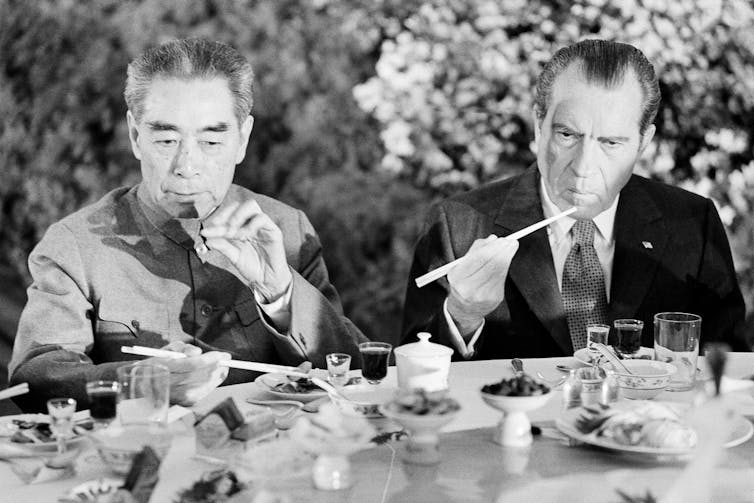
In the diplomatic history of the People’s Republic, there has been a consistent theme. This goes back to Premier Zhou Enlai’s declaration of the Five Principles of Peaceful Co-existence, adopted by the Bandung Conference of Non-Aligned Nations in 1955.
China has used these “five principles”, which begin with “mutual respect for each nation’s territorial integrity and sovereignty”, as a diplomatic shield ever since to rebut criticisms of its conduct internally and assert its views abroad.
Beijing, of course, has not always adhered to these five principles, such as its invasion of Vietnam in 1978, or its persistent border clashes with India, or its aggressive pursuit of its territorial ambitions in the South China Sea.
China’s resort to the five principles to assail others and defend its own misbehaviour has been nothing if not opportunistic.
On the other hand, there has scarcely been a more flagrant breach of national sovereignty, and therefore the five principles, than Russia’s use of brute force to bring a neighbouring country to heel.
China’s responses to the Russian invasion have been contradictory. On one hand, it has sought to justify Putin’s gambit by suggesting an American-led NATO had brought such an outcome on itself by refusing to disavow Ukraine participation.
On the other, it has tried to reassert its belief in non-interference in the sovereign affairs of another country.
This has been an unedifying spectacle, and one that has called into question both the steadfastness of Chinese diplomacy and the judgment of its paramount leader, Xi Jinping.
As much as this is Putin’s war, it is also Xi’s most challenging and confounding moment on a world stage. If Putin and Xi are intent on ushering in a new world order, their experiment in shifting global building blocks is not going well.
A simple question arises. Will Xi continue to double down on a bad bet on Putin’s recklessness, or will he seek cover in China’s traditional adherence to the principles that Zhou Enlai laid down three-quarters of a century ago?
Put simply, will Xi’s ill-starred alignment with Putin, in which the Chinese leader declared in a joint communique in February the Russian leader was his “best friend”, place him in a diplomatic cul de sac?
If Putin has miscalculated in all of this, then so has Xi, in a year of great importance to him personally.
In Chinese Communist Party history, no events assume greater significance than sessions, each five years, of the National Party Congress.
The NPC’s 20th session since the founding of the Community Party of China in 1921 will be held in October.
As things stand, it is anticipated Xi will be anointed for a further five year-term as general secretary of the Chinese Communist Party and president. This will breach the convention introduced during the Deng Xiaoping era that restricted these leadership roles to two terms.
Xi’s confirmation will invite questions as to whether he is being installed as Communist Party leader for life.
From Xi’s perspective, he will not want there to be questions about his judgment in the lead-up to this event.
What is sometimes overlooked in assessments of what is happening in China politically is that behind the scenes, debate and contentiousness, often bitter, are integral to leadership manoeuvring. Power struggles are not absent from this process.
The stakes are high in the world’s most populous country, and soon to be largest economy in US dollar terms. China is already the largest on a purchasing power parity basis.
Xi’s alignment with a Russian miscalculation is clearly not in his or China’s interests.
In this, the US-led response to Putin’s war in Ukraine raises the costs for China in its policy towards Taiwan. Global push-back against Chinese adventurism across the Taiwan Strait would dwarf what is now happening in Eastern Europe.
Inside the Chinese leadership there will be those who will no doubt hark back to the principles on which effective Chinese diplomacy has rested from the days of China’s emerging leadership of the non-aligned movement, through the Deng Xiaoping era to those of Xi’s predecessors, Jiang Zemin and Hu Jintao.
Deng’s “24-character” diplomatic strategy, which emerged in 1990 in response to China’s isolation after the Tiananmen Square bloodshed, guided Beijing for more than a generation until Xi began to preside over a more assertive foreign policy.
Loosely translated, Deng’s advice was:
Observe calmly; secure our position; cope with affairs calmly; hide our capabilities and bide our time; be good at maintaining a low profile; and never claim leadership.
In the years since, Deng’s words have been truncated to read “hide our capabilities, and bide our time” to suggest he was advocating a foreign policy of concealment. On this question there is no definitive answer.
Since he succeeded Hu Jintao as party leader in 2012, Xi has deviated from both the Zhou and Deng principles in the conduct of Chinese foreign policy.
His alignment with Putin would have sat awkwardly with Zhou and Deng, both of whom understood China’s best interests were served by avoiding entanglements that would involve unnecessary cost.
In Xi’s case, the costs could be very high indeed. Nothing would serve China’s interests less than a disruption to global trade flows and a possible recession brought about by the overreach of its principal ally.
Read more: Australia's strategic blind spot: China's newfound intimacy with once-rival Russia
China’s economic well-being, and indeed Xi’s own tenure, depends on the country’s continued economic growth and its dominance as a trading powerhouse. At present, China accounts for about 19%, or nearly one-fifth, of global growth and 15% of global trade.
An upheaval that would stunt China’s ability to continue to export and grow its economy would be very bad news indeed for Xi, whose hold on power depends to a significant extent on his ability to continue to improve living standards.
All of this invites questions about Xi’s judgment and his ability to endure in a system that can be unforgiving.
Authors: Tony Walker, Vice-chancellor's fellow, La Trobe University


















