

The floods have killed at least 21 Australians. Adapting to a harsher climate is now a life-or-death matter
- Written by: Barbara Norman, Professor of Urban & Regional Planning; Chair of the Climate Change Adaptation and Resilience Research Network (CCARRN), University of Canberra
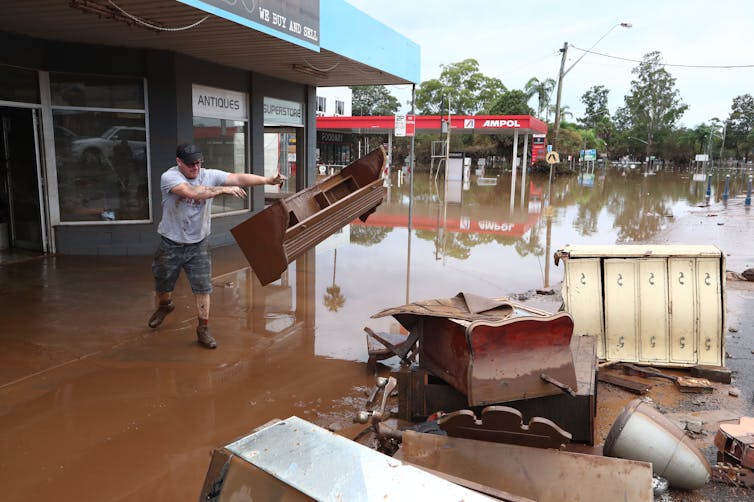
The devastating floods in Queensland and New South Wales highlight, yet again, Australia’s failure to plan for natural disasters. As we’re seeing now in heartbreaking detail, everyday Australians bear the enormous cost of this inaction.
It’s too soon to say whether the current floods are directly linked to climate change. But we know such disasters are becoming more frequent and severe as the climate heats up.
In 2019, Australia ranked last out of 54 nations on its strategy to cope with climate change.
Australia had a chance to lift its game when it released a new climate resilience and adaptation strategy late last year. But the plan was weak and contained no funding or detailed action.
At the time of writing, the current floods had killed at least 21 people across two states and left many thousands homeless. Sydney suburbs were being evacuated amid warnings of more intense rain.
Governments must urgently invest in measures to help communities cope with extreme weather events. As we’re seeing right now, Australian lives depend on it.
Right here, right now
Last week’s report by the Intergovernmental Panel on Climate Change was just one in a long line of warnings about the increasing risk of natural disasters as global warming worsens.
Australian governments are well aware of the problem. In fact, the federal government’s new National Climate Resilience and Adaptation Strategy, launched at the Glasgow climate conference in November last year, stated:
As the global temperature rises and other changes to the climate increase, Australia will face more frequent and severe events, such as extreme weather, fires and floods, and slow-onset events, such as changing rainfall patterns, ocean acidification and sea level rise.
The measures it contained were a start – but communities across Australia need much more, right now.
The strategy contained no new budget commitments or specific programs. It also lacked detailed actions on how to help urban and regional communities prepare for the impacts of climate change.
I have extensive experience in the public sector at all levels of government, in areas such as coastal, urban and regional planning, and climate change adaptation.
I also have first-hand experience of natural disasters. In the 2019-20 Black Summer bushfires my family lost a much-loved holiday home at Mallacoota in Victoria, which we’d held for four generations. I’ve also worked on the ground helping councils and communities prepare for and recover from disasters.
Read more: The east coast rain seems endless. Where on Earth is all the water coming from?
I’m deeply concerned at how badly prepared Australia is for current and future damage from climate change. Australia lacks even the most basic policies and plans, including:
no national coastal plan for coastal erosion and inundation
no national urban policy for climate-resilient development
no national requirement for climate change to be considered in urban and regional land-use plans
no funded national support program for urban and regional communities to adapt to current and future climate risk.
Australia was once a leader in climate adaptation. But this momentum has been lost over the past decade, as the climate wars played out in federal parliament.
And last week, it emerged the federal government has spent just a fraction of the A$4.8 billion emergency fund despite the worsening flood crisis.
This does little to reassure the public that our leaders are focused on helping communities recover from and adapt to natural disasters.
The plan Australians deserve
So what must Australia do to get ready for the harsher future that awaits? Over many years, experts from a range of organisations and disciplines have put their minds to this question. These are some measures they’ve called for:
1. An integrated national climate action plan
This would involve funding and programs for state governments, local councils and industry, enabling them to work with communities to prepare for climate change.
2. A national coastal strategy
Coastal communities are especially vulnerable to storms, floods and bushfires which will worsen under climate change. Leading experts last year outlined the need for a climate change plan tailored to these communities. It would include a national agency to coordinate ocean and coastal governance across tiers of government.
3. Review urban planning legislation and city plans
Planning experts and others have called for climate change considered when making everyday decisions about the built environment. This would lead to more sustainable, pleasant and healthy urban and regional communities, as well as minimising disaster risks.
These decisions include where to locate new housing developments, as well as investing in green buildings and water-sensitive urban design.
And we also need to start conversations with communities at risk, such as those on floodplains or in bushfire-prone areas, to prepare city and town plans that incorporate future risks.
4. Stronger links between organisations
Greater cooperation is needed between emergency management, climate scientists and land-use planners, so they can effectively work together to prepare climate-resilient community plans. Better communication is also needed to ensure knowledge is shared and best-practice is maintained.
5. More money for research and community plans
Governments must fund the development of cutting-edge applied research to better understand and map climate risks. In addition, funding is needed for climate-resilient urban development and to support vulnerable communities through long-term adaptation plans.
Facing hard facts
In just a few years, many Australian communities have weathered a series of natural disasters overlaid by the COVID pandemic. They are exhausted, and deserve better.
Crucially, governments must be prepared to lead on emissions reduction to minimise, as much as we can, damage to Earth’s climate.
But we must also face the reality that natural disasters in Australia will get worse. Communities need practical, funded help now to ensure they survive and thrive as the climate warms.
Authors: Barbara Norman, Professor of Urban & Regional Planning; Chair of the Climate Change Adaptation and Resilience Research Network (CCARRN), University of Canberra


















