

Higher petrol prices hurt, but cutting the fuel excise would harm long-term energy security
- Written by: Vlado Vivoda, Senior Lecturer in Strategic Studies (Australian War College), Deakin University
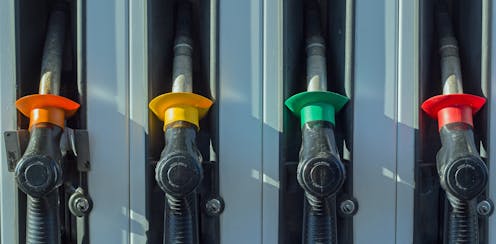
Australian petrol prices are rising as Russia’s invasion of Ukraine pushes up global oil prices. It’s likely motorists will be paying more than $2.15 a litre for unleaded petrol within a few weeks.
In response, independent South Australian senator Rex Patrick has called on the federal government to halve the fuel excise on petrol for 12 months. “Extreme petrol prices are an economic boa constrictor throttling household budgets,” he said this week. “We have to take the pressure off.”
The fuel excise is a fixed amount, currently set at 44.2 cents a litre. Halving it would therefore knock 22.1 cents off the price of petrol.
That would certainly offer some relief at the bowser, and to the economy. It would not, however, serve Australia’s economic and national interests in the longer term.
At a time when world events underline the importance of greater energy security, it would prolong our already alarming dependence on oil-based imports and undermine policies to shift the nation away from fossil fuels.
Read more: What Russia's war means for Australian petrol prices: $2.10 a litre
What is the fuel excise worth?
Calls to cut fuel tax arise whenever Australian petrol prices rise. This is despite Australian taxes – the fuel excise plus 10% GST – being among the lowest rates in the OECD and making little contribution to price increases.
All GST revenue is distributed to state and territory governments. The fuel excise is (theoretically) levied to pay for Australia’s road infrastructure.
In the 2019-20 financial year it collected about $5.6 billion from petrol and about $11.8 billion from diesel (much of which was reimbursed through diesel tax rebates). The net revenue from all fuel excises, according to the Australian Automobile Association, is about $11 billion, a figure that has not substantially increased in the past decade.
Undermining decarbonisation
While making energy prices as cheap as possible does have some short-term economic logic, cutting the fuel excise would undermine the government’s longer term strategic goal to decarbonise the economy.
This is important both for Australia to meet its international obligations to take action on climate change and to look after the narrower national interest of preparing the Australian economy to compete in a carbon-constrained world.
Shifting away from fossil fuels to electric (and some hydrogen fuel-cell) vehicles is a key part of this. The Morrison government has acknowledged this with a target of 30% of all new car sales being electric by 2030. (Electric vehicles made up just under 2% of new car sales in 2021.)
While the government has committed $250 million to its Future Fuels and Vehicles Strategy to help achieve the target, its policy mostly depends on low-emissions vehicles achieving “pricing parity” with internal combustion engines by mid-decade, and for market forces to do the rest.
Slashing the fuel excise won’t do anything to help this plan become reality.
Read more: As petrol prices rise, will carbon emissions come down?
It would also undermine state and territory government spending on policies to encourage the uptake of electric vehicles, through incentives such as stamp-duty waivers, free registration and rebates.
Taking energy security seriously
Moving away from fossil fuels is critical for addressing Australia’s growing energy insecurity.
Read more: Explainer: what is energy security, and how has it changed?
Energy security entails two essential aspects: uninterrupted availability and affordability. It’s an issue Senator Patrick cares about. In mid-Febuary, for example, he joined with the Greens leader Adam Bandt and independent members Andrew Wilkie and Bob Katter to draw attention to the issue, hopping aboard an electric bus built in Sydney for a photo op in front of Old Parliament House.

Energy security doesn’t get much attention during “normal” times, but current events have well and truly underlined the dangers of being overly dependent on foreign supplies.
As Prime Minister Scott Morrison warned this week, the world has entered a period of “profound strategic challenge and disruption”. We are at the mercy of the international market and global supply chains for our supply security and fuel affordability.
Australia’s dependence on oil imports has been growing for at least a decade. Closure of oil refineries along with declining oil production means we now import more than 90% of our petrol needs. Yet we are abundant with renewable resources to generate electricity to power low-emissions vehicles, and the rest of the economy.
The solution to consumers being hostage to foreign oil supplies and volatile global prices will not come from slashing the fuel excise.
It will come from reducing demand for oil-based fuels through policies that promote local energy generation and switching to low-emissions vehicles – like the electric bus that Patrick sat in a just few weeks ago.
Authors: Vlado Vivoda, Senior Lecturer in Strategic Studies (Australian War College), Deakin University


















