

Thinking of buying an electric vehicle for your next car? Here's the market outlook and what to consider
- Written by: Jake Whitehead, Tritum E-Mobility Fellow & Advance Queensland Industry Research Fellow, The University of Queensland
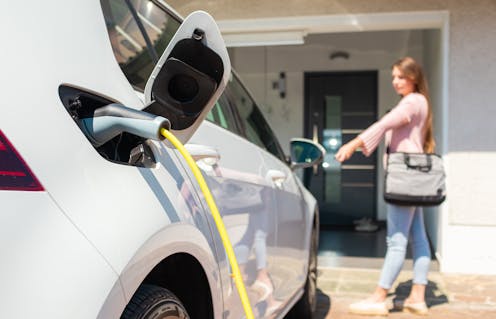
As petrol prices soar and climate change impacts make themselves felt, many people are likely wondering if their next car should be a fully electric vehicle.
Yes, the upfront costs are generally higher – but what does the future hold? Will prices fall in coming years and what costs do you need to factor into your decision?
The unfortunate truth is unless policy settings in Australia change, we shouldn’t expect a significant increase in the number of electric vehicles (EVs) available to Australians over the coming years.
It’s important we all start to make the switch to this cleaner technology, but unfortunately that choice is not available to many Australian households and businesses due to a lack of local, supportive policy.
Read more: Here's why electric cars have plenty of grunt, oomph and torque
Costs to consider
EVs in Australia are currently A$15,000-20,000 more expensive than petrol or diesel cars. But in some market segments – like some sub-premium sedans priced between $60,000 and $75,000 – they are already at parity.
Several manufacturers have promised to bring more supply to the Australian market in 2022 but many of these vehicles were meant to be here in 2021 (with their arrival pushed back).
If you’re thinking of making the switch to an EV, here’s what to consider:
don’t focus only on the price tag. With petrol prices now pushing past $2 per litre, many Australians will find themselves paying more than $2,000 in fuel each year for every car they own. Electric vehicles can be charged for the equivalent of around $0.20 per litre, or even cheaper when using your home solar. These savings add up, totalling more than $20,000 over the life of the vehicle.
EVs are cheaper to maintain, and in some cases have no servicing costs. This equates to thousands of dollars potentially saved over the life of the vehicle.
what about charging? Anywhere you have access to a standard power point you can charge an EV. With cars parked 90% of the time, and mainly driven fewer than 50 kilometres per day, a couple of hours’ charging is more than enough for most. If you want a quicker charge, you can install a wall charger in your garage. And if you park on the street you can use the growing list of public fast chargers across the country or ask your workplace to install a charger.
The reality, though, is that if there’s no change to policy settings, we can expect the EV market in Australia to stay much the same this year and for many years to come.
This means many Australians won’t have a choice but to continue to pay for expensive imported fuel, instead of using cheap Australian energy to power our vehicles.
Are all EVs expensive?
There’s a vast range of EV models. It’s just that most of them aren’t sold in Australia.
One of Australia’s disadvantages is we are a market for right-hand-drive vehicles, and many European and American EVs just aren’t built that way. The UK is also a right-hand-drive market, where people have similar average incomes and quality of life compared to Australia. But the EV market there is very different with more than 160 EV models compared with around 50 in Australia.
The key difference is the UK has a (conservative) government that has embraced the technology and understands the broader economic benefits of making EVs easy for people to get and run.
Yes, Australia has boosted EV charging infrastructure but that’s not enough to encourage manufacturers to bring more models to this country (which would help get more affordable EVs on the market).
How would the Australian market look if we did have supportive policy? Well, there are about 80 million cars sold worldwide each year, around 1 million of which are sold in Australia. So we are about 1.3% of the global car market.
There were about 6.6 million EVs sold worldwide in 2021. So 6.6 million x 1.3% equals about 85,000 cars. That’s 85,000 EVs that should have been sold here last year if our market was in line with global trends.
But in fact, the number of EVs sold here was just over 21,000 in 2021. So we are about a quarter of the size we should be.
There’s plenty of demand for EVs in Australia, we just cannot get enough delivered because we haven’t got the right policy settings.
What policies could help?
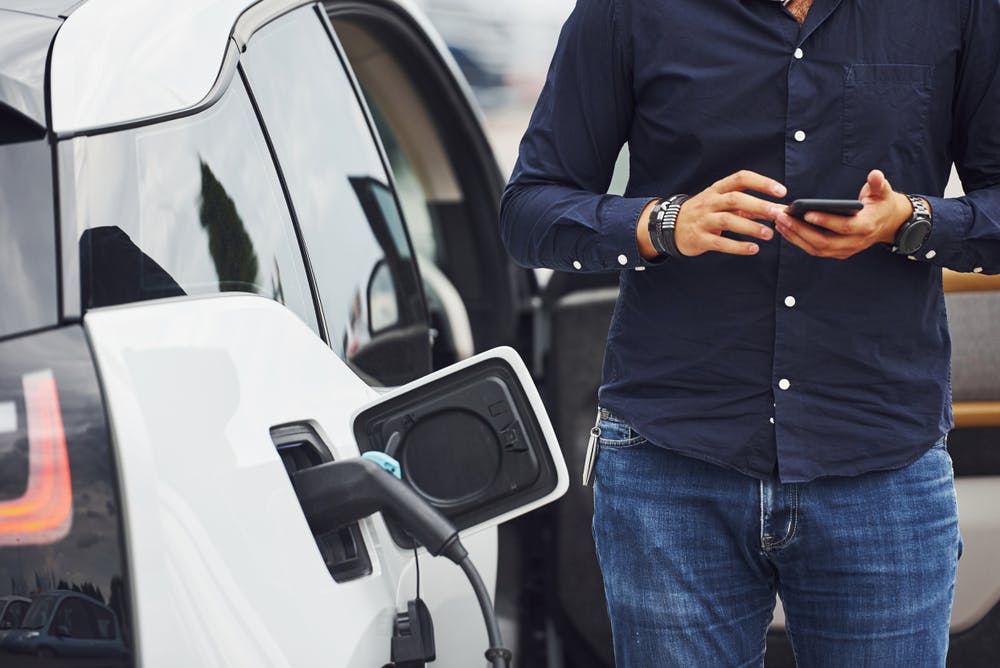
Policies that would help make EVs more affordable in Australia include:
incentives to bring down the upfront cost of EVs. Some people say this is subsidising rich people but clever policy would support jobs in the Australian energy market. It’s estimated we spend more than A$30 billion on foreign fuel for our cars every year. Redirecting that money to powering EVs would help keep those billions in the country, and support local Australian energy jobs.
we don’t have a fuel efficiency standard, putting us in poor company with Russia as two of the last remaining major economies without such standards. That’s why people say Australia is a dumping ground for vehicles that are illegal to sell overseas. The markets that have fuel efficiency standards are getting all of the EV supply.
having a clear target of EV sales for the next five to 15 years would support achieving net zero by 2050 – in other words, selling the last petrol or diesel car by the mid-2030s.
So what’s the market outlook?
Not much will change in Australia unless there’s a change in policy. We are competing with markets that have the right policies to stimulate EV sales. The manufacturers are, of course, going to prioritise supply there.
There will be small increases in EV sales in Australia every year. But it will take a number of years for the supply of these new vehicles to ramp up.
I’m sorry to be the bearer of bad news. And I do hope your next vehicle purchase is an EV, after considering all of the costs over the life of the vehicle. It is the right thing to do for the climate and the long-term savings are attractive, especially if fuel prices continue to be so volatile.
Unfortunately, though, Australians should not expect EVs to suddenly become cheap and easy to buy here in the next couple of years – unless policy changes.
Read more: The embarrassingly easy, tax-free way for Australia to cut the cost of electric cars
Authors: Jake Whitehead, Tritum E-Mobility Fellow & Advance Queensland Industry Research Fellow, The University of Queensland


















