

Olga Tokarczuk's whirlwind tour of the 18th century
- Written by: Isabelle Hesse, Senior lecturer, University of Sydney
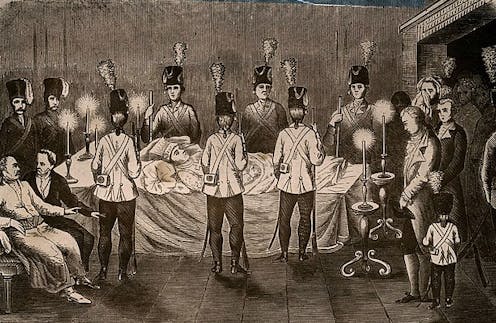
Nobel-Prize winner Olga Tokarczuk’s epic experimental novel The Books of Jacob is – perhaps unsurprisingly, given its title – a book about reading and writing.
At the centre of the novel are the Frankists, an 18th and 19th century Jewish religious sect. Within the more than 900 pages of Tokarczuk’s masterful account of the life of Jacob Frank – the self-proclaimed Messiah of the Frankists – we encounter several kinds of readers and writers. There are writers and readers of letters, authors and readers of books, chroniclers of lives and facts.
Review: The Books of Jacob - Olga Tokarczuk, translated by Jennifer Croft (Text Publishing)
One of these writers is Polish Priest Father Chmielowski – another historical figure – who is compiling an encyclopaedia entitled New Athens. Early in the novel, Chmielowski discusses the power of books. “If people could read the same books,” he says, “they would inhabit the same world.”
What we find in The Books of Jacob, however, is that books create friction. Reading is a different experience for everyone. As Tokarczuk shows again and again, the differences in what we read and how we read become especially intriguing when we read religious books and live by their precepts. These books are used to distinguish between people and divide communities.
Alongside these reports, the novel’s protagonist, Jacob Frank, takes the reader on a whirlwind journey through 18th-century Europe. Jacob gathers disciples. He has to hide from the Catholic Church. He is baptised to avoid persecution. He is imprisoned after being betrayed by some of his followers. He settles in different places, including Podolia, Moldavia, and the Habsburg Empire, where he establishes communities that foreshadow the social structures of the kibbutz in Palestine and, later, Israel.
As Jacob becomes increasingly powerful, the reader is confronted with the less savoury aspects of his leadership. Jacob exemplifies the heretical Frankist doctrine of transgressing moral boundaries.
He punishes his followers for not bringing back enough money from sultans and emperors, money that is needed to finance his often extravagant lifestyle. He has several different lovers, both male and female. As the leader of the Frankists, he also decides which men should sleep with which women, without asking the women for consent. The novel even suggests that he has intercourse with his own daughter, who becomes pregnant and is forced to abort her child.
A multitude of stories
Tokarczuk does not rely on Jacob to carry the narrative. Instead, he can be seen as a means to an end. He creates the space for those around him to tell his and their own stories.
Some of the most interesting stories and voices in The Books of Jacob are female. Yente, the character who opens the book, is suspended between life and death. Later in the novel, we discover that her nephew, Elisha Schorr, has cursed Yente, consigning her to this in-between state so that her death would not ruin his daughter’s wedding day. Yente eventually realises that she sees everything from above and has turned into an omniscient narrator:
At the end of this story, when her body becomes pure crystal, Yente discovers a completely new ability. She ceases to be just a witness, an eye that travels through space and time – she can also flow through human bodies, women, men, and children, and time speeds up so everything happens very fast, in one instant.
Yente returns throughout the novel to comment on the fate of different characters. She is one of the only characters to foresee Jacob’s failure as a Messiah promising to bring redemption to the people.
This failure runs contrary to the beliefs expressed in the book itself, where it is suggested that
As the new world gives birth to the Messiah, it must suffer, and all laws must break, conventions be eradicated, oaths and promises crumble …
Jacob is right: the laws of this world – the laws of the Torah - cannot be in effect anymore. Now everything is the other way around.
Backwards, forwards
The idea of overturning conventions was part and parcel of the Frankist doctrine. In The Books of Jacob, Tokarczuk’s use of page and chapter numbers question how successful this was in bringing about change.
The novel starts on page 965 and then moves backwards to page one. This places The Books of Jacob firmly within a Hebrew tradition of writing and storytelling. Tokarzcuk has explained that “the alternative numbering of the pages in this book is a nod to books written in Hebrew, as well as a reminder that every order, every system, is simply a matter of what you’ve gotten used to”.
The reversed page numbers reflect the breaking down of conventions and illustrate that “everything is the other way around”. The books and chapters inside the novel are, however, numbered consecutively. The narrative also progresses, for the most part, in a linear fashion.
This tension between descending page numbers and ascending book and chapter numbers confirms Yente’s suspicion that the arrival of the Messiah has not changed anything for his followers. It also draws attention to the many philosophical questions about human existence that the novel asks. These include the belief in the afterlife, the need for redemption, and the desire to be remembered and leave a legacy for generations to come.
The ending of the novel offers another way to explain why we start reading The Books of Jacob on page 965. Yente, who is present only as a consciousness later in the text, spends the end of her life in a cave in Korolówa. The memory of this cave is passed down through the generations of Yente’s family. Because of this memory, 38 Jewish people are able to hide there from the Nazis and survive the Holocaust.
The end of the novel thus situates the Holocaust within a longer history of anti-Semitism and persecution. It adds to our understanding of why and how the Holocaust happened, without necessarily solving the philosophical and ethical questions that the genocide raises.
The Books of Jacob does not offer clear-cut answers to big philosophical questions, but it certainly gives us a starting point from which to consider these questions. As Elżbieta Drużbacka, a Baroque poet and correspondent of Father Chmielowski, mentions in a letter:
To express in language the vastness of the world, it is impossible to use words that are too transparent, too unambiguous … words and images must be flexible and contain multitudes, they must flicker, and they must have multiple meanings.
This letter forms part of a chapter that is aptly titled: “Of the perfection of imprecise forms.” Olga Tocarzuk’s words flicker with life and ambiguity. We see examples of “imprecise forms” in the texts composed by the various writers in her novel. But The Books of Jacob itself is a precisely crafted work that skilfully experiments with form, while not losing sight of developing a narrative that keeps the reader hooked until the end.
Authors: Isabelle Hesse, Senior lecturer, University of Sydney


















