

What does it mean to be 'neutral' over Ukraine – and what responsibilities come with it?
- Written by: Maartje Abbenhuis, Professor of History, University of Auckland
There’s a popular cartoon by Tom Toro that’s been doing the social media rounds since 2012, in which two historians sit in a book-lined library as one complains:
Those who don’t study history are doomed to repeat it. Yet those who do study history are doomed to stand by helplessly while everyone else repeats it.
As a historian, I don’t much subscribe to the histoire se répète (history repeats itself) school of thought. No two moments are ever “the same”. Context changes everything – and the complexities of context are as important to understanding an event as the potential similarities with another moment in time.
I find many of the historical analogies being bandied about over the war in Ukraine banal. There is nothing to be gained from equating Putin with Hitler or likening Russia’s invasion of Ukraine with Germany’s invasion of Poland in 1939.
But what is useful in studying past wars is that they help us understand what aspects of a current crisis might be worth asking critical questions about.
In that sense, Toro’s cartoon is apposite, especially when it comes to interrogating our collective responsibility for the war in Ukraine and its victims. Is watching in horror as the war unfolds all we can do? What responsibilities do we have as non-belligerent “neutrals”?
Neutrals and non-belligerents
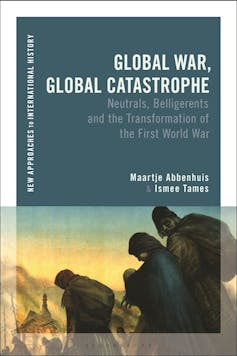
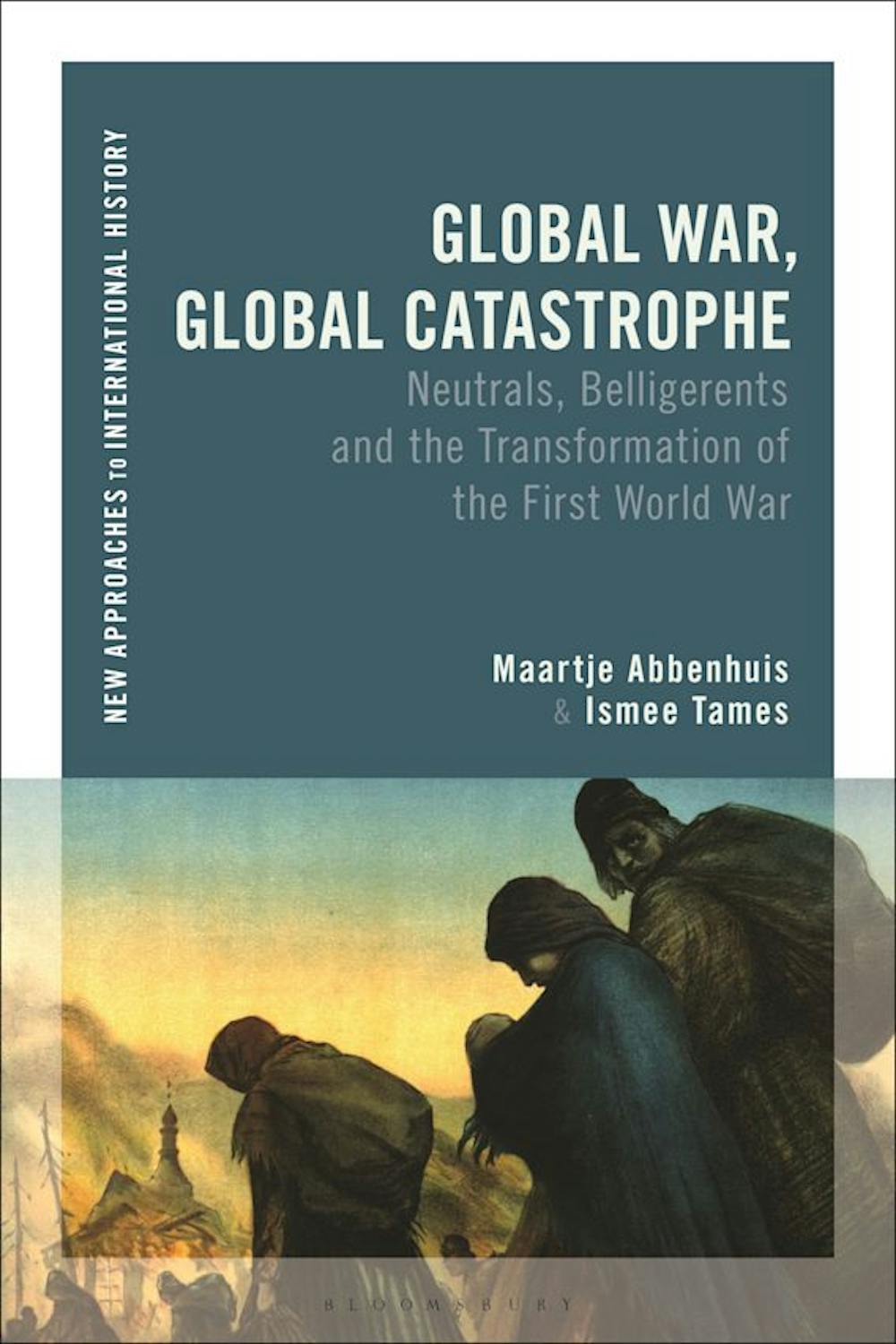
I’ve spent much of my academic career studying international systems and great power diplomacy, particularly in time of war. I’ve written several books about neutrality, peacemaking and avoiding war. My most recent (co-authored) title, Global War, Global Catastrophe, integrates the history of neutrals and non-belligerents into the global history of the first world war.
 Influencing the watchers: Volodymyr Zelenskyy addresses the US Congress by video.
AAP
Neutrality and ending war
Neutrals, then, actively determine what is at stake in a war. Winning the “hearts and minds” of the people watching as non-belligerents is therefore vitally important to the warring parties.
At the moment, Ukraine’s president, Volodymyr Zelenskyy, is doing an exceptional job of influencing the watching world’s expectations and framing what the invasion of Ukraine is about. He needs that global support to help set the terms of any peace negotiations with Russia.
Historians of warfare almost always fixate on the actions of those actually doing the fighting or falling victim to the violence of a war. Today, too, we seem fixated on understanding Russia and Putin and on explaining why Ukraine is so important.
Read more:
Ukraine: Putin isn't mad – he's following a long-established great power playbook for conquest
But it’s as important to ask questions about the responsibilities and actions of the neutral and non-belligerent world – those of us watching the war unfold in real time – as it is to interrogate those of any warring parties.
Just as in the 19th century, neutral parties have a massive role to play in the conduct, outcome and terms of this war. Their assessments will help to determine how we understand the conflict in years to come.
Alongside asking serious questions about why Russia invaded Ukraine, we should therefore also train our mirrors on ourselves as non-belligerents. How are we shaping the contours of this conflict? How are we responding to it? Where are our responsibilities to bring its suffering to a successful and speedy close?
Authors: Maartje Abbenhuis, Professor of History, University of Auckland
Influencing the watchers: Volodymyr Zelenskyy addresses the US Congress by video.
AAP
Neutrality and ending war
Neutrals, then, actively determine what is at stake in a war. Winning the “hearts and minds” of the people watching as non-belligerents is therefore vitally important to the warring parties.
At the moment, Ukraine’s president, Volodymyr Zelenskyy, is doing an exceptional job of influencing the watching world’s expectations and framing what the invasion of Ukraine is about. He needs that global support to help set the terms of any peace negotiations with Russia.
Historians of warfare almost always fixate on the actions of those actually doing the fighting or falling victim to the violence of a war. Today, too, we seem fixated on understanding Russia and Putin and on explaining why Ukraine is so important.
Read more:
Ukraine: Putin isn't mad – he's following a long-established great power playbook for conquest
But it’s as important to ask questions about the responsibilities and actions of the neutral and non-belligerent world – those of us watching the war unfold in real time – as it is to interrogate those of any warring parties.
Just as in the 19th century, neutral parties have a massive role to play in the conduct, outcome and terms of this war. Their assessments will help to determine how we understand the conflict in years to come.
Alongside asking serious questions about why Russia invaded Ukraine, we should therefore also train our mirrors on ourselves as non-belligerents. How are we shaping the contours of this conflict? How are we responding to it? Where are our responsibilities to bring its suffering to a successful and speedy close?
Authors: Maartje Abbenhuis, Professor of History, University of Auckland 

















