

is there ever a case to kill tyrants?
- Written by: Shannon Brincat, Senior Lecturer in Politics and International Relations, University of the Sunshine Coast
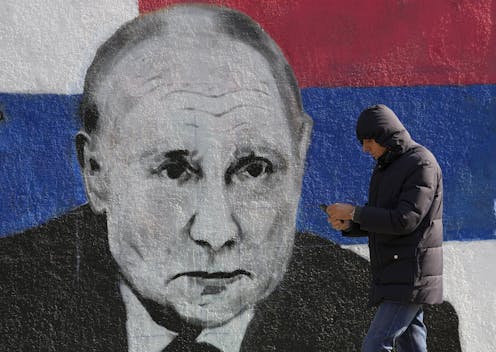
Republican senator Lindsey Graham has been among those calling for the assassination of Russian president Vladimir Putin in the wake of Russia’s invasion of Ukraine.
The Biden administration immediately denied any such plans. But despite the White House’s best attempts to deny targeting Putin, it begs the question, when is it acceptable to assassinate a tyrant?
In Libya, a US drone was involved in the airstrike that lead to the death of former Libyan leader Muammar Qaddafi in 2011. In 2003, the invasion of Iraq began with “decapitation” strikes directly aimed at killing Saddam Hussein.
No wonder Putin is reported to be “extremely paranoid” about being assassinated.
International law and assassination
Since the second world war and the Nuremberg trials, the international culture has been to prosecute tyrants rather than kill them. The assassination of heads of state is also prohibited under the 1973 New York Convention, which covers “internationally protected persons”, and is outlawed under the laws of war, first established in the 19th century.
The US itself has specifically prohibited assassination under its rules of war since 1863, and each president since 1976 has reaffirmed executive orders against assassinating foreign leaders.
It also remains a rare event. Only ten leaders have been assassinated by a foreign state between 1875 and 2004.
Legal philosophy
There is a huge grey area around the issue of tyrannicide – the killing of a ruler who rules illegitimately, oppressively, and/or acts aggressively at home or abroad. Putin appears to meet this definition.
Towering figures of classical jurisprudence (or legal philosophy) like Hugo Grotius and Emer de Vattel claimed tyrants were “common enemies of humankind” who should be targeted like pirates.
But the issue of whether such tyrants can be targeted under international law is somewhat confused, with arguments both for and against.
We also know assassination has substantial effects on political stability at both national and international levels.
Political philosophy
There have been at least three different historical approaches to tyrannicide in political thought.
In Ancient Greece and Rome, if the ruler was harmful, they could be legitimately and violently deposed. For example, in The Republic, Plato condemned tyranny as the most degenerate political crime. In De Officiis, Cicero claimed tyranny was a pestilence on the body politic which, because it injures the rest of the body, should be severed.
During the medieval period, some philosophers justified complete submission to the god-given order, including tyranny. However, theologians such as Thomas Aquinas and protestant reformers like Martin Luther and John Calvin generally argued private individuals had a tacit mandate of tyrannicide when no other means of ridding the community of the tyrant were available.
In the modern period, especially with the advent of liberalism around the 17th century, there was a push to institutionalise a protective right of the people against tyranny. For example, in 1689, John Locke argued the people retained the ability of saving themselves from tyranny through the existence of a “supreme power” or “implied reserve”.
These principles can be traced to the second paragraph of the Declaration of Independence and the American Constitution, widely believed to include a right to “alter or abolish” and bear arms against tyranny. This has recently led to confused attempts at subverting democratic processes also, as we saw at Capitol Hill in January 2021.
The US approach
Yet we know the US has used assassination in its foreign and military affairs. For example, a 1953 CIA training manual bluntly called “Study of Assassination” is easily found online.
Since 2001, the US has also killed over 4,000 targets in drone strikes and retains “kill lists” of terrorist suspects. The 2011 assassination of Osama Bin Laden has been popularised in a film partly written by the CIA.
So clearly, the US does assassinate people, and quite often – but can it ever be justified against a leader of a foreign state?
In 1975, a US Senate committee concluded the US had supported a number of plots to kill foreign leaders, though there was no evidence of direct involvement.
Interestingly, the very conundrum posed by Russia’s invasion was anticipated by the committee. In these circumstances, assassination may be compatible with American values, it said:
This country was created by violent revolt against a regime believed to be tyrannous, and our founding fathers (the local dissidents of that era) received aid from foreign countries […] we should not today rule out support for dissident groups seeking to overthrow tyrants.
Human rights vs chaos
Today, the justifications for tyrannicide revolve around self-defence and protecting human rights. Arguably, these justifications could be made in the defence of a state like Ukraine and the human rights of its citizens. However, these exact arguments could also be said of the illegal American-led war in Iraq.
Still, the answer is unclear.
One of the main problems is the outcome is unpredictable. In the case of Iraq, it created a hotbed for terrorism in the form of ISIS and in Libya it allowed slavery to return.
Read more: Putin is on a personal mission to rewrite Cold War history, making the risks in Ukraine far graver
Another fear is tyrannicide will spawn an even worse leader. Or result in an escalation of hostilities and retaliation. What leader would be safe in such a world?
Ultimately, the problem of tyrannicide is not only ethically vexing but legally complex and politically doubtful. More than 2,000 years after Plato, we still don’t have a definitive answer.
Authors: Shannon Brincat, Senior Lecturer in Politics and International Relations, University of the Sunshine Coast
Read more https://theconversation.com/the-putin-problem-is-there-ever-a-case-to-kill-tyrants-179295


















