

Why a leaked WTO 'solution' for a COVID patent waiver is unworkable and won't make enough difference for developing countries
- Written by: Jane Kelsey, Professor of Law, University of Auckland
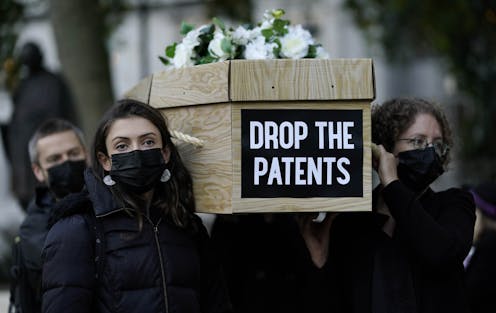
There was a brief moment of euphoria last week, when it seemed that COVID-19 vaccines, medicines and supplies might be liberated from the World Trade Organization’s intellectual property rights straitjacket and a patent waiver would make them available and affordable to the unvaccinated in the global south.
But on closer scrutiny, Big Pharma and their parent states have won again.
The leaked “solution” agreed by the informal “quad” (US, EU, India and South Africa) is insufficient, problematic and unworkable. There are too many limitations to make any significant difference and it is a far cry from the original proposal from India and South Africa that would have effectively addressed the barriers.
While the WTO makes decisions by consensus, it is unclear how far this deeply flawed text can, or will, be reopened when members debate it next week. Given its fraught history, it is unlikely they will agree to remedy its defects.
Let us recall some stark and distressing facts. Into the third year of this pandemic, only 14% of people in low-income countries have been vaccinated even once. Wealthy countries like New Zealand are 90% vaccinated and on our third shots. Indeed, by the end of last year, more boosters had been given in high-income countries than total doses in low-income ones.
Read more: The big barriers to global vaccination: patent rights, national self-interest and the wealth gap
A second stark and disturbing fact: in November last year the People’s Vaccine Alliance reported that Pfizer, BioNTech and Moderna, the companies behind two of the most successful COVID-19 vaccines, were together making US$65,000 (NZ$92,000) every minute.
They had received more than US$8 billion in public funding to develop the lucrative COVID-19 vaccines. Pfizer and BioNTech had delivered less than 1% of their total vaccine supplies to low-income countries, while Moderna has delivered just 0.2%.
Pharma’s profits and property rights before right to life
An important guarantor of pharmaceutical companies’ profits is a little-known trade agreement, the Agreement on Trade-related Intellectual Property Rights (TRIPS).
During negotiations to form the WTO during the early 1990s, the US had demanded strong protections for its corporations’ intellectual property rights as the price for agreeing to discuss genuine trade issues such as subsidised agriculture. The WTO’s members, aside from the least developed countries, have to implement these rules in their domestic laws.
The significance of the TRIPS was exposed in the late 1990s when pharmaceutical giants threatened legal action against South Africa and Brazil for producing generic versions of patented HIV-AIDS anti-retroviral medicines.
A global name-and-shame campaign led them to back down and saw a Declaration on TRIPS and Public Health adopted at the WTO ministerial conference in 2001. That compromise was a forerunner of the COVID-19 scenario.
Read more: Wealthy nations starved the developing world of vaccines. Omicron shows the cost of this greed
To date, only one country, Rwanda (which belongs to the group of least developed countries), has been able to jump the hurdles and import pharmaceuticals under the amendment to TRIPS.
Tentative deal limited to vaccines only
Two decades later, in October 2020, South Africa and India led moves for a TRIPS waiver for COVID-19 vaccines, medicines, test kits and other supplies. Despite another global campaign, which included New Zealand public health advocates, unions, churches and development agencies, the European Union, Switzerland and UK blocked the waiver every step of the way.
The Biden administration shifted its position in May 2021 to support negotiations for a waiver, but limited it to vaccines. That announcement brought a fence-sitting New Zealand on board.
The proposal remained stuck for 18 months. Some richer countries demanded completely unrelated trade-offs to advance their commercial objectives, while the hard core refused to budge. Last December, the talks moved to a new phase where the “quad” of key WTO members tried to broker a deal.
When that tentative deal was announced last week and the text was leaked, the euphoria quickly subsided.
The text applies only to patents on vaccines, and only for COVID-19, which means a similarly fraught process would be required for future pandemics. WTO members will decide in six months whether to extend it to medicines, diagnostics and therapeutics, as South Africa and India had proposed. Realistically, that won’t happen.
Odds continue to be stacked against poorer countries
Beyond these limitations, there is no guarantee that governments can access the “recipe” for all currently patented vaccines, let alone second-generation vaccines still applying for patents, or the technology needed to produce them.
There are many legal uncertainties. A WTO member state can authorise “use of patented subject matter” that is otherwise protected under TRIPS Article 28.1 “to the extent necessary to address the COVID-19 pandemic”.
When does COVID-19 cease being a pandemic, who decides, and what happens when COVID-19 is just endemic? Which uses of patented subject matter will be considered “necessary” (a restrictive concept in trade law) and which go too far? The text still allows those matters to be taken to a dispute.
The odds are stacked further against poorer countries. Eligibility is limited to WTO developing countries that exported less than 10% of the world’s vaccines in 2021. That means China and non-WTO countries are excluded, as are countries like Brazil that recently surrendered their developing country status.
Coverage of least developed countries is unclear. And the complex and burdensome notification and compliance requirements are likely to be as unworkable as the previous TRIPS waiver.
Four things remain to be seen. First, will the deal actually be gavelled through without debate and amendment in another travesty of the WTO’s consensus process?
Second, what trade-offs will richer countries demand in return for their support?
Third, will this be the end of moves to set aside TRIPS rules, even temporarily, to secure genuine access to life-saving COVID medicines, vaccines and medical supplies for the majority of the world’s people in the developing world once the immediate COVID-19 crisis has subsided?
And will the New Zealand and Australian governments be complicit in this happening?
Authors: Jane Kelsey, Professor of Law, University of Auckland


















