

'Odd radio circles' that baffled astronomers are likely explosions from distant galaxies
- Written by: Ray Norris, Professor, School of Science, Western Sydney University
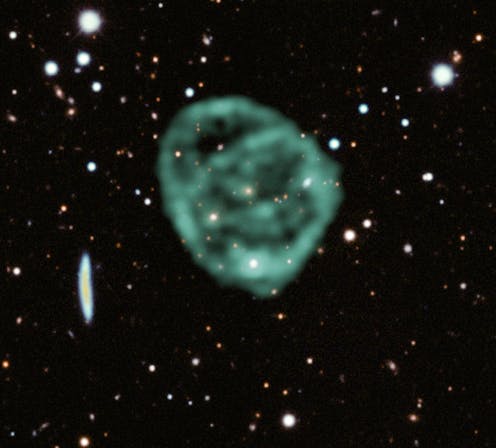
In 2019, my colleagues and I discovered spooky glowing rings in the sky using CSIRO’s ASKAP radio telescope in Western Australia. The rings were unlike anything seen before, and we had no idea what they were.
We dubbed them odd radio circles, or ORCs. They continue to puzzle us, but new data from South Africa’s MeerKAT telescope are helping us solve the mystery.
We can now see each ORC is centred on a galaxy too faint to be detected earlier. The circles are most likely enormous explosions of hot gas, about a million light years across, emanating from the central galaxy.
Our paper showing these results has been peer-reviewed and accepted for publication by Monthly Notices of the Royal Astronomical Society.
A closer look
We now have beautiful images of one of these rings taken with South Africa’s MeerKAT radio telescope, which shows the ORC in stunning detail.
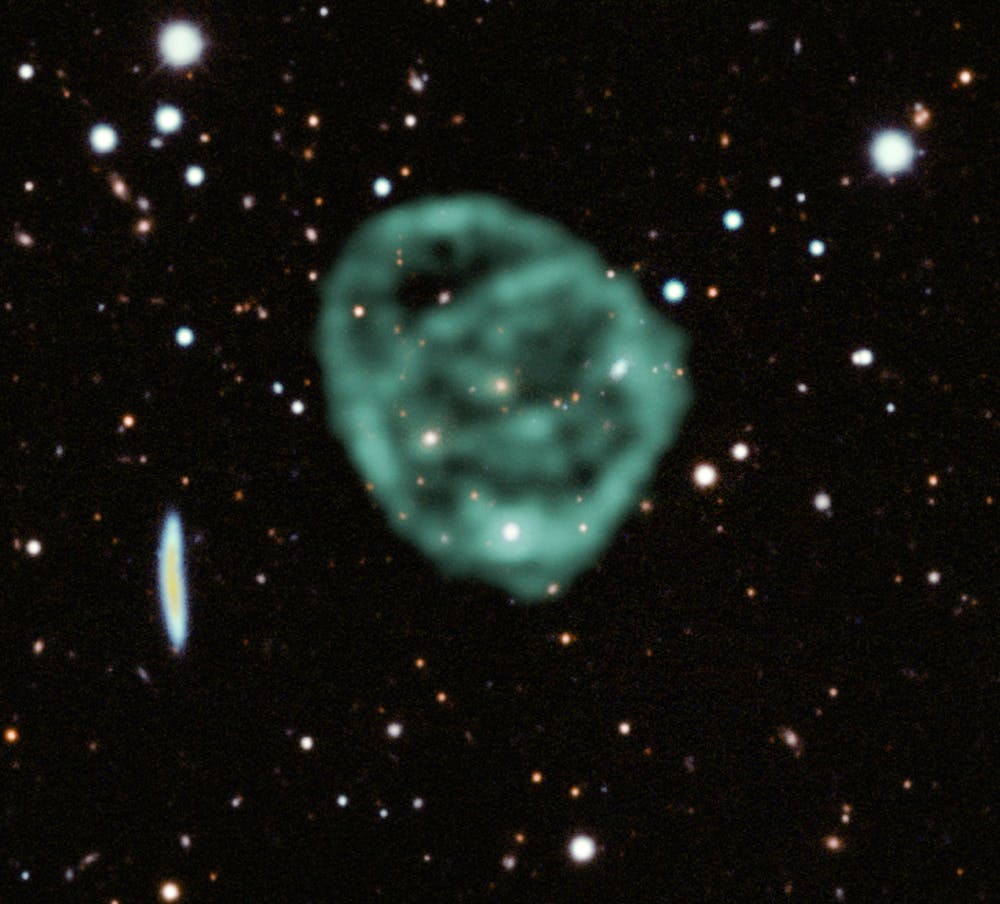
For example, MeerKAT sees a small blob of radio emission in the centre of the ring, which is coincident with a distant galaxy. We are now fairly certain this galaxy generated the ORC.
We see these central galaxies in other ORCs too, all at vast distances from Earth. We now think that these rings surround distant galaxies about a billion light years away, which means the rings are enormous – around a million light years across.
From modelling the faint cloudy radio emission that MeerKAT detects within the rings, it seems the rings are the edges of a spherical shell surrounding the galaxy, like a blast wave from a giant explosion in the galaxy. They look like rings instead of orbs only because the sphere appears brighter at the edges where there is more material along the line of sight, much like a soap bubble.
Artist’s impression of odd radio circles exploding from a central galaxy. It is thought to take the rings 1 billion years to reach the size we see them today. The rings are so big (millions of light years across), they’ve expanded past other galaxies. Sam Moorfield/CSIROEnergetic electrons
MeerKAT has also mapped the polarisation of the radio waves, which tells us about the magnetic field in the ring. Our polarisation image shows a magnetic field running along the edge of the sphere.
This suggests that an explosion in the central galaxy caused a hot blast to collide with the tenuous gas outside the galaxy. The resulting shock wave then energised electrons in the gas, making them spiral around the magnetic field, generating radio waves.
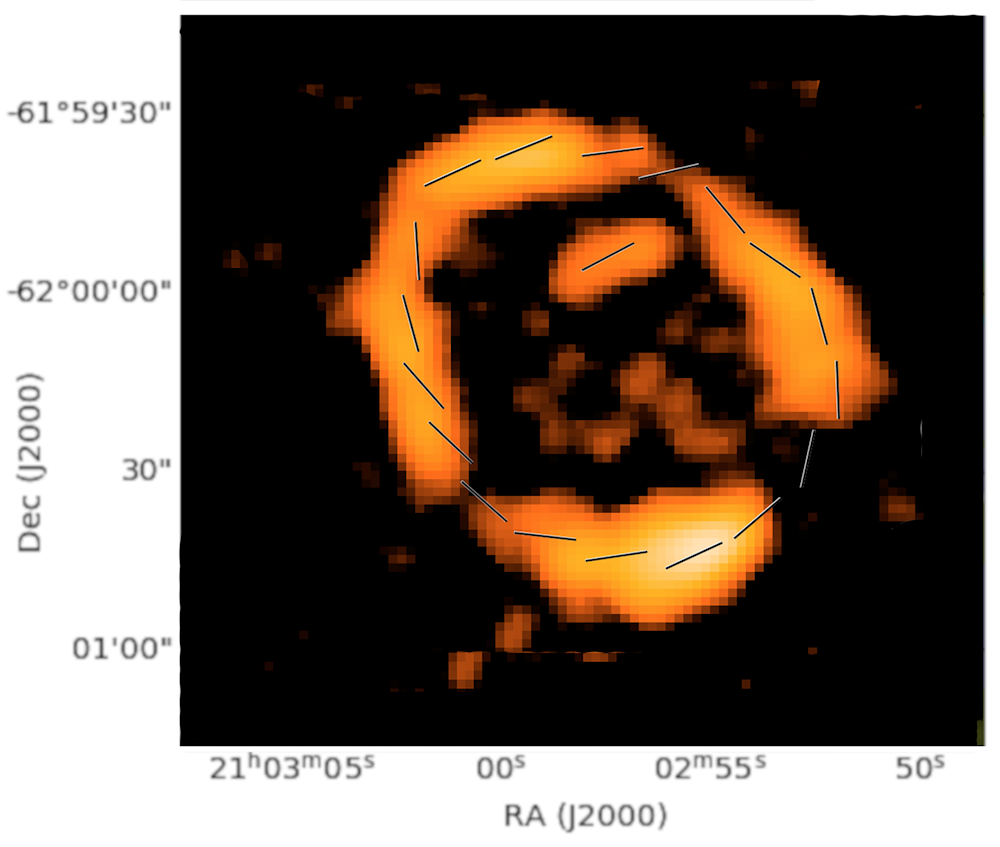 Lines around the edge of the ORC show the direction of the magnetic field. A circular magnetic field like this indicates it has been compressed by a shock wave from the central galaxy.
Created by Larry Rudnick from MeerKAT data.
Lines around the edge of the ORC show the direction of the magnetic field. A circular magnetic field like this indicates it has been compressed by a shock wave from the central galaxy.
Created by Larry Rudnick from MeerKAT data.
One big surprise from the MeerKAT result is that within the ring we see several curved filaments of radio emission. We still don’t know what these are.
But we do know that the sphere is so huge that it has swallowed up other galaxies as it blasted out from the central galaxy. Perhaps the filaments are trails of gas ripped off the galaxies by the passing shock wave?
Colliding black holes or the birth of millions of stars?
The big question, of course, is what caused the explosion. We are exploring two possibilities.
One is that they were caused by the merging of two supermassive black holes. Such a “merger event” releases an enormous amount of energy, enough to generate the ORC.
Another possibility is that the central galaxy went through a “starburst” event, in which millions of stars were suddenly born from the gas in the galaxy. Such a starburst causes hot gas to blast out from the galaxy, causing a spherical shock wave.
Both black hole mergers and starburst events are rare, which accounts for why ORCs are so rare (only five have so far been reported).
The puzzle of ORCs is not solved yet, and we still have much to learn about these mysterious rings in the sky. So far, we have only detected them with radio telescopes – we see nothing from the rings at optical, infrared, or X-ray wavelengths.
Getting a better view
To find out more, we need a tool even more sensitive than MeerKAT and ASKAP. Fortunately, the global astronomical community is building just such an observatory – the Square Kilometre Array (SKA), an international effort with telescopes in South Africa and Australia.
ASKAP and MeerKAT were built to test the sites and technology for the SKA. Quite apart from their role as precursors for the SKA, both telescopes have been hugely successful in their own right, making major discoveries in their first years of operation.
Read more: Analysis of 2 000 galaxies using the MeerKat radio telescope reveals fresh insights
Their success in discovering and studying ORCs therefore bodes well for the SKA.
The two telescopes are also beautifully complementary – ASKAP is superb at surveying large areas of sky and finding new objects, while MeerKAT is unrivalled for zooming in on those objects and studying them with higher sensitivity and resolution.
The SKA promises to surpass both. No doubt the SKA will find many more ORCs, and will also be able to probe them to find out what they are telling us about the lifecycle of galaxies.
Authors: Ray Norris, Professor, School of Science, Western Sydney University


















