

Modern Australian
The Times

Research reveals 111 times Australian quolls reportedly chewed on human corpses

  • Written by David Eric Peacock, Adjunct Fellow, University of Adelaide
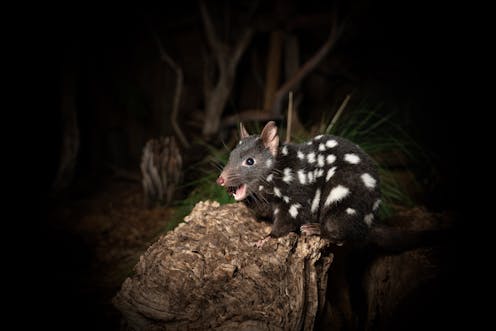
Research reveals 111 times Australian quolls reportedly chewed on human corpses

Warning: this article contains graphic descriptions of human disfigurement.

In 1878, the body of Sergeant Michael Kennedy lay in the bush in Victoria’s Wombat Ranges. He’d been shot by the notorious Ned Kelly gang – but the bush would add its own gruesome ending.

According to the man who later stumbled across his body, “one ear was gone. I imagined it had been gnawed away by native cats (quolls). The body was very much decomposed”.

This report is not isolated. My recent research has found 111 accounts between 1831 and 1916 where the scavenging of a corpse was attributed partly or entirely to quolls.

These grisly reports reveal a fascinating picture – not just of quolls, but of life in Australia in the 1800s.

two man beaside body in bush
Two men stand near the body of Michael Kennedy, after it was purportedly disfigured by quolls. Victoria Police Museum

A captivating carnivore

Quolls, historically known as native cats, are carnivorous marsupials. Four species are native to Australia: the spotted-tailed quoll, and the western, eastern and northern quoll.

Quoll populations in Australia have been declining for more than a century. Tasmania’s remaining eastern quoll population, for example, fell more than half in the decade to 2009 and numbers have not recovered since.

Quolls are known to scavenge. But I wanted to know more about their scavenging of human corpses. I hoped this would yield further insights into the animal’s diet and feeding behaviour.

Read more: Quolls are in danger of going the way of Tasmanian tigers

northern quoll eating
The research sought to learn more about quoll diets. UTS

Delving into a gruesome history

Of the 111 historical accounts I found of quolls scavenging on a human corpse, six involved definitive evidence – either eyewitness accounts of the behaviour, or tracks and scats at the scene.

In 1862, a police officer saw seven quolls scavenging a corpse near Sale in Victoria. Upon being disturbed they ran into a dead tree. The policeman “burnt them and the tree to the ground” – revealing the widespread antipathy towards quolls at the time.

Tragically, in two cases quolls were seen feeding on infant corpses: at Araluen in New South Wales in 1895, and Sydney’s Middle Harbour in 1897.

And a sorry account tells of a man lost in the forest at Winchelsea in Victoria. Found near death, he said quolls and other animals “had eaten his fingers and his toes. They had bitten his face and torn his nose away”. He died soon after.

In 105 accounts I identified, quolls were not caught in the act of disfigurement, but were assumed to be the culprits.

In 1831, for example, Captain Bartholomew Thomas died in the Tasmanian bush after an Aboriginal spear attack during the Black War. When his body was found it was missing half the throat. A member of the search party speculated it had been eaten by crows or “native cats”.

A sign reading 'Caution Quolls'
The author found 111 historical accounts of quolls eating human bodies. Sutterstock

In a modern context, it may seem a huge leap to attribute so many corpse disfigurements to quolls. And of course, correlation does not equal causation.

But during the period, quolls were a major problem. They were recorded invading homes and other buildings, and in one account from South Australia, someone’s bed.

In 1856 at Glencoe in South Australia, 550 quolls were killed in one day after the animals reportedly gnawed on boots and stock whips.

And quolls were, and remain, abundant in a few parts of Tasmania, threatening rabbits, chickens, poultry and captive birds.

So in this context, assuming a quoll was responsible for scavenging a human corpse was only natural.

What we can learn

In the 1800s and early 1900s, quolls were found across Australia. But the accounts I uncovered were limited to Tasmania, and a wide coastal-inland band from the Queensland/NSW border to just east of the South Australia/Victoria border.

Those areas had significant human populations – and newspapers to report their observations – which may explain the pattern. But at the time, the eastern quoll reportedly reached plague proportions in some places, and may have been desperate for food.

a spotted quoll
Shutterstock The victims spanned all reaches of society: a former convict, swagmen, farm workers and labourers, Chinese settlers and Aboriginal people. They died from a range of causes including murder, suicide, old age and misadventure. Some 85% of the reported human victims of quoll scavenging were male. This is consistent with social attitudes during the 19th and early 20th centuries, when the outdoors was an overwhelmingly male domain. Quolls are most abundant in late spring and summer. However, 41% of human scavenging accounts were reported in winter, and only 16% in both spring and summer. This likely demonstrates quolls are hungriest in winter, as you might expect. But it also reflects the challenge of human survival at the time. There were minimal social supports, and human frailty or misadventure could easily lead to death from exposure. Most accounts reported facial damage – to the eyes, ears, nose or tongue. Fingers and toes were reported in just three accounts. Clothing worn by the person at their death, such as gloves, may help explain this. It may also reflect a bias on examining the face when identifying a corpse. But it could also suggest quolls preferred some human body parts over others. In Tasmania, for example, quolls typically start on soft animal parts where they are able to tear open the skin. Bringing back the quolls I uncovered few corpse disfigurement accounts after 1900. This is consistent with a massive decline in quoll numbers by this time, reportedly after constant persecution by humans, and disease. Australia’s four quoll species are now struggling to survive. They’re variously listed as endangered or vulnerable, due to perils such as habitat loss, introduced cats and foxes, poisonous cane toads, climate change and car strikes. Read more: Extinction crisis: native mammals are disappearing in Northern Australia, but few people are watching a group of young sleeping quolls
Australia’s four quoll species are now struggling to survive. shutterstock

Quolls are beautiful and special animals. I want to spread their story far and wide in the hope efforts to protect them will be expanded.

In some cases, fox and cat control has allowed quolls to return to places they’ve been absent from for many years. But more conservation measures are needed.

Let’s hope quolls never again chew on a human corpse. But, restored to healthy numbers, perhaps they can resume their role in the bush as tough and wily predators.

Read more: Pet quolls are practically useless for real-world conservation

Authors: David Eric Peacock, Adjunct Fellow, University of Adelaide

Read more https://theconversation.com/research-reveals-111-times-australian-quolls-reportedly-chewed-on-human-corpses-179566

How Long Do Bathroom Renovations Melbourne Take? Step-by-Step Process Explained

Planning a bathroom renovation is exciting, but one of the biggest questions homeowners ask is, "How long will it take?" While every project is uniq...

Why Your Skin Breaks Out: The Science of Acne Explained

Acne is the most common skin condition in the world. An estimated 85% of people experience it at some point between the ages of 12 and 24, and a gro...

10 Swimwear Trends Australian Women Are Wearing This Summer

Every Australian summer brings a fresh wave of swimwear trends, but some styles have much greater staying power than others. While fashion constantly ...

Why Regular Skills Updates Are Essential for Licensed Security Officers

A guard at a Brisbane shopping centre gets a call about a shoplifter who's turned aggressive.  They’ve done the job for six years. But their de-...

10 Benefits of Choosing Professional Tutoring Penrith Services

Every student has unique learning strengths, challenges, and academic goals. While classroom teaching provides essential knowledge and structure, so...

Sunshine Coast Baby Classes Prove Big Hit Among First-Time Mums

There's a movement gaining traction on the Sunshine Coast, providing a village of support, socialisation and relief for first-time mothers and babie...

Father's Day Gift Ideas for Men Who Are Hard to Buy For

Some dads are easy to buy for. Others do not want anything, already have everything, or give you the classic "don't worry about me" answer every yea...

Top 5 Mistakes That Wear Out Your Brakes Faster

Brakes don't need frequent replacements like oil changes do.   But a lot of the wear happens quietly, over months, because of habits most drivers...

Plantation Shutters vs Curtains: Which Is Better for Your New Home?

Moving into a new home is an exciting opportunity to personalise your space and make it your own. While many homeowners focus on furniture, flooring...

Celebration of Life vs Traditional Funeral: What's the Difference?

When saying goodbye to someone you love, there is no single way to honour their life. Every family has different traditions, beliefs, and preference...

Building Approval for Roofing Projects: What Homeowners Need to Know

Roofing projects are an important part of maintaining and protecting your home. Whether you're repairing storm damage, replacing an ageing roof, or ...

Chatswood Tutoring And Its Role In Academic Achievement

Academic success often requires more than classroom attendance alone. Students face increasing expectations as they progress through school, particu...

Why Laser Hair Removal Treatments Continue Growing In Popularity

Managing unwanted hair can become time-consuming and frustrating for many people, especially when shaving, waxing, and other temporary methods requi...

Choosing the Right Devices for a Flexible Workplace

For IT leaders managing large fleets, the device layer is where workforce productivity and security policy meet. The shift towards flexible and hybrid...

How Business Advisory Services Help Companies Achieve Sustainable Growth

Every business owner aims to build a profitable and sustainable organisation. While dedication, innovation, and hard work are important, achieving l...

Why Body Contouring Has Become A Popular Cosmetic Treatment

Many people maintain healthy lifestyles through regular exercise and balanced eating habits but still struggle with stubborn areas of fat that are d...

How to Choose the Right POS Hardware for Your Business in Australia

A lot of Australian business owners spend weeks researching POS software but buy hardware almost as an afterthought. That's a mistake. The wrong har...

Why Material Handling Hose Is Critical for Industrial Efficiency

A high-performance material handling hose is an essential component in industries that transport abrasive, dry, or bulk materials on a daily basis...
















